
Choosing the right headwear for your organization is a strategic investment in your brand’s physical footprint. A poorly selected baseball cap vs trucker hat can lead to wasted budgets, low employee adoption, and logistical headaches. My team and I have spent over 15 years navigating global supply chains to help procurement managers mitigate these risks. We focus on the technical specs that ensure your merchandise survives the warehouse and the washing machine.
Key Takeaways for Procurement Managers:
- Durability & Form: Structured baseball caps provide superior logo stability for corporate environments, while trucker hats offer maximum ventilation and high-profile visibility for outdoor labor.
- Hidden Costs: Shipping structured hats requires specialized double-walled packaging to prevent “crown collapse,” a defect that affects up to 5% of poorly packed ocean freight.
- Compliance Risk: Trucker hat foam must be verified for phthalate content to ensure compliance with US Prop 65 and REACH standards.
Many buyers treat headwear as a commodity. They focus only on the price per unit. But after a decade of managing OEM production, we know that the real cost of a hat includes its “wearability” and lifespan. If your team refuses to wear a scratchy, ill-fitting trucker hat, your cost per impression is infinite. We wrote this guide to provide the technical logic you need to make a data-driven choice between these two iconic styles.
What Is the Real Total Cost of Ownership (TCO)?
Many procurement teams focus solely on the factory ex-works price. This is a strategic mistake. A low unit cost often masks systemic risks in logistics and quality control that inflate your final bill. We view TCO as the sum of the purchase price, freight efficiency, duty classification, and the financial impact of the defect rate upon arrival.
Hidden Logistics: Volumetric Weight vs. Real Weight
In global sourcing, you do not pay for the weight of the hats; you pay for the air inside the boxes. Both baseball caps and trucker hats are “non-crushable” cargo. This means they are billed at their volumetric weight. If a factory uses sub-optimal box dimensions, your shipping costs can spike by 30%. We recommend a standard 25-unit inner pack within a master carton that matches the exact dimensions of a 40HQ container. This maximizes “cube utilization” and lowers your per-unit landed cost.
Storage Dynamics: Crushing Resistance and Warehouse Footprints
The structural integrity of a hat determines your secondary storage costs. A trucker hat with a foam front has a high “stacking sensitivity.” If your 3PL (Third-Party Logistics) provider stacks pallets more than two levels high without racking, the bottom layers will suffer from crown deformation. This is not a manufacturing defect; it is a logistics failure. Structured baseball caps with a 400gsm buckram lining offer higher resistance, but they still require climate-controlled environments to prevent the glue from softening in high humidity.
Tariffs and Classification: HS Codes (6505.00) and Duty Impact
Duty rates are a silent margin killer. Most custom headwear falls under HS Code 6505.00, but the fiber content changes everything. For example, a 100% cotton baseball cap may carry a different duty rate than a synthetic mesh trucker hat under specific trade agreements. We have seen shipments delayed for weeks because the Commercial Invoice listed “Hats” instead of the specific material breakdown required by US Customs. You must mandate that your factory provides a pre-clearance “Material Construction Sheet” to avoid demurrage fees at the port.
Insider Insight: Trucker hats are more prone to “crown collapse” during sea freight if not double-walled in export cartons. This leads to a 3-5% defect rate upon arrival that isn’t visible in the factory sample. Always mandate “inner support inserts” in your RFQ to maintain the profile during long-transit humidity cycles.
Does Material Integrity Impact Your Brand’s Long-Term Value?
Procurement managers often prioritize the visual logo, but the base fabric dictates the actual lifespan of the asset. A hat that fades after three weeks of sun exposure is a liability, not a branding tool. We evaluate material integrity through the lens of color fastness, mechanical breathability, and tactile comfort.
UV Degradation and Color Fastness Standards
Hats are high-exposure garments. For outdoor industries, we specify materials that meet an AATCC 16.3 Grade 4 standard for color fastness to light. While 100% cotton twill is the traditional choice for a premium baseball cap vs trucker hat comparison, cotton is organic and naturally prone to UV bleaching. If your brand uses dark palettes like navy or charcoal, we recommend a “Poly-Cotton” blend. The synthetic fibers hold the dye deep within the polymer matrix, ensuring the black stays black even after months of field use.
Breathability Metrics: The “CFM” (Cubic Feet per Minute) Factor
Breathability is a technical requirement, not a marketing buzzword. It is measured by the rate of airflow through the fabric (CFM). In the trucker hat category, the mesh back offers near-infinite CFM, which is vital for high-heat environments. However, the front panel material matters too. A heavy foam front creates a heat trap. For high-performance B2B projects, we suggest replacing standard foam with “Laser-Perforated Polyester” panels. This maintains the structured “trucker” look while allowing heat to escape from the forehead.
Moisture Management for High-Utility Brand Assets
The sweatband is the most frequent point of failure in custom headwear. A cheap cotton sweatband absorbs moisture but does not release it, leading to “salt rings” and bacterial growth. We advocate for a multi-layer performance sweatband with a wicking finish. This moves moisture to the outer layer where it can evaporate. This technical detail significantly extends the “active wear-life” of the hat, ensuring your logo remains in the public eye rather than in a trash can.
| Material Property | Performance Polyester | Premium Cotton Twill | Soft-Touch Nylon Mesh |
| UV Resistance | Excellent (Grade 4+) | Fair (Grade 2-3) | Good |
| Moisture Wicking | Superior | Poor (Absorbs) | N/A (Max Airflow) |
| Tactile Comfort | Functional/Slick | High/Soft | Premium/Supple |
| B2B Use Case | Industrial/Field Work | Corporate/Retail | Lifestyle/Premium Merch |
Insider Insight: Not all mesh is equal. Cheap trucker mesh uses mono-filament plastic that irritates the skin and snags hair. For “Premium B2B” positioning, always specify “Soft-Touch Nylon Mesh”—it increases the perceived retail value by 40% for only a $0.15 increase in COGS. It is the difference between a “giveaway” and a “favorite hat.”
How Do You Enforce Quality Consistency in Mass Production?
The most common failure in headwear procurement is “production drift.” The factory sends a perfect hand-made sample, but the 10,000-unit bulk order arrives with varying shapes and weak seams. To prevent this, we move past visual inspections and focus on the internal “skeleton” of the baseball cap vs trucker hat.
Structured vs. Unstructured Support Systems
The “crown” is the most visible part of your branding. A structured hat uses a stiffening fabric called buckram glued to the back of the front panels. If the factory uses a low-quality adhesive or thin buckram, the hat will develop “bubbles” or wrinkles over time. For B2B orders that must look professional on a shelf, we mandate a double-layer buckram system. This ensures the hat remains upright and “retail-ready” even after being shipped halfway across the world.
Buckram Weight Specifications (250gsm vs. 400gsm)
“GSM” (Grams per Square Meter) is the metric that separates promotional trash from corporate assets. Most budget factories use 150-200gsm buckram. It feels fine for a day, but it collapses under the weight of heavy embroidery. We specify a minimum of 400gsm for premium 6-panel baseball caps. This creates a rigid “pro-style” profile that supports complex 3D embroidery without sagging. If your factory cannot provide the GSM specs for their interlining, they are likely outsourcing the component to a sub-standard supplier.
Seam Tension and Stitch Density Requirements (S.P.I.)
The lifespan of a hat is held together by its threads. We measure this through Stitches Per Inch (S.P.I.). A high-end cap should have 10-12 S.P.I. Cheap mass-production often drops to 6-8 S.P.I. to speed up the sewing lines. Low stitch density leads to seam “grinning”—where you can see the threads pulling apart under tension. Furthermore, high S.P.I. is required for clean embroidery; if the base fabric isn’t tightly stitched, the embroidery needle will cause the fabric to puckering, ruining your logo’s crisp edges.
| Technical Metric | Industrial Standard | Our B2B Requirement | Impact on Quality |
| Buckram Weight | 180 – 200 gsm | 350 – 400 gsm | Prevents crown collapse and wrinkling. |
| Stitch Density | 6 – 8 S.P.I. | 10 – 12 S.P.I. | Ensures seam strength and embroidery clarity. |
| Panel Alignment | +/- 3.0mm | +/- 1.5mm | Ensures the logo is perfectly centered. |
| Color Variance | Delta E < 2.0 | Delta E < 1.0 | Guarantees brand color consistency across batches. |
Insider Insight: To verify a factory’s technical capability, ask for their “Blocked Shape Retention” test results. This test uses a pressurized steam machine to simulate years of wear. If the factory representative doesn’t know what this test is, they aren’t a top-tier OEM manufacturer; they are a middleman.
Which Style Fits Your Strategic Audience?
Selecting between a baseball cap vs trucker hat is a demographic decision as much as a stylistic one. In the B2B sector, “adoption rate” is your primary KPI. If your targets do not wear the hat, your cost-per-impression (CPI) is effectively a total loss. We analyze this through three lenses: professional context, climate logistics, and gifting tier.
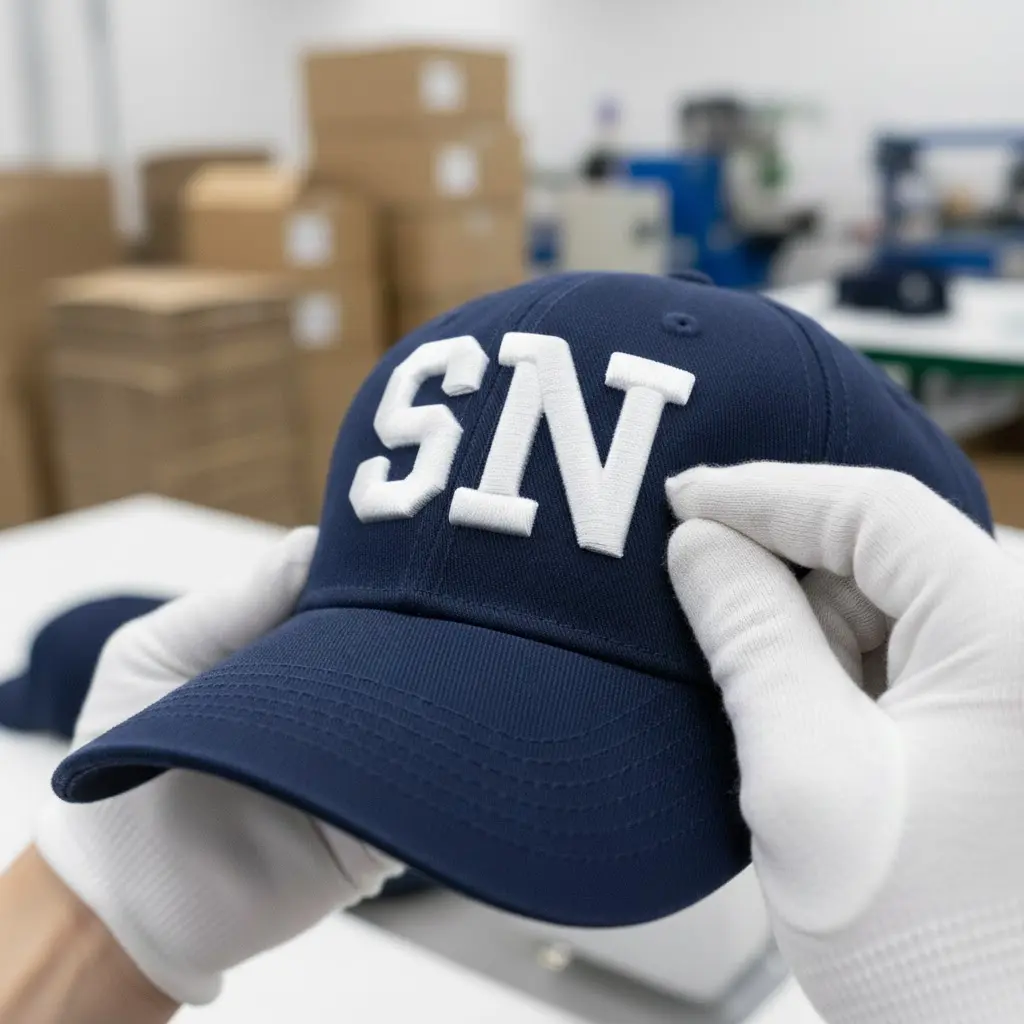
[Baseball caps offer a structured, professional canvas suitable for embroidery, while trucker hats prioritize breathability and high-profile foam front visibility, making them ideal for outdoor labor or casual lifestyle branding.]
Professional Services vs. Blue-Collar Trade Demographics
Corporate environments usually demand the “low-profile” silhouette of a 6-panel baseball cap. It is subtle and aligns with the dress code of tech firms or professional services. Conversely, the “high-profile” trucker hat is a staple in blue-collar trades. The increased crown height is not just for style; it provides a larger air gap between the head and the sun-heated fabric, reducing the risk of heat stroke for field teams.
Seasonality and Geographic Distribution Logistics
Geography dictates fabric choice. If you are distributing merchandise in humid regions like the Southeast US or Southeast Asia, a 100% cotton baseball cap will fail. The moisture will saturate the fibers, leading to mildew and odor. A trucker hat’s mesh back is a functional necessity here. For northern climates, we recommend the 6-panel baseball cap because it provides a thermal barrier against wind and cold.
High-End Corporate Gifting vs. High-Volume Event Giveaways
For internal high-end gifting (e.g., tenure awards), we always pivot to the premium baseball cap with a metal tri-glide buckle. It feels like a retail piece. For high-volume marketing events, the “foam front” trucker hat is the superior choice. It is lightweight, lowering air-freight costs, and its flat front surface allows for cheaper, high-speed screen printing without losing visual impact.
Strategic Selection Matrix: Baseball vs. Trucker
| Decision Factor | Baseball Cap (6-Panel) | Trucker Hat (5-Panel Foam) |
| Material Durability | High (Heavy Twill) | Medium (Foam/Mesh) |
| Logo Visibility | Subtle/Sophisticated | Bold/High-Impact |
| Cost per Impression | Lower (Longer lifespan) | Higher (High immediate visibility) |
| Demographic Lean | Executive/Corporate | Outdoor/Lifestyle/Trade |
| Decoration Match | 3D Embroidery | Screen Print / Woven Patch |
What Are the Technical Decoration Limits for Each Style?
Your logo is the most critical component of the asset. However, the physical construction of a baseball cap vs trucker hat dictates which decoration methods will succeed and which will fail. We analyze decoration through the lens of seam interference and material density to ensure your brand remains undistorted.
Foam Front Constraints: Heat Press vs. Direct Embroidery
Trucker hats with foam fronts are essentially “padded billboards.” The foam provides a smooth, flat surface ideal for high-definition heat transfers or screen printing. But direct embroidery on foam is a high-risk maneuver. If the needle tension is too high, the foam collapses, creating a “crater” effect around your logo. For a premium look on a trucker hat, we recommend woven or silicone patches. These are applied to the surface without compromising the foam’s structural integrity.
The “Curve” Factor and Distortion Risks
A standard 6-panel baseball cap has a vertical seam running directly down the center of the forehead. You cannot print a complex, fine-detail logo over this seam without it “splitting” or looking misaligned. This is why 3D embroidery is the gold standard for 6-panel caps; the thick thread covers the seam transition. If your logo is a detailed photograph or a complex crest, you must pivot to a 5-panel construction (common in truckers), which offers a seamless front canvas.
3D Puff Embroidery: Cost-to-Value Analysis
3D puff embroidery adds significant perceived value, making a $5 hat look like a $25 retail item. However, it requires a “heavyweight” substrate. An unstructured “dad hat” or a thin polyester cap cannot support the weight of 3D stitching; the fabric will pucker and sag. We only approve 3D puff for structured baseball caps with a minimum 400gsm buckram lining.
[Logic Flowchart — Choosing the Right Decoration Method]
- Does the hat have a center seam?
- Yes (6-Panel): Use Embroidery or a Sublimated Patch.
- No (5-Panel): Use Screen Printing, Heat Transfer, or Large Patches.
- Is the logo highly detailed (small text < 5mm)?
- Yes: Use a Woven Patch or High-Def Print.
- No: Direct Embroidery is viable.
- Is the material foam-based?
- Yes: Use Heat Transfer or Patches to avoid “foam crushing.”
- No: Direct Embroidery (Flat or 3D) is best for durability.
How Do You Manage Compliance and ESG Risks in Global Sourcing?
A “cheap” hat becomes an existential expense if it triggers a customs seizure or a public relations crisis. For US-based procurement managers, compliance is a dual-track process: social governance and chemical safety. We ensure that both baseball caps and trucker hats meet the stringent requirements of the UFLPA (Uyghur Forced Labor Prevention Act) and regional safety laws.
Labor Standards: Beyond the “Gold-Tier” Audit
Certifications like BSCI or Sedex are entry-level requirements, but they are not foolproof. We look for “Chain of Custody” documentation. In the current trade environment, you must be able to prove the origin of the cotton or polyester fibers. We prioritize factories that utilize vertically integrated supply chains, where the spinning, dyeing, and sewing happen under one corporate umbrella. This transparency reduces the risk of unauthorized sub-contracting, which is where most labor violations occur.
Chemical Safety: REACH and Prop 65 Compliance for Dyes
The dyes and plastic components of a hat are subject to heavy regulation. If your hats are distributed in California, they must comply with Prop 65 regarding lead and phthalate content. Many budget factories use “recycled” materials that contain legacy chemicals from their previous life cycles. We mandate third-party lab testing (SGS or Intertek) for every production batch. You should never rely on a “standard” certificate provided by the factory from a previous year; the test must match your specific PO (Purchase Order).
Sustainable Alternatives: Recycled PET (rPET) vs. Organic Cotton
Sustainability is a major ESG driver, but “greenwashing” is rampant. When choosing between a recycled baseball cap vs trucker hat, verify the GRS (Global Recycled Standard) certification. For trucker hats, the mesh and the foam can both be made from rPET (recycled plastic bottles). For baseball caps, organic cotton is the standard, but it requires GOTS (Global Organic Textile Standard) certification to be legitimate. Without these certifications, you are paying a premium for a “green” label that may not hold up to an environmental audit.
Insider Insight: The “foam” in trucker hats is a frequent compliance failure point. Many budget-tier factories use foam containing restricted phthalates as a blowing agent. Always demand a “Third-Party Chemical Lab Report” specifically for the foam interlining, not just the outer fabric. A failure here can lead to massive fines and mandatory product recalls.
How Can You Mitigate Lead Time Risks and Seasonal Traps?
In global procurement, a late delivery is as useless as a defective one. The production of a baseball cap vs trucker hat is subject to seasonal spikes and logistical bottlenecks. We manage these risks by synchronizing our sourcing cycles with factory capacity and weather patterns.
Off-Season Sourcing Cycles (The Lunar New Year Factor)
The single biggest disruptor in the headwear industry is the Lunar New Year (LNY). Most high-tier OEM factories in Asia close for 3 to 4 weeks. This creates a massive backlog in March and April. To mitigate this, we advise our clients to finalize their Spring/Summer orders by November. If you wait until January to decide between a baseball cap and a trucker hat, you will face “peak season” surcharges and a 30% increase in lead times.
Air Freight vs. Ocean Freight: The Fragility of the “Trucker Crown”
As established, trucker hats are susceptible to heat and pressure. During a 30-day ocean voyage, the humidity inside a container can fluctuate wildly. For high-priority launches, air freight is tempting, but it is 5x more expensive. If you must use ocean freight, we insist on “Top-Load Only” instructions for the pallets and the inclusion of industrial-grade desiccants (moisture absorbers) in the container. This prevents the “glue softening” that leads to crown collapse in structured hats.
Buffer Stock Strategies for Rolling Brand Campaigns
We never recommend ordering the exact quantity needed for a campaign. For recurring brand assets, we implement a “Safety Stock” protocol. By ordering an additional 10% and storing it in a regional hub, you protect the brand against localized spikes in demand or minor shipping delays. This small upfront investment in inventory is significantly cheaper than a last-minute air-freight shipment to cover a shortage.
How Do You Vet a True Manufacturer vs. a Trading Company?
In the custom headwear market, “factory” is a loosely used term. Many entities on B2B platforms are actually trading companies that outsource your order to the lowest bidder. This creates a massive risk for your baseball cap vs trucker hat project, as the entity you are talking to has zero control over the machines. We use a technical vetting process to identify true OEM-tier manufacturers.
The Red Flags of “Generalist” Trading Companies
A true headwear factory is a specialist. They own heavy machinery like steam-blocking stations, eyelet embroidery machines, and laser cutters. If a supplier’s catalog includes t-shirts, mugs, and pens alongside hats, they are almost certainly a middleman. These generalists lack the technical depth to troubleshoot “crown collapse” or color-fastness issues. We only work with facilities where 90% of the production floor is dedicated exclusively to headwear.
In-House Embroidery vs. Outsourced Finishing Risks
The most complex part of a hat is the embroidery. Many factories outsource this step to save on labor costs. This is where quality consistency dies. When embroidery is outsourced, the factory loses control over needle tension and thread quality. We mandate that our manufacturers maintain in-house embroidery departments. This allows for real-time adjustments and ensures that the “Golden Sample” matches the 10,000th unit.
Sample-to-Production Variance: The “Golden Sample” Protocol
To protect your investment, you must establish a “Golden Sample” protocol. Once you approve a pre-production sample, we recommend cutting it in half. Send one half back to the factory with a signed tag and keep the other half in your office. When the bulk shipment of baseball caps or trucker hats arrives, perform a side-by-side comparison of the stitch density (S.P.I.) and buckram stiffness. If there is a variance, you have undeniable physical evidence for a claim.
Insider Insight: Never settle for a pre-recorded factory tour. Request a “Live Video Walkthrough” of the assembly line during the sewing and blocking stage of your specific order. Trading companies will show you a beautiful showroom but will be “unable” to show the production floor because it belongs to someone else. If they can’t show you the machines running your fabric, they aren’t the manufacturer.
How Do You Finalize the Selection Matrix for Your Brand?
The final choice between a baseball cap vs trucker hat is a balance of performance, perceived value, and budget efficiency. As procurement experts, we don’t just look at what looks “cool”; we look at what maximizes the “Brand Halo” effect—the positive association a high-quality product brings to your company.
Assessing the “Brand Halo” Effect per Dollar Spent
A $5.00 hat that feels like a $30.00 retail piece creates a significant Brand Halo. A $4.00 hat that feels like a “giveaway” can actually damage your brand perception. If your budget is tight, we always recommend ordering a smaller quantity of premium 6-panel baseball caps rather than a large volume of low-grade trucker hats. Quality creates longevity, and longevity creates more impressions per dollar spent.
Feedback Loops: Post-Distribution Wearability Surveys
The procurement process should not end at delivery. We implement feedback loops to track “Adoption Rates.” If your team reports that the trucker hats are too stiff or the baseball caps are too hot, this data must inform your next PO. We have found that brands that switch to “Soft-Touch Nylon Mesh” or “Moisture-Wicking Sweatbands” see a 60% increase in long-term wearability among employees.
The Pivot to Custom: When Off-the-Shelf Blanks Fail
If you cannot find the exact color match or fabric weight in a standard catalog, it is time to pivot to Full Custom (OEM) manufacturing. This allows you to control the “DNA” of the hat—from custom interior seam taping featuring your brand’s URL to specialized “sandwich” piping in the visor. While the lead times are longer (usually 60-90 days), the risk of brand dilution is zero.
Conclusion: The B2B Verdict There is no “better” hat, only the “right” hat for your specific constraints.
- Choose the Baseball Cap if your priority is executive gifting, a professional corporate image, and long-term durability in cooler climates.
- Choose the Trucker Hat if your priority is high-impact visual branding, employee comfort in high-heat environments, and a modern, active lifestyle aesthetic.
FAQ
Q1: How can we guarantee color consistency between the hats and our existing corporate apparel?
Answer: You must request a Lab Dip approval based on a physical Pantone Matching System (PMS) coated chip. Do not rely on digital swatches, as screen calibrations vary. We mandate a “Delta E” (color variance) tolerance of less than 1.0 for high-tier brand assets.
Pro Tip: Different materials reflect light differently. A “Navy” 100% cotton baseball cap will never perfectly match a “Navy” polyester mesh trucker hat. To achieve a cohesive look across styles, we recommend choosing a “Poly-Cotton” blend for both to ensure the dye absorbs identically across your entire headwear range.
Q2: What is the most effective way to prevent “Crown Collapse” during long-term warehouse storage?
Answer: Specify a minimum of 400gsm (grams per square meter) double-layered buckram for structured caps and ensure your 3PL provider utilizes pallet racking instead of floor stacking. The weight of just three master cartons is enough to permanently deform the foam front of a trucker hat.
Pro Tip: Request that the factory include “Recyclable Plastic Crown Inserts” in every hat. While this adds approximately $0.08 to the unit cost, it acts as an internal skeleton that maintains the hat’s retail shape regardless of how many boxes are stacked on top of it in your warehouse.
Q3: How do we verify that the recycled PET (rPET) or Organic Cotton is genuine and not “Greenwashed”?
Answer: Demand a “Transaction Certificate” (TC) that matches your specific Purchase Order number. A general factory certificate only proves the facility is capable of handling sustainable materials; a TC proves that the specific fibers in your hats were tracked from the source.
Pro Tip: Check the GRS (Global Recycled Standard) or GOTS (Organic) label inside the hat. If the factory cannot provide the unique license number associated with that label, the material is likely standard polyester or conventional cotton being sold at a premium.
Q4: Why is there a significant price gap between two seemingly identical Trucker Hats from different suppliers?
Answer: The discrepancy usually lies in the “hidden components”: the sweatband construction, the mesh quality, and the foam density. A $3.00 hat likely uses mono-filament plastic mesh (which causes skin irritation) and a single-layer cotton sweatband (which causes salt staining).
Pro Tip: Ask the supplier for a “Component Breakdown.” Specifically, look for “Nylon Soft-Mesh” and “Four-Row Stitching” on the sweatband. These two upgrades cost pennies at the factory level but double the “wearability lifespan” of the hat, significantly lowering your long-term Cost Per Impression.
Q5: Can we use 3D Puff Embroidery on unstructured “Dad Hats” to save on the base cost?
Answer: No. We strongly advise against this. 3D embroidery requires a high-tension stitch that will cause thin, unstructured fabric to pucker and distort. The result is a logo that looks “pulled” and unprofessional.
Pro Tip: If you want the premium look of 3D puff but prefer a softer hat, choose a “Semi-Structured” crown with a 250gsm buckram. This provides just enough internal support to hold the heavy 3D stitches without the rigid, “boxy” look of a full pro-style cap.