You find a quote that looks great on paper — $2.00 less per hat.
But when the shipment arrives late, the logos are misaligned, and the fabric feels nothing like the sample, the savings disappear overnight.
What looked like a smart cost decision quietly turns into added freight, rework, missed deadlines, and products you can’t confidently sell or distribute. At that point, the issue is no longer price — it’s risk.
This is a common pattern for B2B buyers sourcing custom hats. The quote fits the quarterly budget, but the hidden costs show up later in brand damage, lost time, and reduced ROI.
The real question isn’t how cheap the hats are.
It’s how predictable the outcome is.
Are Hidden Fees Inflating Your “Cheap” Hat Quote?
Low unit prices often look attractive — especially for busy procurement teams under budget pressure. But many “cheap” hat quotes are designed to minimize the number you see upfront, not the total cost you will ultimately pay.
In practice, these quotes are frequently stripped down to exclude shipping, customs duties, packaging, or handling. The unit price looks competitive, but the final invoice tells a very different story.
The Complexity Behind “All-In” Pricing
When comparing suppliers, the number that actually matters is the total landed cost — not just the factory price.
Many low-cost vendors quote on an EXW (Ex-Works) basis. This means the price only covers the hats sitting on the factory floor. Everything after that — freight, customs clearance, delivery — becomes your responsibility.
If you don’t have an internal logistics team, those services are often purchased at retail rates. It’s common for shipping and handling alone to add $1–$2 per hat, completely erasing the original savings.
Transparent partners surface these costs early so budgets can be planned with confidence, not adjusted after the fact.
The Setup Fee Spiral
Another common issue is fragmented pricing.
A low quote may exclude logo digitizing, machine setup, thread changes, or artwork revisions. Individually, these fees seem minor. Together, they create unpredictable invoices and administrative friction.
Professional manufacturers structure pricing to support long-term relationships, not to monetize every micro-change. Fewer line items mean clearer expectations — and fewer surprises.
The Often-Ignored Cost: Your Time
Hidden fees aren’t always monetary.
Every billing correction, shipping clarification, or last-minute adjustment requires emails, approvals, and follow-ups. If you spend hours resolving issues that were never disclosed upfront, that time has a real cost — even if it never appears on an invoice.
Reliable manufacturing isn’t just about product quality.
It’s about predictability: one scope, one price, one outcome.
That predictability is what ultimately protects your margin — and your focus.
Is Poor Material Quality Killing Your Brand Image?
If your customers wear a hat that fades after two weeks, they won’t just judge the product — they’ll judge your brand. In the physical world, materials are your brand. What people touch, wear, and feel becomes their perception of your company.
Low-cost hats often rely on thin, “crunchy” polyester fabrics and weak buckram that collapses quickly. On paper, the hat meets the spec. In real use, it doesn’t survive. Higher-grade manufacturing focuses on fabric density, color stability, and structural recovery — the things customers notice long after the invoice is paid.
Fabric Longevity and the Fade Factor
Many low quotes are built around promotional-grade fabrics. These materials are lightweight and inexpensive, but they don’t breathe well and they struggle to hold dye.
In real-world conditions, the problem becomes obvious fast. A black hat worn outdoors can fade to a dull brown within weeks, especially under sun exposure. At that point, your logo hasn’t changed — but the background has, and the entire hat looks worn out.
Higher-grade cotton twill and technical synthetics are tested for UV resistance and colorfastness. The result is simple: the hat still looks intentional months later, not disposable. That difference becomes obvious the moment you compare finished products side by side.
The “Skeleton” of the Hat: Buckram and Shape
Buckram is the hidden structure inside the front panels of a structured hat. It determines whether a crown stands tall or collapses.
Low-end production often uses paper-thin buckram that creases during shipping and never recovers. Hats arrive crushed, and no amount of steaming brings them back. The customer doesn’t see “manufacturing variance” — they see a hat that looks tired before it’s even worn.
Professional-grade buckram is thicker, more elastic, and designed to recover after compression. Whether the hat is packed in a box or a suitcase, it returns to shape. This is the difference between a throwaway item and a piece of apparel people choose to wear again.
Hardware That Doesn’t Fail First
Closures are the most handled part of a hat — and often the first to fail.
Cheap production saves cents by using brittle recycled plastic snaps or thin, untreated metal buckles. Over time, snaps crack and metal corrodes. When that happens, the entire hat feels cheap, regardless of how good the embroidery looks.
Higher-quality hats use reinforced plastic, brass components, and durable hook-and-loop systems. These materials are selected for repeated use, moisture exposure, and tension — the realities of daily wear.
Why Material Choices Matter at Scale
When you order in bulk, you are making a public bet on your brand.
If 1,000 hats fade, lose shape, or break within weeks, you’re not building awareness — you’re creating waste and disappointment. Choosing better materials upfront reduces replacements, protects brand perception, and keeps your logo visible in the real world for longer.
Material quality isn’t a luxury decision.
It’s a risk decision.
Comparison Table: Material Choices and Real-World Impact
| Decision Area | Promotional-Grade Materials | Professional-Grade Materials |
|---|---|---|
| Fabric Density | Thin and lightweight, wears out quickly | Dense and durable, built for repeated wear |
| Color Retention | Fades under sunlight and washing | UV-tested, maintains color consistency |
| Breathability | Poor airflow, traps heat | Balanced airflow for long-term comfort |
| Buckram Quality | Paper-thin, collapses during shipping | Thick, elastic, recovers shape after compression |
| Shape Recovery | Permanent creasing and collapse | Crown returns to form after packing |
| Hardware Durability | Brittle plastic, untreated metal | Reinforced plastic, brass, durable closures |
| Customer Perception | Feels disposable and low-end | Feels intentional and premium |
| Brand Impact Over Time | Short-term visibility, quick discard | Repeat wear, long-term brand exposure |
Can Low Stitch Counts Ruin Your Custom Logo?
On a custom hat, the logo is the product.
When embroidery quality is compromised, the entire project fails—no matter how good the hat itself may be.
Low-cost production often cuts corners where it matters most: stitch density, thread quality, and alignment. These decisions save cents at the factory level but quietly damage how your brand is perceived in the real world.
Stitch Count vs. Production Speed
Embroidery machines run on time—and time is money inside a factory.
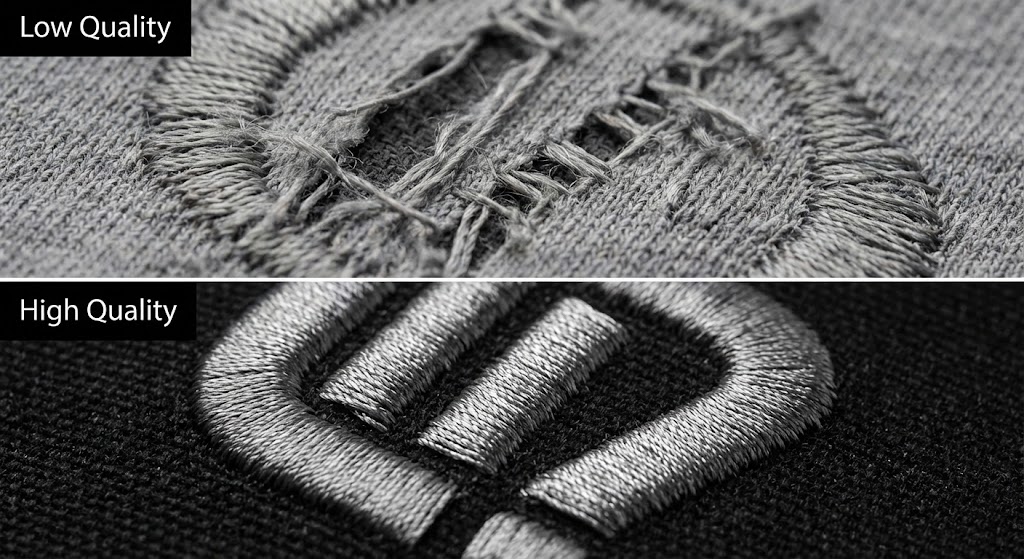
To hit aggressive price targets, some suppliers reduce stitch density in the embroidery file. Fewer stitches are used to cover the same logo area. The result is gapping, where the fabric shows through the design. Logos appear thin, uneven, and unfinished.
Higher-quality embroidery prioritizes density and stability. Machines run slower, stitches sit tighter, and backing materials are chosen to support the logo—not just hold it in place. The difference is immediately visible: a flat promotional look versus a retail-ready finish you would expect from a premium brand.
Precision Engineering and Logo Alignment
A logo that is slightly tilted or off-center is rarely an accident—it’s a process issue.
Misalignment often happens when proper hooping techniques, stabilizers, or calibration checks are skipped to save time. In high-volume production, small shortcuts compound quickly.
Professional embroidery processes treat alignment as a controlled variable. Positioning tolerances are defined, checked, and enforced. A few millimeters may sound insignificant, but visually, they signal whether a brand pays attention to detail—or doesn’t.
The “Thin Thread” Problem
Not all embroidery thread performs the same.
Low-grade rayon threads fray easily and lose definition after washing. Over time, logos begin to look fuzzy or uneven, especially under repeated wear or exposure to sun and moisture.
Higher-quality polyester threads are colorfast, abrasion-resistant, and designed for long-term use. They maintain sharp edges and consistent color, even after washing. Advanced techniques like 3D puff embroidery further enhance depth and visual impact—something low-density stitching simply cannot achieve.
Why Embroidery Quality Matters in B2B Orders
In B2B projects, the hat is only the carrier.
The logo is the message.
If embroidery looks weak, inconsistent, or careless, the brand absorbs that perception immediately. Investing in proper stitch density, alignment control, and durable materials ensures your logo remains crisp, authoritative, and wearable over time.
A well-executed logo doesn’t just look better—it builds confidence.
And confidence is what turns a hat into something people are proud to wear.
Comparison Table: Stitch Quality and Brand Impact
| Decision Area | Low Stitch Density (Budget Production) | High Stitch Density (Professional Production) |
|---|---|---|
| Stitch Coverage | Thin, visible gaps in the logo | Full coverage, clean edges |
| Visual Sharpness | Blurry, unfinished appearance | Crisp, defined, retail-ready |
| Production Speed | Faster machine time | Slower, controlled stitching |
| Thread Quality | Low-grade rayon, prone to fraying | Colorfast polyester, durable |
| Wash & Wear Performance | Fades and fuzzes quickly | Maintains clarity after use |
| Alignment Control | Inconsistent positioning | Controlled tolerances, centered logos |
| Brand Perception | Promotional, disposable | Professional, premium |
| Long-Term Value | Short lifespan, low reuse | Repeat wear, lasting exposure |
Will Shipping Delays and Bad Logistics Cost You Business?
A cheap hat that arrives after your event is worth exactly zero dollars. Reliability is the most expensive thing a cheap vendor forgets to include in their quote.
Cheap vendors overpromise on lead times but have no control over their supply chain. This leads to “ghosting” and missed deadlines. Professional partners provide real-time updates and guaranteed delivery dates.
The Price of a Missed Deadline
Imagine you have a major trade show on Tuesday. You ordered 500 hats to give away to potential big clients. The cheap vendor promised they would arrive by Friday. But Friday comes, and there is no tracking number. Monday comes, and they stop answering your emails. The hats arrive on Wednesday, the day after the show. Now you have 500 hats you don’t need and zero leads from the show. You lost the cost of the hats AND the potential revenue from the event. We take deadlines seriously because we know your business depends on them.
Communication Black Holes
The “headache tax” is real. When you work with a low-cost vendor, you are often dealing with someone who is juggling too many orders to give you any attention. If there is a problem with the artwork or a delay in the factory, they might not tell you until it is too late. We provide dedicated account management. You always know where your order is. If you have questions about our , we give you straight answers. No “ghosting,” just professional service.
The Risk of the “Wrong Color”
Cheap quotes often mean the factory will use whatever thread or fabric they have on hand to save money. If your brand color is a specific shade of navy, but the hats arrive in a bright royal blue, your branding is ruined. Professional manufacturers use Pantone matching. We make sure the color on the hat matches the color in your brand guidelines. We send digital proofs and physical samples so there are no surprises when the big box arrives at your door.
For a B2B buyer, your time is your most valuable asset. If you have to spend days chasing a vendor for a tracking number, you are losing money. A professional partner handles the stress so you can focus on your high-level strategy. We treat your deadline as if it were our own because we want to be your long-term supplier.
Is the True Cost-Per-Wear Draining Your Marketing Budget?
If you want to understand the real value of a product, you have to look at the math. A cheap hat is a short-term expense; a quality hat is a long-term investment.
The “Cost-Per-Wear” (CPW) proves that a $12 hat is actually much cheaper than a $4 hat. If people wear the better hat 50 times more often, your brand gets 50 times more exposure for just a few extra dollars.
Why a $15 Hat is Cheaper than a $5 Hat
Let’s do the math. You buy a cheap hat for $5. It is itchy and fits poorly. The customer wears it once to wash their car and then throws it in the trash. Your “Cost Per Impression” is $5.00. Now, imagine you buy a high-quality hat for $15. It fits perfectly and looks great. The customer wears it to the gym, the grocery store, and on weekend trips for a whole year. If they wear it 100 times, your “Cost Per Impression” is only $0.15. The “expensive” hat is actually much more efficient for your marketing budget.
The “Mowing the Lawn” Fate
Where do you want your logo to be seen? Cheap hats usually end up as “work hats.” They are seen in backyards and dusty garages. Premium hats end up at high-end golf courses, coffee shops, and in social media photos. If you want your brand to be associated with quality and success, you must give people a product that reflects those values. When you choose to , you are choosing to put your logo in the best possible environments.
Sustainability and Waste
Modern consumers are very smart. They know when they are being given “junk.” Giving away 1,000 cheap hats that end up in a landfill is bad for the planet and bad for your image. It makes your company look wasteful. On the other hand, giving away 500 high-quality hats that people keep for years shows that you care about quality and sustainability. People value items that last. They will respect your brand more if you give them one great hat instead of three bad ones.
Business is about ROI. If you spend $5,000 on cheap hats and they all get thrown away, you have a 0% return. If you spend $7,500 on great hats and they become your customers’ favorite headwear, you have a walking billboard for the next two years. That is how you win in B2B marketing. You buy the best product so it can do the best work for you.
How Do You Audit a Hat Manufacturer Before Buying?
You should never take a quote at face value. You need to ask the right questions to see if the factory is actually capable of delivering what they promise.
A professional manufacturer will have no problem sharing technical details. You should check fabric weights, embroidery samples, and their quality assurance (QA) process before you sign any contract or pay a deposit.
Questions to Ask Your Manufacturer
Before you send money, ask for the “GSM” or weight of the fabric. If they cannot tell you, they are likely using whatever is cheapest at the moment. Ask if the embroidery is done in-house or outsourced to a third party. Ask about their “defect rate” and what happens if 10% of the hats arrive with mistakes. A good partner will have clear answers. They will show you their and give you confidence. If they are vague, it is time to walk away.
Red Flags to Watch Out For
If a quote is 40% lower than everyone else, there is a reason. They are either skipping the QC process, using child labor, or using materials that will fall apart. Another red flag is a lack of physical samples. You should always be able to see and feel a “golden sample” before the full production run begins. If they only offer digital mockups, they are hiding the physical reality of the product. High-resolution photos and physical samples are standard for any serious B2B transaction.
The Importance of the “Golden Sample”
The golden sample is the final version of the hat that you approve. It sets the standard for the entire order. If a factory refuses to send one, they are not a professional partner. We always suggest starting with a sample. This lets you check the fit, the fabric, and the embroidery under your own lights. It removes all the risk from the process. Once you are happy with the sample, you can order 1,000 pieces with total confidence.
Buying in bulk is a big responsibility. You are the one who has to answer to your boss or your clients if the project fails. By auditing your manufacturer properly, you protect your career and your company’s money. Don’t be afraid to ask the hard questions. A great manufacturer will welcome them because they are proud of their work.
Conclusion
A cheap hat quote is a short-term win that leads to a long-term loss for your brand.
Your brand deserves a product that lasts as long as your reputation, so choose quality over the lowest price.
Ready to build a hat that people will fight over? Let’s look past the low-ball quotes and build something premium together. for a quote that reflects the real value of your brand.