
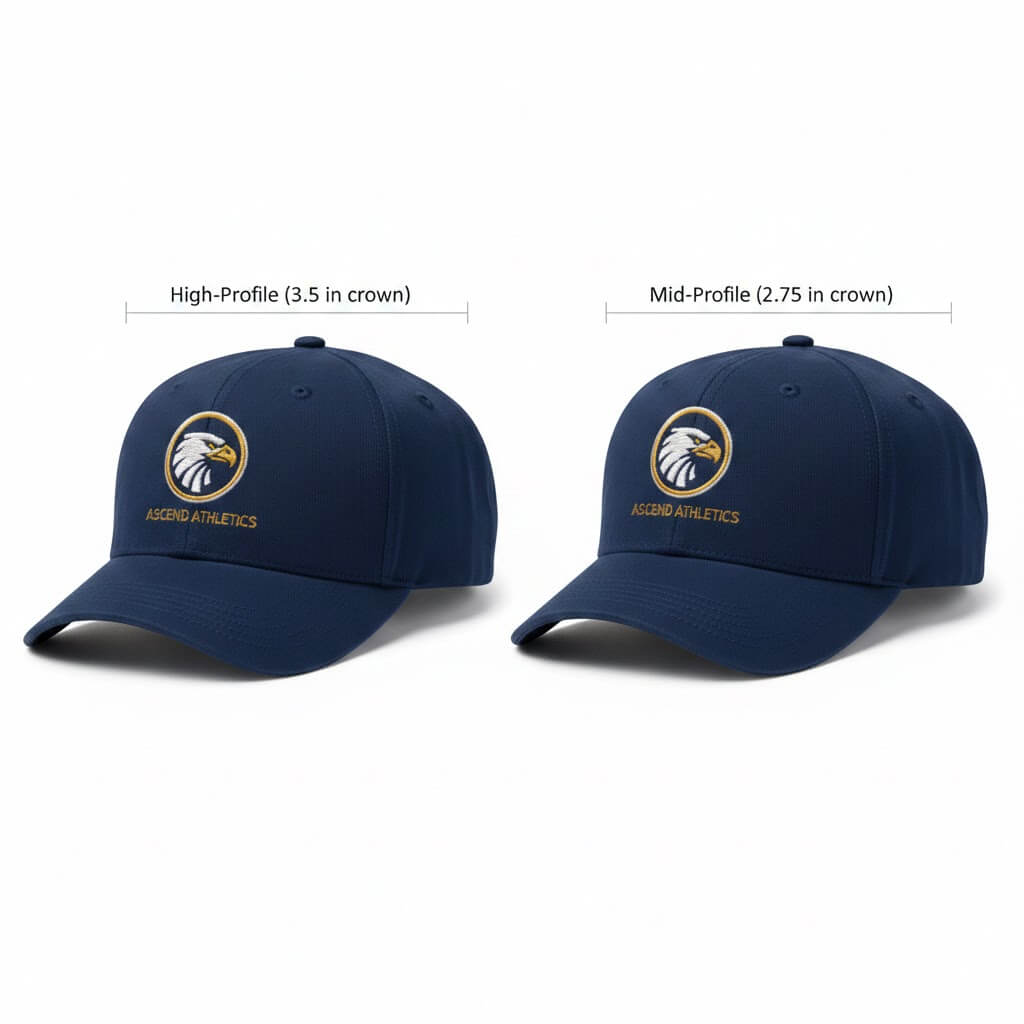
Hat crown height changes both the way a cap fits and the amount of usable space available for front decoration. A logo that looks balanced on a tall structured crown can feel crowded on a lower, more curved profile—even when the artwork file is identical.
For a custom program, crown profile, front-panel construction, fabric, logo dimensions, and placement must be approved together. This guide explains how to compare low-, mid-, and high-profile caps without relying on universal measurements that may not apply to every pattern.
What Is Hat Crown Height?
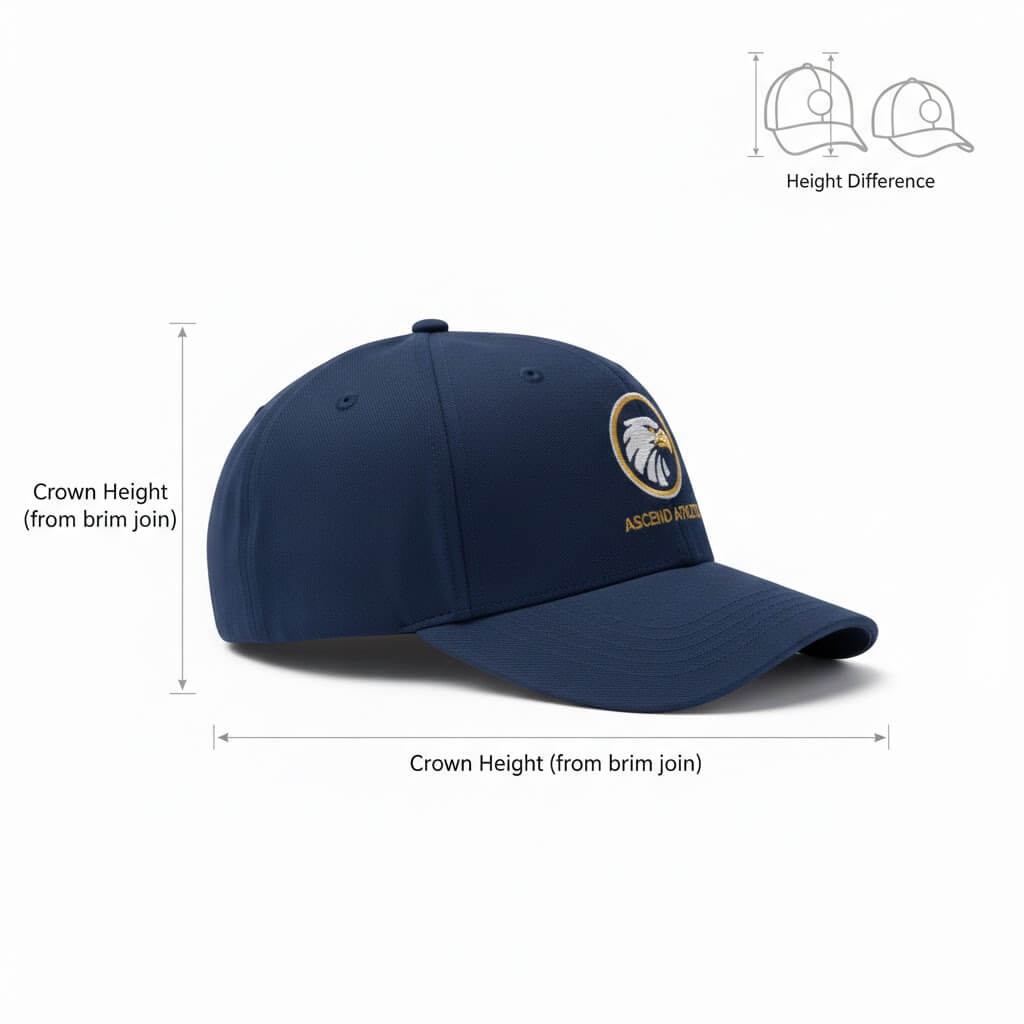
Hat crown height describes the vertical depth of the crown above the visor. The exact measurement method can vary by pattern maker and factory, so a number is only useful when the reference points are defined. A physical reference cap or an approved pattern is often clearer than the words “low,” “mid,” or “high” alone.
Crown height is also different from crown shape. Two caps can have a similar measured height while looking different because of panel curvature, top width, front angle, buckram, seam position, or the way the crown sits on the head.
1. Compare the Profile on the Head, Not Only on a Table
A flat product photo does not show the full fit. A higher crown may stand farther from the forehead, while a lower crown follows the head more closely. The same profile can also look different across head sizes and hair volume.
During sampling, review front, side, and three-quarter views. Check where the crown begins to curve, whether the front collapses, and how the visor angle affects the overall silhouette. If the project serves more than one customer group, test the same sample on several people before approving the pattern.
2. Treat Profile Names as Starting Points
Low profile, mid profile, and high profile are useful categories, but they are not universal engineering specifications. One supplier’s mid crown may be close to another supplier’s high crown.
| Profile | Typical visual effect | Decoration consideration |
|---|---|---|
| Low profile | Close-fitting, softer silhouette | Less vertical room; artwork often needs a compact layout |
| Mid profile | Balanced everyday shape | Works with many logo formats when placement is confirmed on the sample |
| High profile | Taller, more prominent front | More visible area, but the logo still must respect seams and crown shape |
Use the profile name to begin the discussion, then confirm the actual pattern, measurement method, and on-head appearance.
3. Match Logo Proportions to the Usable Front Area
The usable decoration area is not the full front panel. The visor seam, center seam, side seams, eyelets, top curvature, and embroidery frame all reduce the practical working space.
A tall, narrow logo may need more crown height than a wide wordmark. A circular badge may need enough clear space around all edges, while small text requires sufficient size and spacing to remain readable after stitching.
Before digitizing, confirm:
- Finished logo width and height
- Distance from the visor seam
- Relationship to the center and panel seams
- Whether the artwork crosses a seam
- Flat embroidery, 3D embroidery, patch, or another method
Review our customization options when choosing the decoration method.
4. Separate Crown Height from Front-Panel Structure
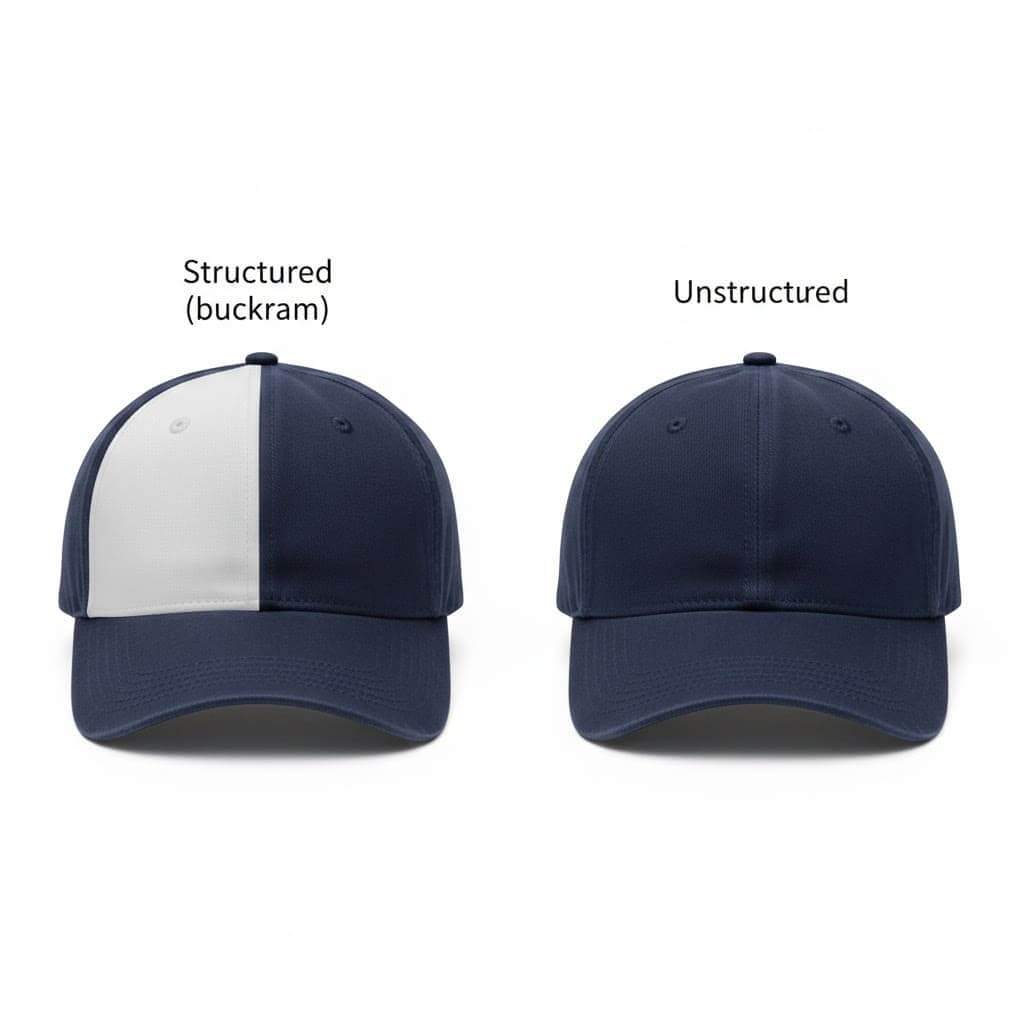
Crown height does not determine whether a cap is structured. A high crown can be soft, and a mid crown can use firm front support. Structure depends on the pattern, fabric, reinforcement, and construction method.
Structured front panels provide a more stable surface and help the crown retain its intended shape. Unstructured fronts create a softer look and can conform more closely to the wearer, but the embroidery plan may need lighter coverage, appropriate backing, or adjusted artwork.
5. Do Not Reuse One Embroidery File Without Testing
A digitized file contains stitch directions, density, underlay, pull compensation, and sequencing decisions. Those settings interact with the fabric and the shape of the cap.
When a collection uses several crown profiles or materials, the same logo may require separate test sew-outs or file adjustments. Simply scaling one file can make small text too dense, change border proportions, or move important details too close to a seam.
Approve embroidery on the actual cap construction and fabric. A flat fabric swatch is useful for color and thread review, but it does not replace a finished-cap sample.
6. Use the Sample to Lock Placement
“Front center” is not a complete placement instruction. Record measurable reference points so bulk production can follow the approved sample.
The specification should show:
- Logo size in finished dimensions
- Position relative to the visor seam
- Alignment to the crown centerline
- Acceptable relationship to panel seams
- Orientation when the cap is viewed on the head
Photograph the approved sample from consistent angles and retain the signed measurement sheet. If the logo, crown pattern, or fabric changes, confirm the placement again.
7. Approve the Whole System Before Bulk Production
Embroidery quality is not controlled by crown height alone. The final result comes from the interaction of artwork, digitizing, thread, needle, backing, fabric, front support, hooping, machine settings, and operator checks.
A practical approval sequence is:
- Confirm the desired on-head profile.
- Approve the crown pattern and front-panel structure.
- Confirm fabric and reinforcement.
- Set the finished logo dimensions and placement.
- Review a sew-out on the intended cap construction.
- Approve a complete pre-production sample.
- Use that sample and specification as the bulk-production reference.
Our custom hat development process shows how sampling, approval, production, and inspection connect.
Mid Crown vs High Crown: Which Should a Brand Choose?
Choose the profile that supports the intended customer, silhouette, and decoration—not the profile with the largest theoretical logo area.
A mid crown is often appropriate when the brand wants a balanced, familiar fit and a moderate front decoration. A high crown may suit a taller streetwear, workwear, or trucker-inspired shape, or artwork that needs a more prominent front presentation. A low crown can support a relaxed look when the logo is designed for the available space.
If the visual identity depends on a large logo, first test whether the crown still looks right on the wearer. Increasing crown height only to fit oversized artwork can change the character of the product.
Common Problems and What to Check First
| Observed issue | Possible factors to review |
|---|---|
| Logo looks crowded | Crown profile, logo height, distance from visor seam, top curvature |
| Edges look wavy | Fabric stability, backing, stitch direction, density, hooping |
| Logo crosses or leans toward a seam | Placement reference, panel symmetry, artwork width |
| Small text fills in | Letter size, spacing, thread and stitch density |
| Result differs between cap styles | Separate digitizing and placement approval for each construction |
These symptoms do not prove one cause. Review the full construction and embroidery setup before changing the pattern or artwork.
Frequently Asked Questions
Is a high-profile cap always better for embroidery?
No. A high profile can provide more visible front area, but structure, fabric, seams, artwork, placement, and the intended fit still determine the result.
Can the same logo file be used on mid- and high-profile caps?
Sometimes, but it should be tested on both constructions. Different curvature and placement limits may require a separate digitized file or adjusted logo dimensions.
How should crown height be specified?
Define the measurement points, record the approved pattern or physical reference, and include front and side photos of the approved sample. Do not rely on the profile name alone.
Does structured mean high profile?
No. Structure describes the support and shape retention of the front panels. Profile describes the crown’s overall height and silhouette.
When should logo placement be approved?
Approve it on a complete sample made with the intended crown construction, fabric, support, and decoration method before bulk production.
Develop the Crown and Decoration Together
The safest approach is to treat hat crown height, fit, construction, and decoration as one product-development decision. Confirm the silhouette first, then adapt the artwork and embroidery plan to the approved cap.
To develop a fully custom baseball cap or trucker hat, send us your reference cap, artwork, target quantity, and intended fit. We can review the crown profile and decoration requirements during sampling.