Struggling with samples that look nothing like your sketches? In the world of custom hat manufacturing, poor communication during the prototyping phase is the #1 killer of budgets and timelines. It leads to expensive delays, wasted materials, and missed market opportunities.
To manage hat prototyping like a veteran buyer, you need more than just a creative vision. You need a structured approach: providing a precision tech pack, selecting a factory with genuine technical expertise, and embracing an iterative sampling process to verify fit, fabric performance, and production costs before you commit to bulk manufacturing.
Navigating the transition from a digital file to a physical product is where most brands either fail or fly. Here is how to safeguard your investment and get your headwear right the first time.
Why the “Messy Middle” Is the Heart of Your Brand
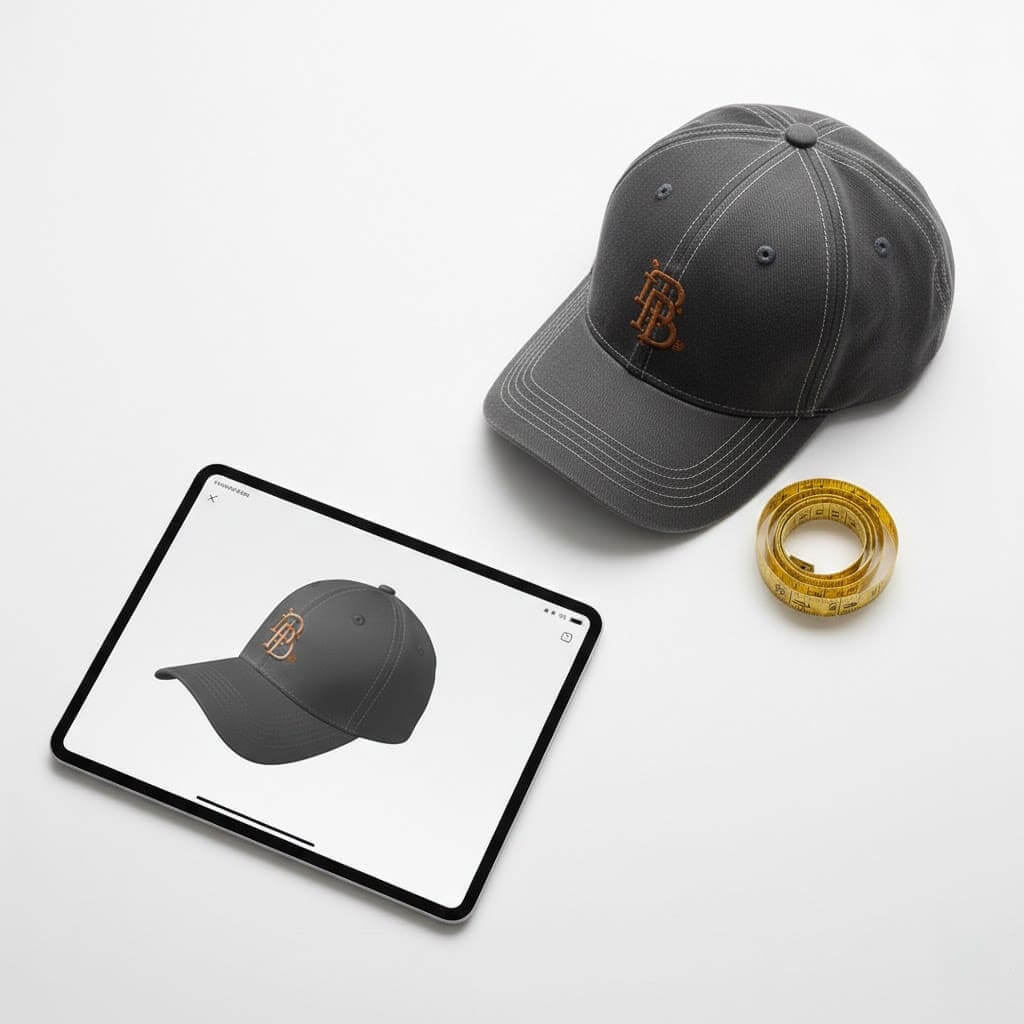
Bridging the Gap: Moving from iPad to Reality
The jump from a 2D digital drawing to a physical hat is bigger than most buyers realize. On a screen, every seam looks flawless and every fabric sits perfectly. In the real world, physics—gravity, tension, and texture—takes over.
For B2B buyers looking to scale, a prototype is not a mere “formality.” It is the stage where you identify if your vision is actually manufacturable. We’ve seen brands fall in love with a 2D design only to realize that a specific 3D embroidery placement makes the crown too heavy to wear comfortably. Prototyping allows you to solve these structural puzzles before they become expensive liabilities.
The Real Cost of Impatience
We understand the pressure to hit market deadlines. However, rushing through the custom hat prototyping phase is the fastest way to lose money. When you ignore “red flags” in the first sample, those errors multiply across thousands of units. A minor fit issue on one hat becomes a disaster when you have 5,000 units sitting in a warehouse that no one wants.
| Risk Factor | Impact on Bulk Production | Solution |
| Poor Fabric Choice | High return rates due to shrinkage/fading | Wear-test the initial prototype early |
| Unclear Specs | High variance between individual units | Standardize the Tech Pack details |
| Rushed Timeline | Hidden defects found too late to fix | Build in a 2-week buffer for review |
Adopting the Iterative Mindset
To succeed, you must view the first sample as a “draft,” not the final product. Prototyping is about learning what doesn’t work so you can refine what does. This mindset shift separates professional commercial buyers from hobbyists. By treating each version as a step closer to perfection, you reduce stress and create an “insurance policy” for your brand’s reputation.
Is Your Tech Pack Truly Your Production Bible?
Confused why your factory keeps getting the measurements wrong? Without a professional Tech Pack, your manufacturer is just guessing. In the world of custom headwear production, guessing leads to inconsistent sizing and poor quality control in large orders.
A Tech Pack is not just a drawing; it is a technical contract that speaks for you when you aren’t in the factory. It must include Points of Measure (POM). Instead of a vague request to “make it a medium,” you must define the crown height, brim width, and circumference in centimeters. If you leave these details out, the factory will use their “house fit,” which may not align with your brand’s aesthetic.
Why “Vague” Kills Profit Margins
When a buyer says “make it blue,” a factory sees fifty shades of blue. Without a Pantone color code, you have no grounds for a refund if the color is off. Professionalism in the Tech Pack stage signals to the manufacturer that you are a serious business partner with high standards. This clarity is what collapses the sampling process from three months down to three weeks.
| Tech Pack Element | Why It Matters for B2B | Consequence of Omission |
| BOM (Bill of Materials) | Ensures correct fabric and thread cost | Factory uses cheaper, low-quality substitutes |
| Graded Spec Sheet | Maintains fit across all sizes (S-XL) | Large sizes fit differently than smalls |
| Construction Details | Defines stitch types and reinforcement | Hat falls apart after minimal wear |
Visual Communication Tools: 2D vs. 3D
You must decide between 2D CADs and 3D renderings. 2D CADs are essential for flat layouts and showing precise stitch lines. However, 3D renderings are a game-changer for B2B buyers because they simulate how fabric drapes in real life. Using the right visual language reduces the “back-and-forth” emails that eat up your production timeline.
How to Find the Right Sample Maker for Your Project
Factory vs. Freelance: The “Translation Error”
Many new buyers hire a freelance sample maker first. While freelancers offer creative flair, they often use different machinery than a high-volume factory. This creates a “translation error” when you move to bulk production.
For commercial headwear buyers, it is superior to work with a factory that has a dedicated, in-house sample room. This ensures the sample you approve is made on the same type of equipment that will produce your 1,000+ unit order. Choosing a partner who can handle both initial sampling and mass production ensures consistency and significantly reduces your speed-to-market.
The “Vibe Check” for B2B Success
In the custom hat prototyping phase, communication speed is your most valuable asset. It doesn’t matter how skilled a factory is if they take five days to answer a simple email. Before committing funds, ask technical questions about their Minimum Order Quantities (MOQ) and sample lead times. If their answers are vague now, they will be even more elusive when a production crisis occurs.
| Partner Type | Pros | Cons |
| Independent Studio | Highly creative, personalized service | Expensive; cannot scale for bulk production |
| Full-Service Factory | Seamless transition to bulk; lower costs | May have higher MOQs for initial sampling |
| Sourcing Agent | Handles communication for you | Adds a layer of cost and potential delay |
Assessing Technical Capability
Don’t just look at glossy marketing photos. Ask for high-resolution images of the “inside” of their hats. Check the stitching on the sweatband and the seam taping. A pro-level manufacturer is proud to show these technical details. For a B2B buyer, the “inside” quality determines the longevity of the product. If a factory struggles with complex embroidery at the sample stage, they will certainly fail during a high-speed production run.
Why Is the First Prototype Often the “Ugliest”?
Lowering Expectations Strategically
Are you disappointed when your first sample arrives and the fabric feels “off”? Many buyers abandon projects prematurely because they don’t realize the first prototype is meant for structural testing, not aesthetic perfection.
In the industry, we call the “Proto 1” a fit sample. It might be the wrong color, and the logo might be printed instead of embroidered. That is okay. The goal here is to verify the “bones” of the hat—ensuring the crown isn’t too deep and the brim isn’t too wide. If you insist on using premium, custom-dyed materials for the first version, you are wasting your budget on a product that hasn’t even been cleared for fit.
Identifying Structural Red Flags
When you receive that first sample, put it on. Does it feel balanced? Does it stay secure when the wearer moves? These are the “red flags” that need immediate correction. If the structure is weak, no amount of expensive embroidery can save it. We encourage our clients to prioritize wearability before aesthetics.
Key Features to Audit
| Feature to Check | What to Look For | Potential Fix |
| Balance | Does the hat tilt to one side? | Adjust panel tension or symmetry |
| Crown Height | Does it hit or push down the ears? | Reduce side panel measurements |
| Brim Stiffness | Does it flop or hold its shape? | Upgrade the buckram weight |
The Value of Substitute Fabrics
Using “available” or “deadstock” fabric for Proto 1 is a strategic move. If you wait for a custom-dyed fabric just for one sample, you might lose 3-4 weeks of development time. Using a similar-weight substitute allows you to move fast. Speed is a competitive advantage in the B2B world. The faster you clear the structural hurdles, the faster you can finalize the Gold Standard and start selling.
Mastering the Art of the Fit Session
Humans vs. Mannequins: Real-World Testing
Do you find it difficult to explain exactly why a sample feels “wrong”? Without a structured fit session, you risk giving the factory vague feedback that leads to even more incorrect samples.
While mannequins are great for display, they don’t have feelings. A plastic head won’t tell you if the sweatband is itchy or if the hat feels like it’s going to fly off in a light breeze. You need a human fit model who matches your target demographic’s head size. This feedback is vital for B2B buyers who want to ensure high customer satisfaction and low return rates.
Taking Professional Fit Notes
When you identify a problem, avoid vague comments like “fix the back.” Instead, be surgical with your feedback. Take a high-resolution photo, draw an arrow, and specify: “Reduce strap length by 2cm.” Use safety pins to show exactly where the fabric is bunching up. The more visual and data-driven your feedback, the less chance there is for a “lost in translation” moment with the production team.
Your Fit Session Toolkit
| Fit Tool | Purpose | Best Practice |
| Measuring Tape | Verifying actual dimensions vs. Tech Pack | Measure twice before requesting a pattern change |
| Safety Pins | Marking physical adjustments | Leave them in the sample and send it back to the factory |
| Video Clips | Showing movement and flexibility | Film the model putting the hat on/off to check recovery |
The Power of “Wearability”
A hat can look beautiful on a shelf but be a nightmare to wear for eight hours. During your fit session, have the model wear the prototype for at least 30 minutes. Does it leave a red mark on the forehead? Is it breathable? For wholesale clients selling to industrial workers or outdoor enthusiasts, these details are everything. Solving “wearability” issues during the prototyping phase is significantly cheaper than dealing with negative reviews after your product has launched.
Speaking “Manufacturer”: The Secret to Faster Turnarounds
Visual Over Verbose: The Universal Language
Factories handle dozens of projects daily. They don’t have time to read a three-page essay about your “feelings” on a sample. To get results, you must be Visual over Verbose.
If a logo is 5mm too low, don’t just email them; send a photo with a ruler placed next to the logo. Use a red circle to highlight the error and a green arrow to show the desired position. This is the universal language of custom hat manufacturing. It removes all doubt and ensures the next iteration is much closer to your goal.
The Feedback Sandwich: Keeping Your Partner Motivated
Manufacturing is a human business. If you only send negative critiques, the production team may lose interest in your project. We suggest using the “Feedback Sandwich” to maintain a strong B2B partnership:
- The Positive: Start with what they got right (e.g., “The fabric hand-feel is perfect”).
- The Correction: Provide the technical fix (e.g., “The stitch density on the brim needs to increase to 12 SPI”).
- The Outlook: End with a positive next step (e.g., “We are very close to the final version!”).
Communication Style Comparison
| Style | Example | Expected Result |
| Vague/Emotional | “I don’t like how this looks; make it better.” | Confusion, delays, and frustration. |
| Technical/Dry | “Stitch count is 8 per inch; change to 12.” | Accuracy, but lacks collaborative energy. |
| Professional/Clear | “The shape is great! Please move the logo 1cm up.” | Speed, precision, and high-quality results. |
Bridging the Language Gap
Many skilled technicians speak English as a second language. Avoid slang or metaphors like “make it pop” or “give it some soul.” Instead, use precise technical instructions: “Increase embroidery height by 2mm for a 3D effect.” This clarity ensures that the person actually operating the sewing machine understands your vision. For wholesale partners, this level of communication is what keeps a project on budget and on time.
Mastering Version Control and the “Gold Standard”
Tracking the Paper Trail: Avoid Version Confusion
Feeling overwhelmed by multiple iterations of the same design? Poor organization leads to “version confusion,” a nightmare scenario where a factory accidentally triggers bulk production based on an old, rejected prototype.
To manage this like a pro, you must label and tag every physical sample you receive. We recommend a strict naming convention: Proto 1, Proto 2, and finally, the PPS (Pre-Production Sample). Never discard an old sample until the bulk order is delivered. Sometimes, you may realize the brim construction on Proto 1 was actually superior to Proto 2; having that physical reference allows you to tell the factory, “Revert to the Proto 1 brim for bulk.”
Knowing When to Stop: The Law of Diminishing Returns
In custom hat manufacturing, there is no such thing as a “perfect” hat—only a “production-ready” one. Some buyers get trapped in an endless sampling loop, requesting 1mm adjustments that no end-consumer will ever notice. This stalls your launch and eats your profit. If the fit is correct, the materials are locked, and the branding is accurate, it is time to approve the PPS and move to the floor.
The Sample Evolution
| Version Type | Primary Goal | Action Required |
| Proto 1 (Fit) | Verify shape, proportions, and crown fit | Provide major structural feedback |
| Proto 2 (Sales) | Verify colors, embroidery, and trims | Refine small aesthetic details |
| PPS (Gold Standard) | Final sign-off for bulk production | Seal as the physical reference for QC |
Establishing Your “Gold Standard”
Gemini said
这一部分关注的是**“版本控制”与“最终批准”**。在批量生产中,最昂贵的错误就是“工厂按照错误的版本生产了 5,000 顶帽子”。我们将教客户如何建立一套严谨的审核机制,确保大货生产万无一失。
Revised Section 8: Mastering Version Control and the “Gold Standard”
第八部分:掌控版本控制与“黄金标样”的确立
Tracking the Paper Trail: Avoid Version Confusion
追踪记录:避免版本混淆
Feeling overwhelmed by multiple iterations of the same design? Poor organization leads to “version confusion,” a nightmare scenario where a factory accidentally triggers bulk production based on an old, rejected prototype.
To manage this like a pro, you must label and tag every physical sample you receive. We recommend a strict naming convention: Proto 1, Proto 2, and finally, the PPS (Pre-Production Sample). Never discard an old sample until the bulk order is delivered. Sometimes, you may realize the brim construction on Proto 1 was actually superior to Proto 2; having that physical reference allows you to tell the factory, “Revert to the Proto 1 brim for bulk.”
Knowing When to Stop: The Law of Diminishing Returns
见好就收:边际递减效应
In custom hat manufacturing, there is no such thing as a “perfect” hat—only a “production-ready” one. Some buyers get trapped in an endless sampling loop, requesting 1mm adjustments that no end-consumer will ever notice. This stalls your launch and eats your profit. If the fit is correct, the materials are locked, and the branding is accurate, it is time to approve the PPS and move to the floor.
The Sample Evolution (样品演变阶段)
| Version Type (版本类型) | Primary Goal (主要目标) | Action Required (需要采取的行动) |
| Proto 1 (Fit) | Verify shape, proportions, and crown fit | Provide major structural feedback |
| Proto 2 (Sales) | Verify colors, embroidery, and trims | Refine small aesthetic details |
| PPS (Gold Standard) | Final sign-off for bulk production | Seal as the physical reference for QC |
Establishing Your “Gold Standard”
Once you approve the final sample, it becomes the Gold Standard. You must keep one identical copy in your office, and the factory must keep another on the production floor. This physical reference point is your ultimate safety net. If the final 5,000 units do not match the Gold Standard, you have the objective proof needed to request a fix or a claim. For a serious B2B business, this is the only way to ensure 100% accountability.
Are Your Materials Ready for the Real World?
The “Wash and Wear” Test: Durability is Brand Equity
Have you ever had a sample look stunning on day one, only to fall apart after one wash? For B2B buyers, durability isn’t just a feature; it’s a safeguard against mass recalls.
Do not just look at your sample—abuse it. Wash it five times according to the care instructions. Does the color bleed? Does the crown lose its structural integrity? If you are selling hats for construction crews or sports teams, they must withstand sweat and UV exposure. Testing these “Material Realities” during the prototyping phase prevents expensive quality claims once the product is in the hands of your customers.
Hardware and Trim Hurdles
Small components like metal buckles, plastic snaps, and zippers are common failure points. Test them repeatedly. Does the snap closure have a “satisfying” click, or does it feel flimsy? Does the metal buckle rust after exposure to moisture? These details determine whether your product feels “premium” or “cheap.”
| Component | Test Method | What to Avoid |
| Fabric | 5x Wash/Dry cycle | Excessive pilling or shrinkage |
| Embroidery | Tug and friction test | Loose threads or “nesting” |
| Hardware | 50x Open/Close cycle | Snaps that become too loose to stay shut |
Optimizing for Profit: Is Your Design Cost-Effective?
The Reality Check: “Costing as You Go”
During custom hat prototyping, you may discover that a specific stitch type or multi-panel design doubles the labor time. In a factory setting, time is money.
If a design detail adds $2 to the manufacturing cost but doesn’t add $10 to the perceived value, it’s a candidate for simplification. Professional buyers look for ways to maintain the “look” while optimizing for mass production. This ensures that when you scale to thousands of units, your profit margins remain healthy.
Simplifying for Scalability
Is your design “machine-friendly”? For wholesale headwear, consistency is king. If a design is too complex, the defect rate will skyrocket during a high-speed production run. We often help clients tweak their designs to find the “sweet spot” between unique aesthetics and manufacturing efficiency.
| Cost Driver | Possible Simplification | Benefit |
| 3D Embroidery | Move to high-density flat embroidery | Lower cost, faster production |
| Multi-Panel Fabric | Consolidate fabric types | Reduces material waste and cutting time |
| Custom Metal Badges | Use high-quality sonic-welded patches | Lower weight and easier attachment |
Finalizing the Unit Price
By the time you approve the PPS (Pre-Production Sample), you should have a locked-in unit price that includes everything: materials, labor, labeling, and logistics. Being proactive about costs during the sampling phase is what allows a brand to scale from a small startup to a national distributor.。
Conclusion: Ready to Move from Sketch to Success?
Managing the prototyping phase requires a balance of technical precision, clear communication, and financial discipline. By treating your factory as a partner and your Tech Pack as law, you ensure a seamless transition to bulk production.
Success in the custom hat world comes to those who get the foundation right. Ready to start your next project with a team that speaks your language? Contact S&N International today to bring your professional designs to life!
FAQ
1. Why should I invest in a professional Tech Pack instead of just sending a design sketch? A design sketch only conveys your creative vision, but a Tech Pack serves as a technical contract. In custom hat manufacturing, precision is key. A Tech Pack includes “Points of Measure” (POM), Pantone color codes, and a Bill of Materials (BOM). This eliminates factory guesswork, ensures consistent sizing across bulk orders, and provides you with a legal basis for quality claims if the final product deviates from your specifications.
2. Why does the first prototype (Proto 1) often use different fabrics or colors? The primary goal of the “Proto 1” or “Fit Sample” is to verify the structural integrity, shape, and proportions of the hat—not its final aesthetics. Using available “deadstock” fabrics allows us to speed up the development cycle by weeks. It is more cost-effective to fix a crown height or brim width issue on a substitute fabric before cutting into your expensive, custom-dyed materials.
3. What is the difference between a “Fit Sample” and a “Pre-Production Sample” (PPS)? Think of the Fit Sample as a rough draft used to test wearability and dimensions. In contrast, the PPS is the “Gold Standard”—it is the final version that represents exactly what the bulk order will look like, including final fabrics, branding, and trims. Once you approve the PPS, it becomes the physical reference used for Quality Control (QC) during mass production.
4. How can I reduce the per-unit cost of my hat during the prototyping phase? During prototyping, we analyze “Cost Drivers.” For example, if a complex 3D embroidery adds significant labor time without increasing the “perceived value” for your customers, we might suggest high-density flat embroidery instead. Optimizing for “machine-friendly” construction and consolidating fabric types are the most effective ways to lower costs while maintaining a premium look for wholesale distribution.