Are you struggling to scale your brand while relying on generic, off-the-shelf blank hats? While blanks are a great starting point, they often limit your brand’s perceived value and sustainability story. Using standard, mass-produced trims can make your high-end designs feel like “just another promotional item.”
Transitioning to a Full-Custom Collection—incorporating eco-friendly labels and sustainable trims—solves your branding hurdles instantly. It moves your products from “commodity” to “premium,” building the deep-seated trust that modern American consumers demand.
As a procurement specialist or brand owner, navigating this shift can feel overwhelming. Having spent years helping high-volume brands move away from generic sourcing, I want to show you how these “tiny” custom details significantly transform your bottom line and ESG (Environmental, Social, and Governance) standing.
Why Full-Custom Trims are the New Standard for Growing Brands
If you are still using standard polyester trims on your custom headwear, you are leaving money on the table. Traditional trims often feel stiff and “scratchy”—a common complaint that leads to lower customer retention. In the competitive U.S. market, a premium hat should feel as good as it looks.
Moving beyond blanks means you control every fiber. Modern B2B buyers and retailers now prioritize circular-ready products. By choosing recycled polyester (rPET) or organic cotton for your labels and interior tapes, you ensure your entire headwear line aligns with global recycling goals. This isn’t just about comfort; it’s about making your brand “future-proof” for the circular fashion economy.
Comparison: Blanks vs. Full-Custom Sustainability
| Feature | Standard Blank + Patch | Full-Custom Sustainable | Brand Impact |
| Material Base | Virgin Polyester/Acrylic | rPET / Organic Cotton / Hemp | Higher Perceived Value |
| Comfort | Can be abrasive/stiff | Ultra-soft, breathable | Increased Repeat Purchases |
| Recyclability | Mixed materials (Hard to recycle) | Mono-material approach | Meets ESG Requirements |
| Market Positioning | Promotional / Entry-level | Premium / Retail-ready | Supports Higher Price Points |
Protecting Your Brand Integrity in the Age of Transparency
The American consumer—particularly Gen Z and Millennials—has developed a “detective’s eye” for quality. If your brand claims to be premium or eco-conscious but sews a scratchy, virgin plastic label into a high-quality cap, it creates a visual and physical disconnect. In the industry, we call this a “Brand Gap.” For a B2B buyer, this inconsistency is a massive liability.
When you scale from blanks to a Full-Custom Collection, you eliminate the risk of “greenwashing” accusations. Consistency is key. If you are selling a sustainable headwear line, every component—from the sweatband to the woven label—must tell the same story. This level of detail is what separates a professional brand from a side hustle. By integrating these small but vital changes, you’re not just buying a label; you’re buying insurance for your brand’s reputation.
The Circular Fashion Advantage (Simplified)
One of the biggest hurdles in textile recycling is the “contaminant” factor. Standard polyester labels sewn into natural fiber caps make the product nearly impossible to recycle efficiently.
- The Solution: A mono-material approach.
- The Result: Using a cotton label on a cotton cap or an rPET label on a recycled polyester cap ensures the entire piece is “Circular-Ready.”
Elevating the “Hand-Feel”: Why Material Choice is Your Best ROI
Are you worried that “recycled” means “scratchy”? In the premium headwear market, the “hand-feel” of the interior label and sweatband is a direct indicator of quality. Modern weaving technology has advanced so much that GRS-certified rPET (recycled polyester) can be rendered into “Super-Soft” or “Satin” finishes that outperform traditional virgin materials.
When you transition to a Full-Custom Collection, you aren’t just changing a label; you are upgrading the user experience. For a B2B buyer, this justifies a higher retail price point and reduces the risk of returns or “cheap” brand associations.
The Material Strategy for Full-Custom Headwear
| Material | Source | Texture | Best Use Case | ROI Factor |
| rPET (Satin) | Plastic Bottles | Silky / Smooth | Premium Streetwear Caps | High Durability & Brand Story |
| Organic Cotton | Cotton Plant | Soft / Matte | Heritage & Outdoor Wear | Skin-Friendly, High Trust |
| Tencel/Bamboo | Wood Pulp | Luxe / Cool | Luxury / Golf Headwear | Eco-Luxury Positioning |
Understanding the Bottom Line: The “Cents to Dollars” Logic
As a procurement manager, you might hesitate at a 10-15% increase in trim costs. However, because labels and trims are such a small percentage of the total garment cost, this often translates to less than $0.05 – $0.10 per hat. In exchange, you gain:
- Brand Premiumization: The ability to sell a $25 hat for $35 because of the “Full-Custom” feel.
- Regulatory Safety: Future-proofing against U.S. and EU environmental laws (EPR).
- Marketing Edge: A concrete “Sustainability Story” that your sales team can use to close bigger deals.
How Full-Custom Transparency De-Risks Your Supply Chain
When you buy standard blank hats, you often have zero visibility into how the components were made. This lack of transparency is a hidden liability. For U.S. brands, toxic residues in dyes or unethical manufacturing can lead to costly recalls and PR nightmares.
By moving to a Full-Custom Collection, you gain a “Clean” supply chain. This means every component of your hat—from the Oeko-Tex certified non-toxic dyes to the solar-powered weaving process—is documented. This level of oversight ensures that your custom headwear isn’t just “green” in name, but is produced to meet the highest safety and labor standards (like GRS and ISO 14001).
Manufacturing Excellence: Traditional vs. Full-Custom
| Step | Traditional Blank | Full-Custom Sustainable | Benefit to You |
| Dyeing | Chemical Heavy | Oeko-Tex Certified / Low-Impact | Safety & Skin Compliance |
| Cutting | Standard Heat Cut | Ultrasonic Precision | Clean Edges & No Fraying |
| Energy | Coal/Grid Power | Solar / Renewable Energy | Lower Carbon Footprint |
| Waste | High Scrap Rate | Zero-Waste Logic (Software-driven) | More Predictable Pricing |
The Bottom Line: A clean supply chain is a stable supply chain. Energy-efficient factories are less susceptible to fluctuating energy costs, which makes your long-term wholesale procurement more predictable and profitable.
High-Definition Design: Why “Eco” Doesn’t Mean “Basic”
A common misconception among designers is that switching from standard blanks to sustainable custom materials will limit their color palette or logo detail. In reality, modern rPET and organic yarns offer superior clarity.
When you choose a Full-Custom Collection, you unlock High-Definition (HD) weaving capabilities that standard blank labels simply can’t match. Whether it’s a complex multi-color crest or ultra-fine text for your brand’s origin story, eco-friendly yarns provide a crisp, premium finish. In the U.S. retail market, where “unboxing” and “first touch” are everything, these HD details are what justify a luxury price point.
Your Shield Against Greenwashing: Essential Certifications
For a B2B procurement manager, “trust” must be backed by “paperwork.” Claiming a product is sustainable without proof is a major legal risk in today’s regulatory environment. In a full-custom setup, we provide the documentation you need to pass any audit.
| Certification | What It Guarantees | Why It Matters for Your Brand |
| GRS (Global Recycled Standard) | Recycled Content + Fair Labor | Authenticity: Provides a Transaction Certificate (TC) for your order. |
| Oeko-Tex Standard 100 | Zero Harmful Chemicals | Safety: Essential for products with direct skin contact (Headwear). |
| FSC (Forest Stewardship Council) | Sustainable Paper/Packaging | Consistency: Ensures hangtags and boxes match your green mission. |
Your Roadmap: From “Buying Blanks” to “Building a Brand”
Transitioning to a Full-Custom Collection doesn’t have to happen overnight. We recommend a phased approach to ensure your supply chain remains agile while your brand image elevates.
1.The Audit: Review your current blank hat specs. Where is the “Brand Gap”? (Typically the internal labels and fabric origin).
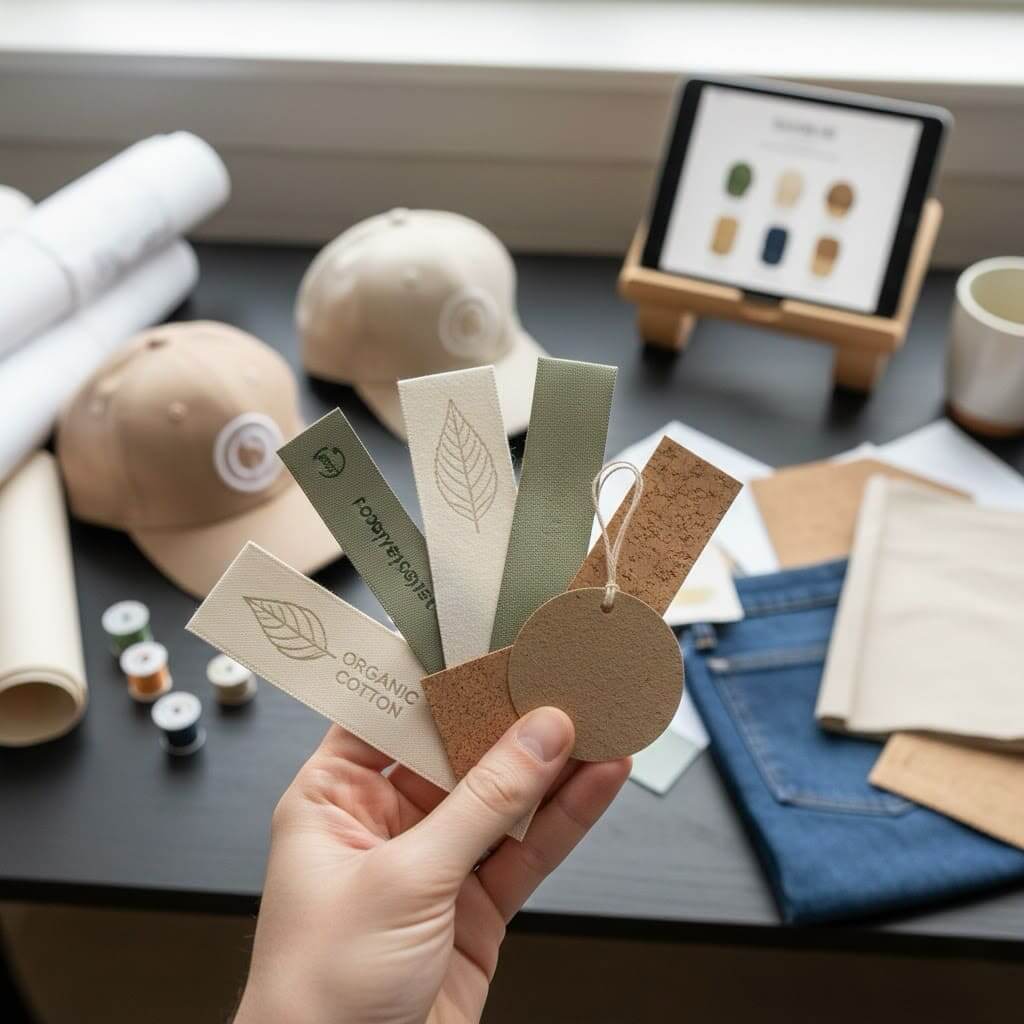
2.Sampling: Replace your standard polyester label with an rPET or Organic Cotton sample. Feel the difference in the “hand-feel.”
3.The Test: Conduct industrial wash and friction tests. Our eco-trims are built to outlast the garment itself.
4.The Scale: Launch your first “Signature Collection” where every detail—from the thread to the brim—is fully customized and sustainably sourced.
Conclusion
Scaling beyond blanks is the single most effective way to protect your margins and build long-term loyalty. Sustainable, full-custom headwear is no longer a luxury; it is the baseline for any brand that intends to lead the market in 2026 and beyond.
FAQ
Q1: How much will my “per-unit” cost increase if I switch from blank hats to a full-custom sustainable collection? A: While raw eco-friendly materials (like GRS-certified rPET or organic cotton) are 10-20% more expensive than virgin polyester, the impact on your final garment cost is minimal. Because trims and labels represent a small fraction of the total build, you are typically looking at an increase of only $0.05 to $0.15 per unit. This small investment is often offset by the ability to command a much higher retail premium.
Q2: Will recycled rPET labels be as durable and soft as the ones I currently use on my blank hats? A: Absolutely. Modern weaving technology has evolved significantly. Our rPET yarns can be processed into “Super-Soft” or “Satin” finishes that are indistinguishable from—or even softer than—virgin polyester. They undergo rigorous testing for colorfastness and friction to ensure they won’t fade or cause skin irritation over the life of the garment.
Q3: Can I get a Transaction Certificate (TC) for my order to prove its sustainability to my retailers? A: Yes. This is a crucial part of avoiding “greenwashing.” When you place an order for GRS-certified materials, we can provide the specific Transaction Certificate (TC) linked to your shipment. This document serves as legal proof of the recycled content, which you can use for your ESG reporting and retail partner audits.
Q4: What are the Minimum Order Quantities (MOQs) for transitioning to full-custom sustainable trims? A: We understand that scaling a brand requires flexibility. While full-custom orders typically require higher volumes than buying blanks, we offer “Entry-Level Custom” packages with lower MOQs to help you test the market. This allows you to upgrade your brand’s trim package without over-committing your inventory budget.
Q5: If I use organic cotton labels on a synthetic hat, is that still considered “circular fashion”? A: Ideally, circular fashion aims for a “mono-material” approach to make recycling easier. If you are using a recycled polyester hat, we recommend rPET labels. If you are using cotton or hemp hats, organic cotton labels are the best fit. However, even a small shift—like replacing a virgin plastic label with an eco-friendly one—is a significant step toward reducing your brand’s overall carbon footprint.