You have spent months perfecting your design, selecting the perfect fabric, and nailing the fit, but have you considered that a single square inch of material could ruin your entire customer experience? We have all been there—wearing a stylish new shirt or cap, only to be constantly distracted by a scratchy, irritating tag digging into our neck. That “neck itch” is the silent killer of brand loyalty, turning a premium product into a nuisance the moment it touches the skin.
The “Itch-Free” Standard is the new non-negotiable metric for high-end branding. Unlike cheap printed tags that stiffen and fade, custom woven labels are created by weaving polyester or cotton threads together on a loom, integrating your logo directly into the fabric structure. This results in a label that is soft, durable, and virtually undetectable against the skin, signaling to your customers that you prioritize their comfort just as much as your aesthetics.
If you are manufacturing premium headwear or apparel, the difference between a satisfied customer and a return often comes down to the details you think they won’t notice. Let’s explore why the smartest brands are ditching printed tags for woven luxury, and why this small investment yields massive returns.
Why Does “Hand Feel” Dictate Your Brand’s Value?
Your customer’s fingers are the first to judge your product’s quality, long before their eyes see the price tag or their brain processes the logo. If the first touch reveals a scratchy, stiff label, the subconscious verdict is “cheap,” regardless of your actual production costs.
Haptic perception—the way we experience the world through touch—is a powerful driver of consumer behavior. A soft, seamless label signals “craftsmanship” and “care,” creating an immediate bond of trust. Conversely, a rough tag interrupts the luxury experience, triggering a psychological association with mass production and cutting corners. In the competitive world of fashion, comfort is not just a feature; it is the physical manifestation of quality.
The Subconscious Trust Signal
When a buyer picks up a custom hat or a high-end hoodie, they are looking for reasons to justify the price. They are playing the role of a detective, hunting for clues of quality. A label that feels like satin against the thumb tells them that you sweated the small stuff. It suggests that if you cared enough to make the inside tag soft, you certainly didn’t compromise on the stitching, the fabric sourcing, or the ethical standards of production.
This is particularly true for items worn directly against sensitive skin, such as beanies or fitted caps. The neck and forehead are areas with high nerve density. A label that scratches here is not just annoying; it is aggressive. By ensuring your hats and headwear meet the “Itch-Free” standard, you are essentially removing friction—both physical and psychological—from the buying experience.
Furthermore, we have to look at the “Princess and the Pea” effect in B2B purchasing. When a retail buyer or a corporate client orders 5,000 units from you, they are terrified of customer complaints. If they receive a sample that scratches, they visualize thousands of returns and negative reviews. A woven label acts as an insurance policy for your bulk buyers, proving that your product is safe for their reputation.
The Haptic Hierarchy
To better understand where your current labeling stands, consider the “Haptic Hierarchy” of garment tags. This mental ladder exists in every consumer’s mind, even if they can’t articulate it.
| Level | Label Type | Tactile Sensation | Consumer Perception |
| Tier 4 (Low) | Paper/Tyvek Sticker | Crinkly, stiff, tearable | “Disposable,” “Cheap,” “Giveaway item” |
| Tier 3 (Standard) | Printed Nylon/Poly | Slick, plasticky, sharp edges | “Mass market,” “Fast fashion,” “Low effort” |
| Tier 2 (Premium) | Satin Printed | Smooth but slippery, cold | “Mid-range,” “Decent quality,” “Acceptable” |
| Tier 1 (Luxury) | High-Def Woven | Soft, textured, fabric-like | “Boutique,” “Heirloom,” “Expensive” |
Moving your product from Tier 3 to Tier 1 is often a matter of cents per unit, yet it allows you to charge significantly more at retail because the perceived value skyrockets.
Printed Tags vs. Woven Labels: Which Wins the Showdown?
You might save a fraction of a penny by choosing printed labels, but are you calculating the long-term cost of a faded brand identity?
Printed labels rely on stamping ink onto the surface of a stiff ribbon, meaning the logo is superficial and liable to wash away, while the material itself often feels like a thin slice of plastic. Woven labels, however, are structural; the design is created by the loom weaving different colored threads together, ensuring the logo is as permanent and flexible as the garment itself.
The Fading Issue: Don’t Let Your Brand Disappear
Imagine a customer buys one of your premium custom caps because they love the design. They wear it for a summer, sweat in it, and wash it a few times. If you used a printed label, the friction and detergents will eventually strip the ink away. Six months later, they reach for that favorite hat, but the label is a ghostly white rectangle. They can’t read the size, the washing instructions, or most importantly, your brand name.
When that customer wants to buy a replacement or recommend the brand to a friend, they literally cannot remember who made it because the branding has been erased. Woven labels prevent this amnesia. Because the text is made of dyed yarn, it is colorfast. A woven label looks as sharp on day 1,000 as it did on day 1. This longevity is crucial for building a legacy brand where vintage items hold value.
Material Stiffness and Integration
The fundamental difference lies in how the label interacts with the main fabric. Printed labels are often made of coated nylon or stiff polyester tape to ensure the ink adheres properly. This coating makes the label rigid. When a soft cotton t-shirt or a flexible beanie moves, the printed label does not move with it. It stands stiff, creating a pressure point against the skin.
Woven labels—specifically those with lower denier threads—behave like fabric. They have a drape. When the garment twists, the label twists. This “integration” is what luxury feels like. The label becomes part of the garment rather than an alien object attached to it. For B2B buyers sourcing uniforms or merchandise, this durability factor is a major selling point. You can assure your clients that the branding will survive industrial washing machines and heavy wear without peeling or cracking, which is a common failure point for cheaper heat-transfer or printed options.
Comparative Analysis for Buyers
| Feature | Printed Label | Woven Label |
| Construction | Ink stamped on surface | Thread woven into structure |
| Durability | High risk of fading/peeling | Permanent, lasts forever |
| Feel | Stiff, papery, “plasticky” | Soft, flexible, cloth-like |
| Resolution | Can smear or blur over time | Sharp, pixel-perfect (in HD) |
| Perception | Disposable / Fast Fashion | High-End / Boutique |
What Actually Causes the Discomfort in Cheap Labels?
It is not just the material that causes irritation; it is the “hot cut” method used to slice the labels during manufacturing.
The standard industry practice for mass-produced polyester labels is “hot cutting” or heat sealing, which melts the edges of the fabric to prevent fraying. While effective for durability, this process creates a microscopic bead of hardened plastic along the perimeter of the label. These jagged, hard edges are what dig into the sensitive skin of the neck, acting like a tiny saw whenever the wearer moves.
The “Hot Cut” Culprit
If you run your finger along the edge of a cheap label, you will feel a ridge. That is the melted polyester. When a label is sewn into the neck seam of a shirt or the sweatband of a hat, that rigid edge is pressed directly against the skin. Sweat and friction amplify the irritation, leading to redness and the irresistible urge to cut the tag out.
For a brand owner, a customer cutting out a tag is a disaster. It is the physical removal of your identity from their life. By understanding that the cut is just as important as the weave, you can specify better manufacturing processes in your tech packs. Luxury labels avoid this by using ultrasonic cutting or specific loom techniques that finish the edge naturally (selvedge) without melting it.
Broadloom vs. Needle Loom
To truly understand quality, we need to look at the machinery.
- Broadloom (The Cheap Way): Manufacturers weave a massive sheet of fabric that is 1 meter wide, containing hundreds of label repeats. They then slice this sheet vertically and horizontally using hot knives to separate the individual labels. This results in hard, melted edges on all four sides (or at least top and bottom). This is the recipe for itchiness.
- Needle Loom (The Luxury Way): Labels are woven to the exact width required on a specialized narrow loom. The top and bottom edges are not cut; they are “selvedge” edges, naturally finished by the turn of the thread. This means there is zero melted plastic on the horizontal edges causing friction against the neck.
When you are sourcing baseball caps or apparel, asking your supplier “Is this broadloom or needle loom?” immediately positions you as an expert buyer who will not accept mediocrity.
The Impact of Label Placement
The itch factor is also determined by where you place the label.
- Neck Seam: The most common but most dangerous spot. Requires ultrasonic soft edges.
- Hem/Sleeve: Less sensitive, but still noticeable if the corners are sharp.
- Sweatband (Hats): In headwear, a scratchy label is a nightmare because the forehead is incredibly sensitive. Luxury hat makers often sew the label flat on all four sides or place it behind the sweatband to avoid contact entirely.
| Cutting Method | Process | Comfort Level | Cost |
| Hot Cut / Heat Seal | Hot knife melts edges | Low (Scratchy edges) | Low |
| Laser Cut | Laser seals edges (precise) | Medium (Can still be hard) | Medium |
| Ultrasonic Cut | Sound waves cut & soften | High (Soft, pliable edges) | High |
| Woven Edge (Selvedge) | Loom finished (no cutting) | Maximum (Zero irritation) | Premium |
Why Is Damask Considered the King of Woven Labels?
You want your logo to look sharp, vivid, and professional, but standard weaves often result in pixelated or blocky text.
Damask labels are the gold standard for high-end branding because they utilize thinner threads and a much tighter weave structure than Satin or Taffeta labels. This high density allows for intricate detailing, elegant typography, and a texture that feels smooth and uniform, much like a high-thread-count sheet.
Thread Count Matters
Think of woven labels exactly like you think of bedding. A 100-thread-count sheet feels rough and burlap-like; a 1000-thread-count sheet feels like silk.
Standard taffeta labels have a low thread density. You can see the individual dots of thread, and the surface feels ribbed. Damask weaves pack thousands of threads into a tiny space. This does two things:
- Resolution: It allows you to reproduce complex logos, serifs on fonts, and subtle spacing that other weaves cannot handle. If your brand logo has fine lines, Damask is your only real option.
- Hand Feel: The tight surface creates a smooth “plane” of fabric. There are no bumps or ribs to catch on the skin. It feels cool and fluid.
High-Definition (HD) Weaving
For the ultimate in luxury, we look to High-Definition (HD) Damask. This process uses the finest denier yarns available. The result is a label that is almost photo-realistic. But beyond the visuals, HD weaving reduces bulk.
A standard woven label can sometimes feel thick or “chunky.” HD labels are incredibly thin and pliable. They drape perfectly. For lightweight garments or performance bucket hats, you don’t want a heavy label weighing down the fabric or creating a visible lump. HD Damask lies flat and remains invisible until the customer looks for it.
Design Versatility
Damask also offers the widest color palette. Because the weave is so tight, you can mix warp and weft threads to create subtle shading and gradients that aren’t possible with coarser weaves. This gives your design team the freedom to be creative without worrying that the manufacturing process will ruin the integrity of the art.
If you are a B2B buyer pitching a line of merchandise to a corporate client with a complex crest or multi-colored logo, specifying “HD Damask” ensures the final product looks like a legitimate retail item, not a cheap promotional giveaway.
| Weave Type | Thread Thickness | Detail Level | Softness | Best For |
| Taffeta | Medium/Thick | Low | Low (Ribbed) | Care labels, retro looks |
| Satin | Medium | Medium | Medium (Slippery) | Bridal, lingerie (shiny) |
| Damask | Fine | High | High (Smooth) | Streetwear, luxury fashion |
| HD Damask | Super Fine | Very High | Maximum (Silky) | Intricate logos, premium brands |
How Does Technology Ensure Comfort and Longevity?
A label should not just look good on the shelf; it must survive the brutal environment of the washing machine and dryer for years without failing.
Modern manufacturing technology, specifically ultrasonic slitting and advanced folding techniques, ensures that woven labels remain soft and intact throughout the garment’s lifecycle. By eliminating the “plastic bead” effect and securing the label properly, you protect your brand’s image and your customer’s skin simultaneously.
Ultrasonic Slitting: The Game Changer
We mentioned “hot cutting” earlier as the villain. The hero is Ultrasonic Slitting.
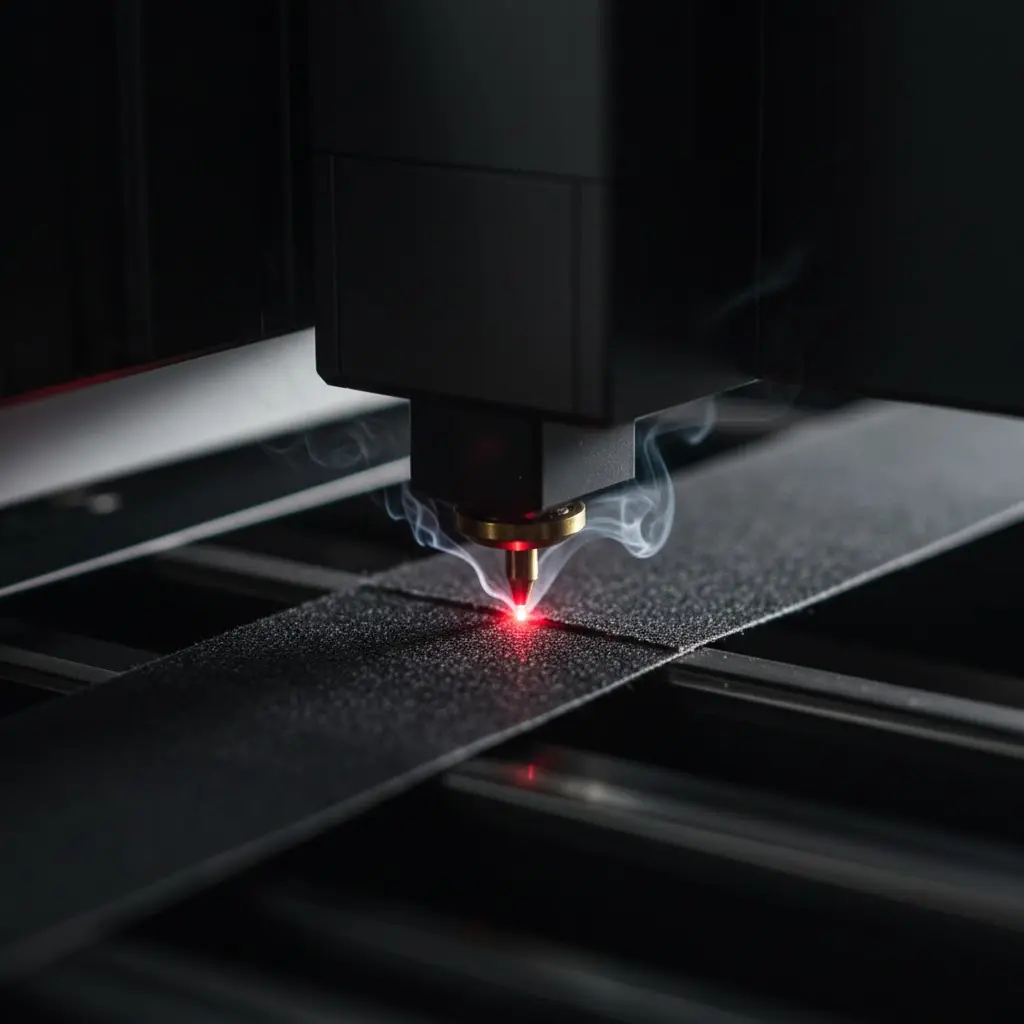
This technology uses high-frequency sound vibrations to cut the fabric. The friction from the vibrations creates just enough heat to seal the edge of the polyester, but—and this is the crucial part—it does so without melting a large bead of plastic. The edge remains soft, pliable, and smooth.
When you rub your thumb over an ultrasonically cut label, you can barely feel where the label ends and the air begins. For intimate apparel, baby clothes, or high-end snapbacks where the label rests against the forehead, this technology is mandatory. It costs slightly more than hot cutting, but the “Itch-Free” guarantee it provides is priceless.
The Fold Matters
How you fold the label changes how it interacts with the skin.
- End Fold: The label is folded down on the left and right sides. This is generally comfortable, but the corners can sometimes poke out if not sewn flat.
- Manhattan Fold: A sophisticated fold where the top edge is folded over, covering the raw edge completely. This creates a very clean, finished look often found on hem tags.
- Center Fold (Loop Label): Common in necklines. If the material is stiff, the “crease” can be sharp. However, with HD Damask, the crease is soft.
- The “Sew-Down” Technique: The ultimate luxury move is to not have a “flapping” label at all. By sewing the label down on all four sides (flat stitch), you eliminate any edges that could curl up or tickle the skin. It also looks incredibly professional, like a patch.
Longevity and Resale Value
We live in the era of the “Resale Economy.” Platforms like Depop, Grailed, and The RealReal have turned fashion into an investment asset. Buyers look for pristine labels to verify authenticity.
A printed label that has cracked or faded reduces the resale value of a garment to near zero. It implies heavy use. A woven label that is bright, legible, and intact signals that the garment still has life left in it. By using high-quality woven labels, you are actually increasing the asset value of your products for your customers. They can buy your $100 jacket knowing that if they resell it in two years, the branding will still be intact.
Conclusion
The difference between a $20 product and a $200 product is often not the fabric, but the finish. Don’t let a $0.10 scratchy tag be the reason a customer rejects your brand. By investing in the “Itch-Free” standard of high-quality woven labels, you are buying customer loyalty, brand longevity, and a reputation for excellence. Would you like me to audit your current label specifications to see if we can improve your softness and durability?