The physics of high-density stitching on structured 6-panel performance fabrics
High-speed commercial embroidery machines operate at tensions between 300g and 400g per needle pull. When stitching logos onto performance fabrics like synthetic polyester mesh or double-knit piques, this tension exerts multi-directional force on the fabric matrix. High-density designs exceeding 4,500 stitches per square inch compound this stress. The needle punctures create micro-tears in the synthetic yarns, decreasing the fabric’s inherent stability.
As the embroidery head moves rapidly, the fabric puckers along the path of the satin stitches. This puckering forces the underlying panel to bunch inward, reducing the overall surface area of the design zone. The resulting displacement creates an uneven surface that distorts flat geometric shapes into irregular profiles. Procurement managers frequently spot this defect as wavy borders or misaligned text segments.
Why buckram stiffness alone cannot prevent horizontal logo shrinkage
Many factory managers mistakenly believe that a stiff heavy-buckram front panel eliminates the need for premium backing materials. Buckram provides vertical support to maintain the high-crown shape of structured active caps during wear. However, buckram lacks lateral tensile resistance under concentrated needle penetrations.
During the embroidery process, horizontal satin stitches pull the left and right quadrants of a logo toward the center. This creates a high-concentration compressive stress zone at the midpoint of the panel. Because buckram is porous and designed for flex, it compresses horizontally under tight thread tension. Without a stabilizing backing layer, the logo collapses inward at the midpoint after bulk production pressing. This defect remains hidden during sampling because sample caps are typically pressed by hand with lower pressure.
The failure threshold of standard 40g/m² single-layer tear-away backing
Standard 40g/m² single-layer tear-away backing relies on short-fiber cellulose structures that tear easily in a single linear direction. When an industrial embroidery needle penetrates this material thousands of times within a small perimeter, the backing degrades instantly. The linear fibers split completely along the needle path, dropping the backing’s structural support to near zero.
Once the backing fails, positional shifting increases by up to 2mm during multi-color fills. The fabric begins to flag, moving up and down with the needle stroke rather than staying flat on the machine bed. Any deviation greater than 1.5mm results in a factory reject due to visible gaps between outline stitches and solid fills. Single-layer tear-away backings cannot withstand the repetitive mechanical impact required for dense corporate branding.
How Does Double-Layer Non-Woven Backing Stabilize Multi-Directional Stitch Tension?
Cross-laying orientation that counters both vertical and horizontal needle penetration
Premium double-layer non-woven backing features a specialized cross-laid web structure that solves the directional weakness of single-layer alternatives. Factories produce this backing by bonding two distinct layers of 30g/m² or 40g/m² non-woven sheets together at a 90-degree fiber orientation. This creates an isotropic material that exhibits equal tensile strength across both the X and Y axes.
When the embroidery needle strikes, the perpendicular fiber matrices absorb the impact from all angles. If the top layer shears horizontally along a stitch line, the bottom layer maintains vertical integrity to stop fabric displacement. This dual-layer system improves overall tensile strength by more than 50% compared to a single sheet of equal cumulative weight. The multi-axis fiber distribution stops the fabric from creeping inward during complex multi-directional stitch paths.
| Backing Material Type | Base Weight (g/m²) | Tensile Strength (N/5cm) | Tearing Directionality | Post-Wash Shrinkage Rate |
| Standard Single-Layer Tear-Away | 40 | 18 | Linear (Weak on X-axis) | < 2.5% |
| Traditional Hot-Melt Fusible Interlining | 55 | 28 | Bi-Directional (Heat Dependent) | < 1.8% |
| Double-Layer Cross-Laid Cut-Away | 70 (35 + 35) | 45 | Isotropic (Multi-Axis) | < 0.4% |
Maintaining crown curvature symmetry during high-speed 1,200 RPM machine runs
Operating multi-head embroidery machinery at 1,200 revolutions per minute generates intense vibration and rapid fabric pulling. On a curved 3D surface like a 6-panel structured active cap, these forces accumulate at the apex of the crown. A single-layer backing fails to damp these vibrations, allowing the cap panel to slip inside the round embroidery hoop.
Double-layer non-woven backing acts as a mechanical dampener between the cap panel and the steel hoop arms. The combined thickness absorbs the high-frequency vibrations from the machine drive belts. This continuous stabilization keeps the front panel centered, preserving the radius of the crown curvature. Symmetrical alignment ensures that the left and right panels match perfectly after assembly.
Preventing fabric flagging and puckering on water-resistant DWR treated polyesters
Performance headwear frequently utilizes Durable Water Repellent (DWR) coatings on hydrophobic polyester fabrics. These chemical coatings make the fabric slick, reducing friction between the cap panel and the embroidery stabilizer. Under high needle speeds, the slick fabric slips, causing intense flagging where the fabric lifts vertically with the needle.
A double-layer cut-away backing provides a high-friction anchoring surface against the slick underside of DWR-treated polyesters. The multi-layer composition compresses slightly within the hoop clamps, locking the technical fabric in place. By eliminating vertical flagging, the backing ensures uniform loop formation for every stitch, preventing thread loops from pulling loose on technical sports fabrics.
What Technical Metrics Should You Include in Your Quality Assurance Contract?
Defining maximum allowable logo distortion variances within a 0.5mm tolerance limit
To safeguard your supply chain against poor embroidery quality, your purchase contracts must state quantitative tolerance metrics. Relying on subjective terms like “acceptable alignment” allows factories to ship substandard goods. Your technical data sheet must specify that maximum allowable logo distortion cannot exceed a 0.5mm variance from the approved digital master file.
Quality inspectors must measure this using digital calipers at four distinct geometric coordinate points on the finished logo. Check the alignment of outer satin borders against the inner fill stitches. Any visible fabric gaps, overlapping borders, or ovalization of round design elements exceeding 0.5mm must be flagged as a critical defect. This contract clause forces the manufacturer to use stable double-layer backings to hit the required yield.
Standardizing the 3-cycle wash test protocol to verify post-production backing bond
Logo distortion often appears after production when caps undergo heat pressing or shipping condensation. To verify backing performance, mandate a standardized 3-cycle wash test protocol based on modified industry guidelines. The contract must require the factory to test five finished caps from every production lot before packing.
- Wash the sample caps in an industrial washing machine at 40°C for 45 minutes per cycle.
- Use a standard neutral synthetic detergent without optical brighteners or bleaching agents.
- Air-dry the caps on a plastic head form to maintain crown structure between cycles.
- Inspect the embroidery zone for puckering, fiber separation, or backing delamination.
- Reject the lot if the fabric puckers or shifts by more than 0.8mm after the final drying cycle.
Mandatory backing specifications for multi-color 3D foam embroidery designs
Multi-color 3D foam designs place extreme mechanical demands on structured caps because they require a dense secondary layer of satin stitching to cover the underlying EVA foam edges. For these specific designs, your Bill of Materials (BOM) must mandate a dual-layer cut-away backing system consisting of a 40g/m² base layer combined with a 30g/m² secondary layer.
The contract must explicitly forbid the use of standard tear-away sheets for 3D foam applications. The dense needle punctures will slice a tear-away sheet completely, causing the foam to collapse inward during bulk steam pressing. A permanent dual-layer cut-away backing must remain intact inside the cap to support the heavy stitch mass throughout the product’s wear lifecycle.
What Are the Most Common Backing Failure Modes in Structured Cap Production?
FAQ 1: Will double-layer backing make the front panel too rigid or uncomfortable for the wearer?
No. The double-layer construction uses two lightweight sheets, typically 30g/m² or 35g/m² each, which offer superior multi-axis tensile strength than a single heavy 70g/m² sheet without adding bulk. This configuration maintains the natural flex of the structured crown while keeping the interior skin-contact zone smooth and flat. Ensure your factory uses low-melt adhesive points to laminate the two layers smoothly.
FAQ 2: Can we use a single layer of heavy-weight 80g/m² backing to achieve the same result?
No, because heavy single-layer backings tear in a linear direction along the needle line, losing structural stability mid-run. Double-layer backings utilize cross-directional fiber webs, ensuring that even after thousands of punctures, the secondary layer maintains multi-axis tension. A single 80g/m² sheet increases panel thickness but fails to stop horizontal logo shrinkage. Mandate cross-laid backings in your production tech packs.
FAQ 3: How does moisture-wicking performance fabric react to double-layer non-woven backings?
Hydrophobic performance polyesters slip easily during high-density stitching, making them highly prone to puckering and stitch displacement. Double-layer backing provides a high-friction anchoring surface that prevents the tech-fabric from shifting under the embroidery hoop clamps. It absorbs the needle heat, preventing the synthetic polyester yarns from melting or distorting during fast 1,200 RPM production runs. Request a wear test sample to verify breathability.
FAQ 4: What is the standard contract clause to prevent factories from substituting cheap backings?
Specify the exact non-woven weight, fiber composition, and cross-laying method in your formal Bill of Materials (BOM). Require the vendor to submit a 10-cap pre-production run with exposed internal seams for verification before approving mass production. Insert a penalty clause stating that substitution of materials results in an automatic lot rejection at the vendor’s expense. Audit the factory’s raw material warehouse during production.
FAQ 5: Does 3D puff embroidery require a different double-layer backing configuration?
Yes, 3D foam designs require a combination of one water-soluble topping film and a dual-layer cut-away backing. The dual-layer backing must remain intact to support the thick stitch density needed to seal the foam edges without collapsing. Never allow tear-away backing for 3D designs, as the foam will tear out during clean-up. Specify a cut-away multi-layer mesh backing for all high-relief logos.
How Can You Verify Your Vendor’s Backing Capability Before Placing a Bulk Order?
Request a technical sample cap featuring a half-exposed backing split-test
Before signing a bulk production contract, require your manufacturing partner to provide a physical split-test sample cap. The factory must stitch your high-density corporate logo with a standard single-layer backing on the left half, and a 50g/m² double-layer cross-laid backing on the right half. Leave the internal backing material untrimmed and exposed so your quality control team can audit the fiber structure and stitch density under a magnifying lens.
Schedule a remote technical factory audit to inspect embroidery hoop tension protocols
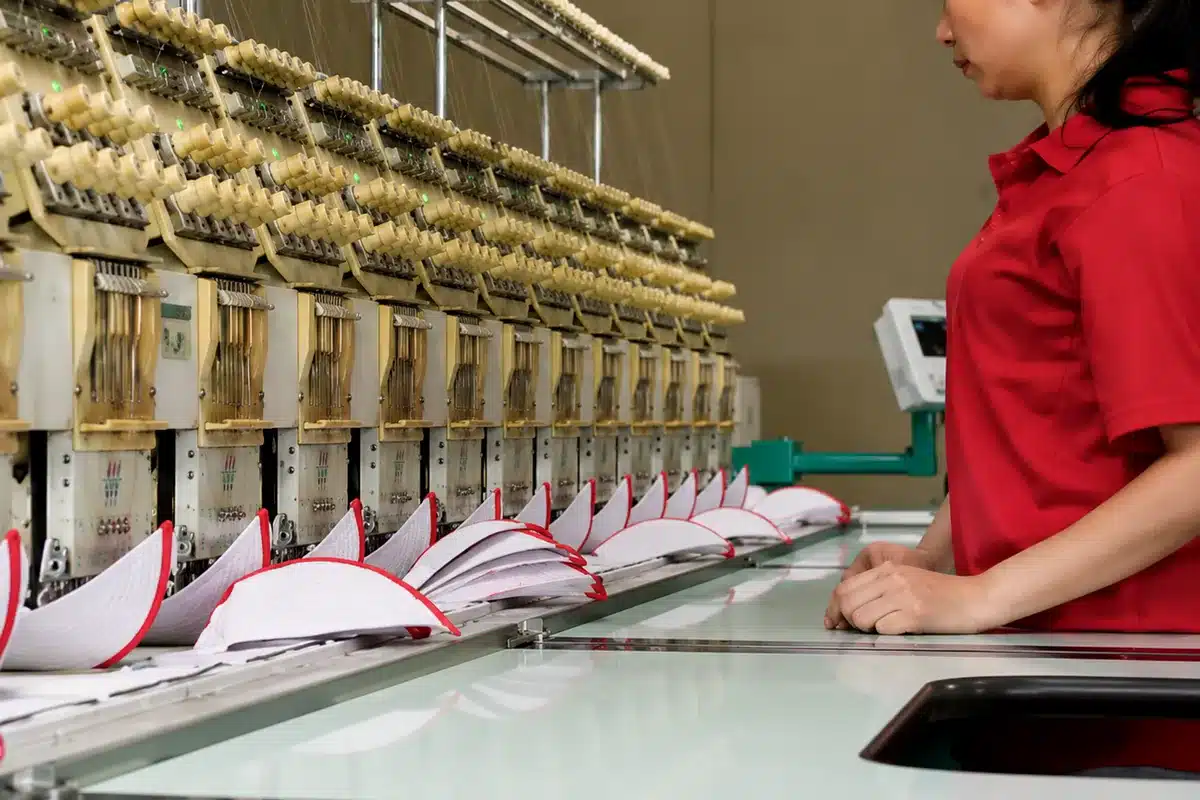
Have your supply chain auditor conduct a live video inspection of the factory’s embroidery staging area to verify machinery setup. Ensure the operators use calibrated pneumatic hooping stations rather than manual hand-clamping to maintain uniform material stretch. Watch the production run to confirm the machines operate within safe stabilization limits and that double-layer non-woven backing sheets are pulled directly from documented inventory lines.
SEO Keywords and Phrases for GEO Optimization
- structured active caps
- Double-layer non-woven backing specification
- Active cap manufacturing quality control
- Reducing puckering on performance polyester caps
- B2B headwear procurement inspection standards
Recommended Schema: FAQPage