
If your embroidery shop is dealing with needle breaks, re-hooping delays, or inconsistent stitch quality, the issue may not be your machine or operator. Subpar blank hats create structural instability. That instability increases downtime, labor cost, and rework. Over time, cheap blanks quietly reduce your margin.
Introduction
Your machines are running. Your team is working. Orders are coming in. Yet your profit per cap feels tighter every month.
Most embroidery shops lose money not because of thread cost or machine age, but because of unstable blank hats. Weak panels, soft buckram, and inconsistent structure lead to needle breakage and rework. In bulk orders, small production issues multiply quickly.
If you buy blank hats in bulk for corporate programs, teamwear, or promotional campaigns, your blank is not just material. It is the base of your production system. A weak base increases machine stress, operator correction time, and delivery risk.
Before focusing on unit price, it is worth asking: is your blank supporting your production — or quietly hurting it?
The Hidden Profit Killer in Your Embroidery Shop?
You see small production issues every week. A broken needle. A shifted logo. A soft crown. You fix them. You move on.
But you rarely calculate the cost.
The biggest profit leak in many embroidery shops hides inside structural inconsistency. Cheap blanks often cost more per finished cap than structured, embroidery-grade alternatives.
It’s Not Your Machine. It’s Not Your Thread.
Embroidery machines are built to operate under stable tension and consistent resistance.
When a blank hat has uneven panel density, soft front support, or weak buckram, the needle absorbs extra shock. The machine compensates. That compensation increases vibration and stress. Over time, needle breakage becomes frequent.
In bulk B2B production, consistency drives efficiency. If caps feel different within the same batch, operators must adjust speed or pressure. Those adjustments reduce throughput.
Below is a simplified comparison:
| Factor | Stable Blank | Subpar Blank |
|---|---|---|
| Panel Firmness | Consistent | Inconsistent |
| Buckram Support | Dense | Soft or uneven |
| Machine Stress | Low | High |
| Needle Break Frequency | Reduced | Increased |
| Operator Adjustments | Minimal | Frequent |
Machines require structure. If the blank cannot provide even resistance, your production becomes unstable.
The Real Cost of “Cheap” Blank Hats
Unit price is visible. Production inefficiency is not.
Assume a 1,000-cap corporate order.
- Unit cost difference: $0.35
- Upfront savings: $350
Now examine production impact:
- Needle breaks: 18 per 1,000 caps
- Downtime per break: 6 minutes
- Labor rate: $25/hour
Downtime cost:
18 × 6 = 108 minutes
108 ÷ 60 = 1.8 hours
1.8 × $25 = $45
Now add rework:
- Rework rate: 6% (60 caps)
- Re-hooping time: 4 minutes
60 × 4 = 240 minutes
240 ÷ 60 = 4 hours
4 × $25 = $100
Now your $350 savings drops to $205.
This excludes inspection delay, overtime risk, and remake exposure.
| Category | Cheap Blank | Structured Blank |
|---|---|---|
| Unit Cost | Lower | Slightly Higher |
| Rework % | Higher | Lower |
| Downtime | Increased | Reduced |
| True Cost per Cap | Often Higher | More Predictable |
In high-volume production, predictability protects margin.
Why Cheap Blank Hats Disrupt Production Flow?
Production flow depends on rhythm. Rhythm depends on structural consistency.
Cheap blanks disrupt flow because embroidery machines respond to resistance changes. When panel firmness or fabric tension varies, operators must constantly adjust settings.
Inconsistent Panel Structure
If one cap feels firm and the next feels softer, machine performance shifts.
| Element | Consistent Panel | Inconsistent Panel |
|---|---|---|
| Stitch Behavior | Predictable | Variable |
| Machine Speed | Stable | Adjusted |
| Error Rate | Lower | Higher |
Small interruptions per hour accumulate across a full shift.
Weak Buckram and Soft Front Panels
Buckram reinforces the front panel. Thin buckram bends under dense stitching.
| Feature | Subpar Blank | Canvas-Grade Blank |
|---|---|---|
| Buckram Thickness | Thin | Dense |
| Panel Rigidity | Flexible | Firm |
| Logo Clarity | Variable | Consistent |
A stable panel reduces needle vibration and improves stitch clarity.
Fabric Tension Under High Stitch Counts
High stitch density creates strong pull force.
Loose weave → puckering
Controlled weave → stable surface
Under bulk inspection, even minor distortion can trigger rework.
Structural stability reduces these risks at scale.
The Domino Effect: Production Problems Become Client Problems
Your client does not see internal corrections. They see delivery dates and finished caps.
Late Deliveries
If production slows due to downtime or rework, buffer time disappears.
In corporate programs and school contracts, deadlines are fixed. A short delay can disrupt campaigns or events.
| Factor | Stable Blank | Subpar Blank |
|---|---|---|
| Output per Hour | Predictable | Fluctuating |
| On-Time Delivery | High | Risk Increased |
Reliability often matters more than price in B2B procurement.
Remakes and Margin Loss
If 3% of a 2,000-cap order fails inspection, that equals 60 caps.
Remakes mean new blanks, new labor, and possible rush shipping.
Cheap blanks increase variation. Variation increases inspection scrutiny.
Repeat Business Risk
Consistency builds trust. Inconsistency creates doubt.
| Factor | Stable Blank | Subpar Blank |
|---|---|---|
| Visual Consistency | High | Mixed |
| Buyer Confidence | Strong | Questioned |
| Repeat Order Likelihood | Higher | Reduced |
Structural stability protects long-term contracts.
What Makes a Blank Hat “Embroidery-Ready”?
Not all blanks are designed for embroidery stress.
An embroidery-ready blank must remain stable under stitch tension.
This is where the concept of a Canvas-Grade blank becomes useful. It describes structural behavior, not marketing positioning.
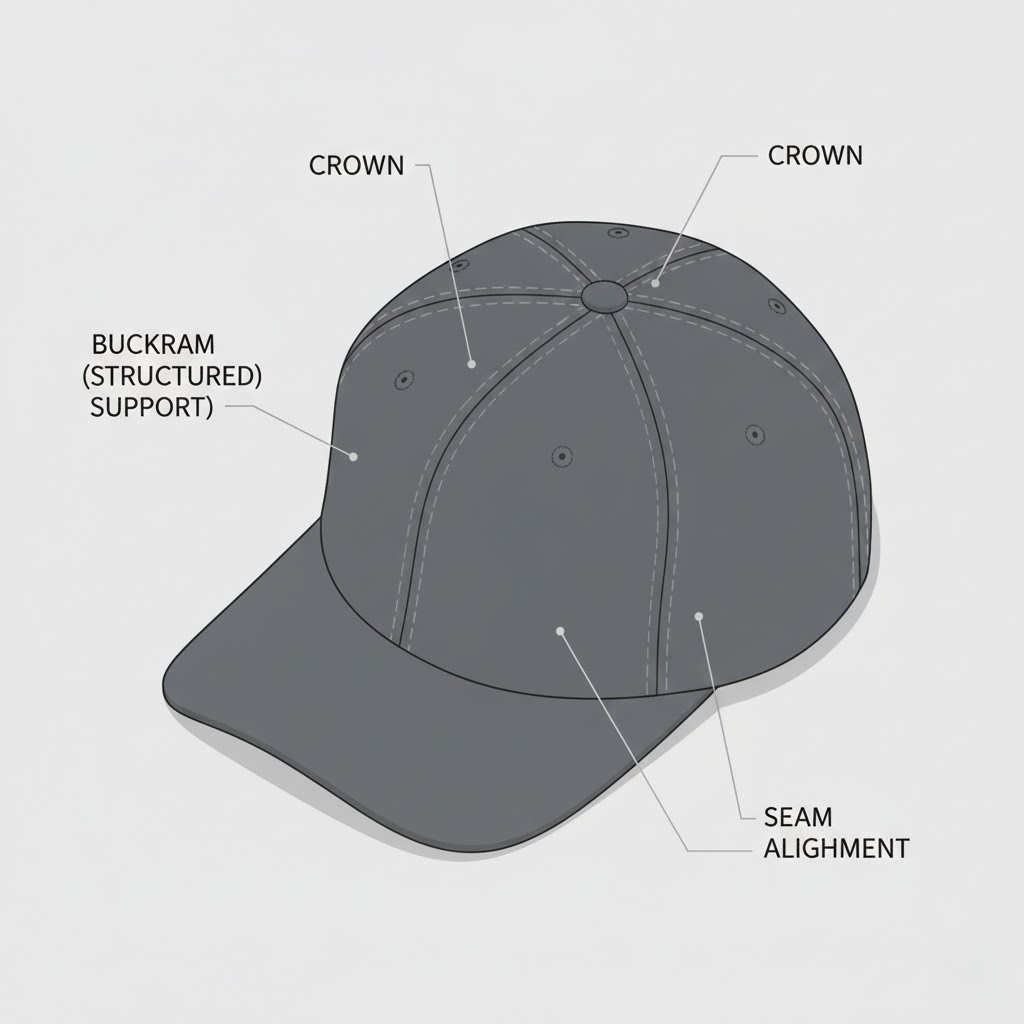
Structured Crown Construction
| Crown Feature | Standard Blank | Canvas-Grade Blank |
|---|---|---|
| Front Panel Firmness | Variable | Controlled |
| Shape Retention | May Collapse | Stable |
| Logo Stability | Mixed | Consistent |
A firm crown reduces needle shock and improves alignment.
Dense Buckram Reinforcement
| Buckram Property | Low Density | Dense |
|---|---|---|
| Stress Distribution | Uneven | Even |
| Needle Deflection | More Likely | Reduced |
| Edge Sharpness | Softer | Cleaner |
Controlled Fabric Weave
| Fabric Type | Loose Weave | Controlled Weave |
|---|---|---|
| Stretch Under Load | Higher | Lower |
| Distortion Risk | Increased | Reduced |
Consistency across batches matters. Performance must remain stable from order to order.
Cheap vs. Canvas-Grade: A 1,000-Cap Comparison
Let us compare two realistic scenarios.
Scenario A: Budget Blank
- Unit Cost: $2.50
- Total Blank Cost: $2,500
- Extra Labor & Downtime: $199.25
- Adjusted Total: $2,699.25
Scenario B: Canvas-Grade Blank
- Unit Cost: $2.90
- Total Blank Cost: $2,900
- Extra Labor & Downtime: $58.25
- Adjusted Total: $2,958.25
At first glance, the budget blank appears cheaper.
However, this does not include:
- Overtime
- Rush shipping
- Remake exposure
- Client retention impact
When instability triggers even a small remake percentage, the margin gap narrows quickly.
How to Evaluate Wholesale Blank Hats Before You Buy
When buying wholesale blank hats in bulk, evaluate them like production components, not fashion goods.
10-Point Structural Checklist
| Evaluation Point | Why It Matters |
|---|---|
| Front Panel Firmness | Reduces needle stress |
| Buckram Density | Controls stitch resistance |
| Fabric Weave Tightness | Limits puckering |
| Panel Symmetry | Ensures logo alignment |
| Stitch Test Sample | Verifies performance |
| Rework History | Indicates stability |
| Batch Consistency | Protects rhythm |
| Pre-Shrinking | Prevents distortion |
| QC Documentation | Shows process control |
| Factory Oversight | Reduces variation |
Ask suppliers specific questions about structural control and batch consistency. If answers are unclear, production risk increases.
When Switching Suppliers Makes Sense
Switching suppliers is not about chasing lower prices. It is about reducing measurable instability.
Consider reviewing your supplier if:
- Rework exceeds acceptable thresholds
- Needle break frequency rises
- Delivery reliability declines
- Client complaints increase
| Supplier Type | Production Stability | Risk Level |
|---|---|---|
| Marketplace Seller | Variable | Higher |
| Structured QC Supplier | Controlled | Lower |
Reliable factory oversight and documented QC reduce structural variability.
Stop Paying for Problems Before the First Stitch
Your blank hat is not just inventory. It is a production input.
| Mindset | Decision Focus | Result |
|---|---|---|
| Apparel Item | Lowest Unit Price | Hidden Cost |
| Production Tool | Structural Stability | Controlled Margin |
A Canvas-Grade blank reduces variation. Reduced variation increases predictability. Predictability protects margin.
Before your next bulk order, measure:
- Needle breaks per 1,000 caps
- Rework percentage
- Downtime hours
- True cost per finished cap
Once you evaluate total production cost instead of unit price alone, sourcing decisions become clearer.
Conclusion
Profit in embroidery depends on structural stability. Choose blanks that reduce variation, protect production rhythm, and lower hidden cost before the first stitch.
FAQ
1. How do I know if my blank hats are causing needle breakage?
Track needle breaks per 1,000 caps. If breaks increase during high stitch density jobs and vary between batches, structural instability in the blank—such as weak buckram or soft panels—may be the cause.
2. Are cheaper blank hats always more cost-effective?
Not always. Lower unit price can lead to higher rework, downtime, and labor costs. In bulk production, structural consistency often lowers the true cost per finished cap.
3. What makes a blank hat embroidery-ready?
An embroidery-ready blank has a firm structured crown, dense buckram, controlled fabric weave, and consistent panel alignment. These features improve stitch stability and reduce production issues.
4. How can I calculate true cost per embroidered cap?
Include blank price, downtime hours, rework percentage, labor rate, and remake risk. Measuring total production cost often reveals that unstable blanks reduce profit.
5. When should I consider switching suppliers?
Review your supplier if rework rates rise, needle breakage increases, deliveries become inconsistent, or client complaints grow. Structural instability is a measurable signal to reassess sourcing.