
Are late deliveries or inconsistent hat quality starting to impact your sales?
For most B2B buyers, these issues don’t just cause frustration.
They delay launches, complicate inventory planning, and create unnecessary pressure across teams.
In many hat sourcing projects, problems don’t begin on the production line.
They usually start earlier — with raw material volatility, unclear design details,or misalignment during the sampling stage.
From reviewing a wide range of hat sourcing projects, one pattern shows up again and again:
when orders run late or quality slips, it’s rarely a single factory error.
More often, the issue traces back to early assumptions that didn’t hold up once production started.
Buyers who spot these risks early tend to keep timelines more stable and avoid last-minute compromises on quality or stock availability.
If you’re sourcing hats at scale, understanding what happens before production starts is often more important than reacting after the goods reach your warehouse.
Why Headwear Quality Often Starts with Raw Fibers
Is your supplier blaming “market conditions” for rising prices or inconsistent quality?
For B2B buyers, this kind of uncertainty doesn’t just squeeze margins.
It makes it harder to commit to delivery timelines and maintain consistent product standards for retail or wholesale partners.
In most headwear supply chains, material risk begins far upstream — at cotton farms, chemical producers, and fiber processing facilities.
When cotton prices spike or polyester output slows, the pressure moves quickly through the entire chain.
That’s why raw fiber decisions often matter more than buyers expect.
Cotton Isn’t Just “Cotton” — And Synthetics Aren’t Risk-Free Either
Many buyers assume cotton quality is largely interchangeable.
In practice, fiber grade directly affects color absorption, durability, and post-wash performance.
With premium cotton prices fluctuating heavily, some factories switch to lower-grade fibers to control costs.
The result can be hats that shrink, fade, or lose structure — issues that directly undermine brand credibility in B2B channels.
To manage cost pressure, many brands shift toward polyester or blended fabrics.
While this can improve price stability, synthetics introduce their own risks.
Because polyester is petroleum-based, pricing often tracks energy markets.
Lead times can also stretch when synthetic fibers are imported or routed through congested shipping lanes.
Material selection, at scale, is always a balance between cost control and supply reliability.
How Material Choice Affects Lead Time and Risk
The table below highlights how common headwear materials influence pricing stability, production timing, and long-term performance.
| Material Type | Price Stability | Lead Time Risk | Durability Impact |
|---|---|---|---|
| Premium Cotton | Low (Volatile) | Medium | High |
| Standard Polyester | Medium | Low | High |
| Recycled Fabrics | Low | High | Medium |
| Organic Cotton | Very Low | Very High | High |
For buyers seeking more predictable timelines, one key question is whether fabric is stocked before orders are placed.
When materials are sourced only after confirmation, production schedules become highly exposed to market swings.
Many extended delays often trace back to this moment — not the sewing line.
The Hidden Costs of Poor Material Decisions
Material risk doesn’t stop at lead time.
Fabrics that are too light or inconsistent can cause embroidery distortion, puckering, or uneven stitching — making an otherwise acceptable hat look cheap.
Before locking in bulk orders, buyers often protect themselves by confirming fabric specifications, including weight measurements such as GSM.
This helps ensure consistency across production runs and reduces the chance of quality surprises later.
Is Your Design Tech Pack Creating “Sample Hell”?
Do you feel stuck in a loop of sending samples back and forth?
For many B2B buyers, repeated sampling doesn’t just slow things down.
It quietly pushes launch dates back and locks teams into weeks — sometimes months — of avoidable revisions.
In most headwear projects, this problem lives in the gap between a digital mockup and a physical hat.
When design specifications aren’t clear, factories are forced to interpret intent.
And once guessing enters the process, delays and rework usually follow.
Why “Simple” Hat Designs Often Break Down in Production
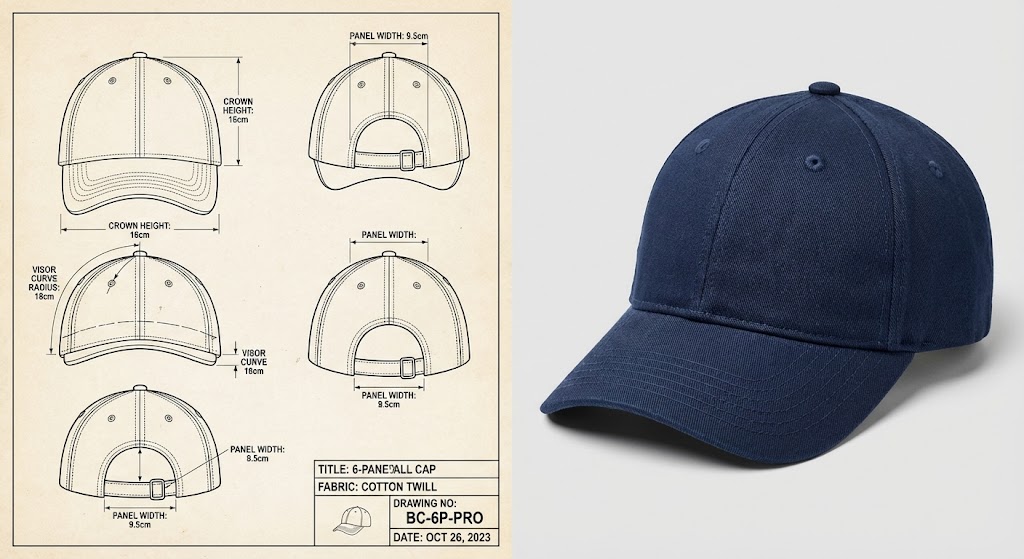
Buyers often describe their product as “just a basic baseball cap.”
In reality, a hat is a three-dimensional product with multiple variables — crown height, brim curve, panel shape, and internal taping all affect the final result.
When these details aren’t fully defined in the tech pack, the first sample is rarely correct.
That’s how “sample hell” starts:
three weeks for a sample, a small issue appears, another three weeks for adjustment — repeated several times.
Clear documentation doesn’t eliminate all revisions, but it significantly reduces unnecessary back-and-forth.
How Tech Pack Detail Impacts Sampling Cycles
The table below illustrates how different levels of design definition affect sampling outcomes.
| Design Approach | Sampling Cycles | Revision Risk | Time to Approval |
|---|---|---|---|
| Basic Mockup Only | High | High | Long |
| Partial Tech Pack | Medium | Medium | Unstable |
| Detailed Tech Pack | Low | Low | Predictable |
For buyers working on custom headwear, clarity functions like a blueprint.
The more precise the documentation, the less room there is for interpretation — and delay.
The “One Size Fits All” Assumption
Many B2B buyers try to simplify production by choosing a single size.
In practice, “one size fits all” often creates fit complaints and higher return rates.
Head shape and sizing expectations vary by region and customer group.
A cap that fits well for one market may feel tight or shallow in another.
| Feature | Standard “One Size” | Graded Sizing |
|---|---|---|
| Fit Range | 56–58 cm | 54–62 cm |
| Customer Comfort | Average | High |
| Return Risk | Higher | Lower |
| Production Complexity | Lower | Slightly Higher |
Sizing decisions may seem minor, but they directly affect customer experience and brand perception.
Digital Color vs. Physical Reality
Another common friction point is color.
Colors displayed on screens often shift once applied to fabric.
Using standardized color references, such as Pantone, reduces ambiguity and helps ensure consistency across sampling and bulk production.
For buyers, this isn’t about perfection — it’s about predictability.
Where Manufacturing Bottlenecks Often Hide
Do your lead times stretch unpredictably during certain months of the year?
For many B2B buyers, these delays aren’t caused by shipping or raw materials —
they come from bottlenecks inside the factory itself.
Headwear production is far more specialized than basic apparel.
When capacity is tight, these internal limits become visible very quickly.
Why Hat Production Has Hard Capacity Limits
Unlike T-shirts, hats require dedicated machinery and highly trained operators.
A single six-panel cap depends on precise alignment.
If even one panel is off, the hat appears crooked — making skilled labor essential.
Training experienced cap sewers takes time, and many manufacturing regions are facing shortages.
When a factory loses its most skilled operators, quality degradation often happens immediately, not gradually.
The same applies to equipment.
Blocking machines shape the hat; taping machines finish the internal seams.
Factories without sufficient backup capacity are vulnerable to stoppages when equipment goes down.
Understanding these constraints helps buyers plan orders around realistic factory capacity, not optimistic schedules.
How Factory Structure Affects Your Lead Time
Industry consolidation has added another layer of risk.
A small number of large factories now handle a significant share of global headwear volume.
When major sports or lifestyle brands place large seasonal orders, smaller B2B programs are often deprioritized.
That’s how a quoted 30-day lead time quietly turns into 60 or 90 days.
| Bottleneck Factor | Impact on Orders | Buyer-Controlled Mitigation |
|---|---|---|
| Skilled Labor Shortage | Inconsistent quality, rework | Plan earlier, avoid peak periods |
| Machine Downtime | Full production stoppage | Confirm backup equipment capacity |
| Peak Season | 30–60 day extensions | Place orders well in advance |
| Major Events (e.g. World Cup) | Price spikes, limited slots | Reserve capacity early |
These delays are rarely caused by a single failure —
they emerge when multiple constraints stack up at the same time.
Secondary Processes Are Often the Hidden Delay
Sewing is only part of the timeline.
Embroidery, screen printing, or patch application often take place off-site.
When these secondary vendors are backed up, finished hats can sit idle for weeks.
Factories that manage these processes in-house typically move faster,
simply because fewer handoffs mean fewer scheduling conflicts.
For buyers, asking where and how these steps are handled can reveal potential delays long before they happen.
Why Some Buyers Move Faster Than Others
Being prioritized doesn’t always mean being the largest customer.
Factories tend to favor programs that are predictable —
clear specifications, timely approvals, and consistent payment behavior reduce friction.
Over time, this operational reliability often matters as much as order size when capacity is tight.
Can Small Hardware Components Disrupt an Entire Order?
Can a missing plastic snap or metal buckle really delay a five-figure order?
For many B2B buyers, hardware components are treated as minor details.
In practice, they are often single points of failure.
A hat isn’t finished until every component is available — brim, top button, and closure.
These parts frequently come from different suppliers.
When one link breaks, final assembly stops.
This is how small items quietly create large supply chain disruptions.
The Hardware Bottleneck Buyers Often Miss
Hat brims are typically made from plastic or reinforced board.
When recycled plastic supply tightens, brim production slows — and without a brim, a hat cannot be completed.
The same applies to metal buckles and plastic snapbacks.
They’re inexpensive individually, but essential to finishing the product.
As more brands adopt eco-friendly hardware — recycled plastics or organic stiffeners — availability becomes less predictable.
These materials support sustainability goals, but they often require longer sourcing and confirmation cycles.
For buyers, hardware choice isn’t just a design decision.
It’s a lead-time decision.
How Hardware and Shipping Choices Affect Your Timeline
Once production is complete, logistics introduce another layer of risk.
Most headwear is manufactured in Asia and shipped to the U.S. or Europe.
Port congestion, container shortages, and routing delays can add weeks — even when production itself is finished.
| Shipping Method | Typical Transit Time | Cost Level | Best Use Case |
|---|---|---|---|
| Sea Freight | 30–45 days | Low | Planned bulk programs |
| Air Freight | 5–10 days | High | Urgent launches or limited drops |
| Rail Freight | 15–25 days | Medium | Regional or mid-volume orders |
Choosing a faster method can recover time, but rarely without cost trade-offs.
Forecasting Risk: The Bullwhip Effect
Small changes in customer demand often lead to amplified ordering decisions upstream.
Over-ordering to “stay safe” can lock capital into excess inventory.
Under-ordering risks missed sales and empty shelves.
Effective forecasting doesn’t eliminate uncertainty,
but it reduces extreme reactions that destabilize the supply chain.
The Hidden Risk of Unapproved Subcontracting
Another overlooked risk is unauthorized subcontracting.
When capacity tightens, some factories quietly outsource overflow orders to secondary workshops.
These “shadow factories” may not meet the same quality, compliance, or ethical standards.
For buyers, visibility into where hardware sourcing and final assembly actually occur
is a key part of protecting brand consistency and reputation.
Conclusion
The headwear supply chain is a complex system shaped by materials, labor capacity, and logistics timing.
Across most projects, delays and quality issues rarely come from a single failure.
They usually trace back to early decisions — material selection, design clarity,factory capacity, or overlooked dependencies further down the chain.
For B2B buyers, long-term reliability isn’t built through one-off transactions.
It comes from understanding where risks tend to surface and planning around them before production is locked in.
Brands that approach sourcing this way tend to make more confident buying decisions, experience fewer surprises, and maintain greater control over timelines and inventory as they scale.
FAQ
Q1: At what stage do most hat sourcing delays actually begin?
Most delays don’t start during sewing or final inspection.
They usually originate earlier — during material selection, sampling, or capacity planning — when assumptions are made before constraints are fully visible.
Q2: Why do small components like snaps or buckles cause such big problems?
Because hats can’t be completed without them.
These parts often come from separate suppliers, and a delay in any one component can stop final assembly entirely.
Q3: Is “one size fits all” really a problem in B2B headwear?
It can be.
Fit expectations vary by region and customer group, and a single-size approach often leads to comfort issues and higher return rates in certain markets.
Q4: Why do lead times change so much during peak seasons?
Headwear production relies on specialized labor and equipment with limited capacity.
During peak periods or major global events, factories prioritize large, long-term programs, which can extend timelines for smaller orders.
Q5: Can eco-friendly materials increase supply chain risk?
They can.
Sustainable options like recycled plastics or organic fibers often have more variable availability, which needs to be factored into planning and lead time expectations.