
In a crowded market, brand visibility doesn’t disappear overnight — it erodes quietly when decorative emblems fail to hold up under real-world use.
Many brands invest heavily in campaigns, uniforms, or event merchandise, only to see low-quality patches fray, fade, or deform after limited wear. The result isn’t just wasted inventory, but lost credibility with customers who notice the details.
This guide walks you through the custom patch manufacturing process — from artwork preparation and material selection to industrial embroidery, backing options, and quality control. It’s written for brands and B2B buyers who need patches that perform consistently across bulk orders, tight timelines, and demanding use cases.
By understanding how professional-grade patches are made, you can make better sourcing decisions, reduce rework risk, and ensure your finished merchandise reflects the same standards you apply to your brand.
1. What starts the design for Custom Patches?
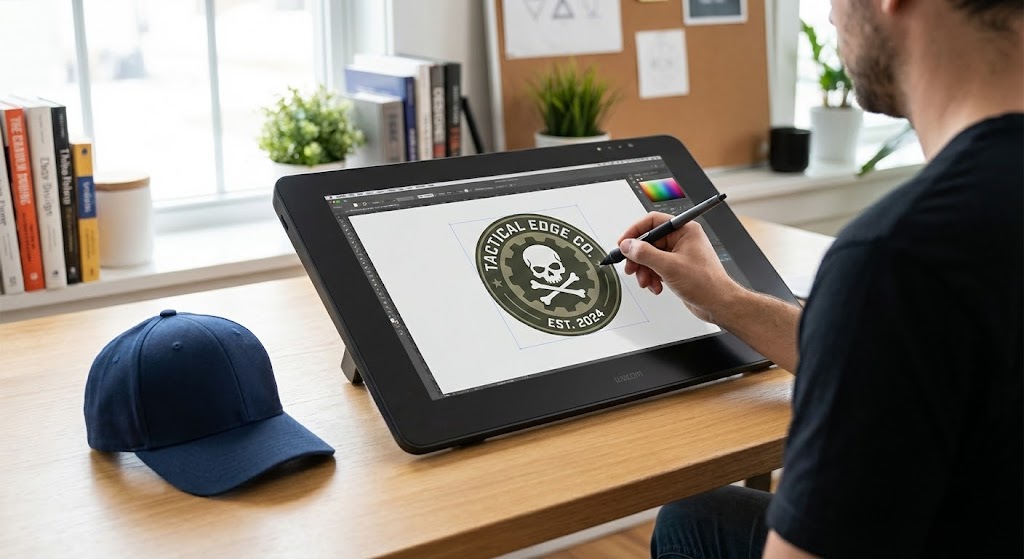
Every custom patch begins with a design decision that quietly determines whether the final product looks professional—or problematic—once it’s stitched at scale.
The first step is translating your brand artwork into production-ready vector files that embroidery machines can actually execute. This isn’t a simple file conversion. Stitch density, color limits, and fabric behavior all affect how your logo will appear when rendered in thread rather than on a screen.
Details like small text, thin outlines, and tight spacing often look acceptable digitally but can blur or break down during embroidery. Experienced technical designers adjust kerning, line weight, and stitch direction to ensure your logo remains legible and consistent across every unit in a bulk run.
How do you refine artwork?
Design refinement is where many patch issues are either prevented—or locked in. Professional designers convert initial concepts into digitized embroidery files using industry-standard software that controls stitch paths, tension, and layering.
These files act as precise blueprints, telling each needle exactly where to land and how the thread should behave on different base fabrics such as heavy twill or structured canvas. Proper digitizing minimizes thread distortion, reduces production errors, and ensures your approved design looks the same on the first patch as it does on the thousandth.
Key design checks typically include:
- Vector graphics scaling
- Stitch density analysis
- Pantone color matching
- Line weight calibration
| Design Phase | Critical Requirement | Expected Outcome |
|---|---|---|
| Concept | Vector Graphics | Scalable Artwork |
| Digitizing | Path Mapping | Stitch File |
| Proofing | Visual Mockup | Client Approval |
Key Takeaway
Professional design translation is the foundation of reliable patch production. A precise digital blueprint directly determines stitch accuracy, visual clarity, and consistency throughout the entire manufacturing process.
2. Which materials build quality Custom Patches?
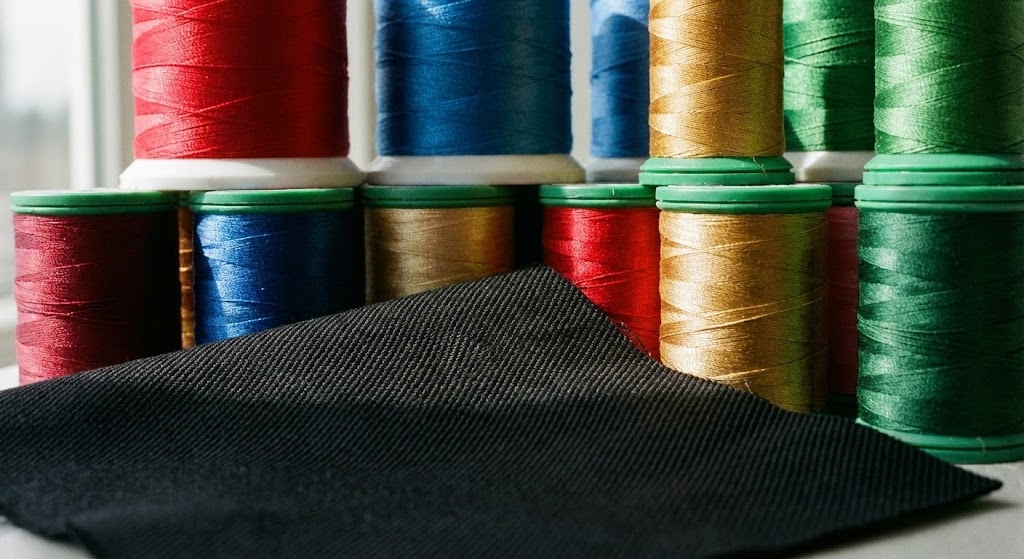
Material selection is one of the earliest points where patch quality is either protected—or compromised—long before production begins.
In high-volume embroidery, the base fabric must remain stable under thousands of needle penetrations at high speed. This is why most professional custom patches are built on high-denier polyester twill, a material engineered to resist puckering, edge distortion, and fraying during production and repeated washing.
For corporate uniforms, workwear, and promotional programs, heavy-duty twill provides the structural consistency needed to keep patches flat, readable, and visually aligned across large batch runs. Poor material choices often don’t fail immediately—they show up later as warped shapes, loose edges, or uneven stitching.
Why Do Industrial Threads Matter?
Thread performance directly affects both appearance and durability. While rayon threads are often selected for their smooth sheen and vibrant color, high-tensile polyester threads are preferred in industrial production environments where machines operate at extreme speeds.
Polyester threads resist breakage, chemical exposure, and UV fading far better than standard decorative yarns, reducing machine downtime and preventing color loss after laundering. In certain designs, metallic or specialty threads can be introduced selectively to add visual emphasis—without sacrificing structural integrity or driving costs beyond reasonable B2B budgets.
Common material components include:
- Polyester twill base
- Rayon embroidery thread
- Buckram stiffening layer
- High-denier fabric construction
| Material Type | Primary Benefit | Best Use Case |
|---|---|---|
| Polyester Twill | Durability | Workwear Patches |
| Rayon Thread | High Sheen | Fashion Apparel |
| Buckram | Structural Stiffness | Structured Hats |
Key Takeaway
High-performance materials are the backbone of reliable patch production. Fabric density and thread composition directly influence durability, wash resistance, and long-term appearance—especially in demanding or high-use environments.
3. How does digitizing help Custom Patches?
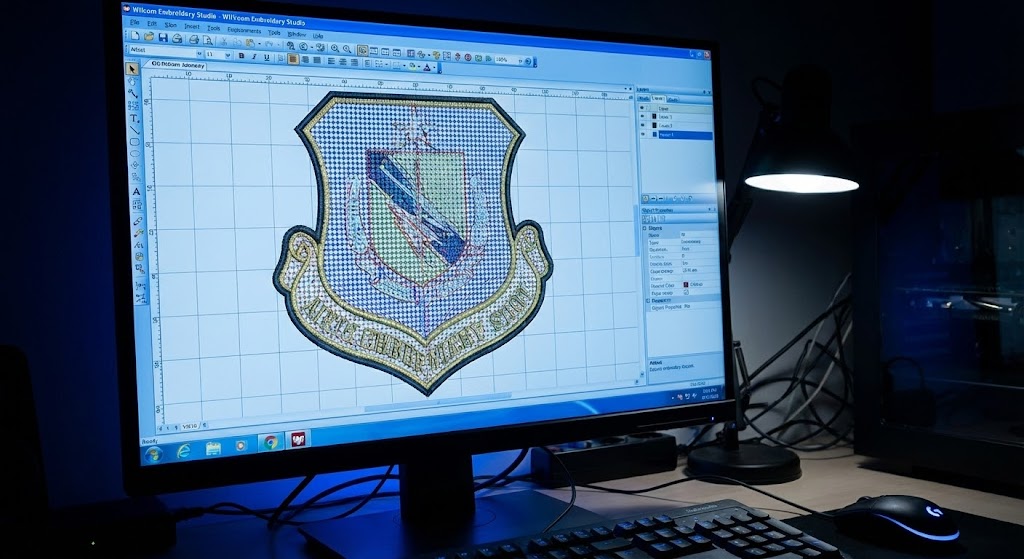
Digitizing is where artwork officially becomes a production instruction set—and where many patch failures either get prevented or permanently locked in.
This process converts vector artwork into coordinate-based stitch paths that control needle movement, stitch type, and thread tension during embroidery. It determines not only how your patch looks, but how it behaves once stitched at scale.
Experienced digitizers manually assign stitch direction and sequence to each design element. This prevents common production issues such as thread nesting, uneven fill, and unnecessary thread jumps—problems that frequently appear in poorly digitized files during high-volume runs.Can Machine Logic Improve Efficiency Without Sacrificing Quality?
Can Machine Logic Improve Efficiency Without Sacrificing Quality?
Modern digitizing software can optimize stitching order and pathing logic, reducing production time while maintaining visual accuracy. However, automation alone isn’t enough.
Thread density settings directly affect flexibility and comfort. Designs that are over-densified may appear solid on screen but become stiff, heavy, or uncomfortable once applied to garments or bags. Skilled digitizing balances density, texture, and compensation so gradients remain smooth without compromising durability or wearability.
Every parameter inside a digitized file—from stitch overlap to pull compensation—directly impacts final texture, sizing accuracy, and long-term performance.
Key digitizing elements include:
- Stitch path mapping
- Density calibration logic
- Tension setting presets
- Push–pull compensation
| Digitizing Step | Technical Focus | Business Impact |
|---|---|---|
| Pathing | Efficiency | Lower Production Cost |
| Density | Texture | Better Comfort |
| Compensation | Accuracy | Precise Sizing |
Key Takeaway
Professional digitizing transforms flat artwork into a three-dimensional production blueprint. Proper compensation for fabric movement is the invisible factor that separates consistent, professional patch manufacturing from amateur-level output.
4. Do machines really stitch Custom Patches?
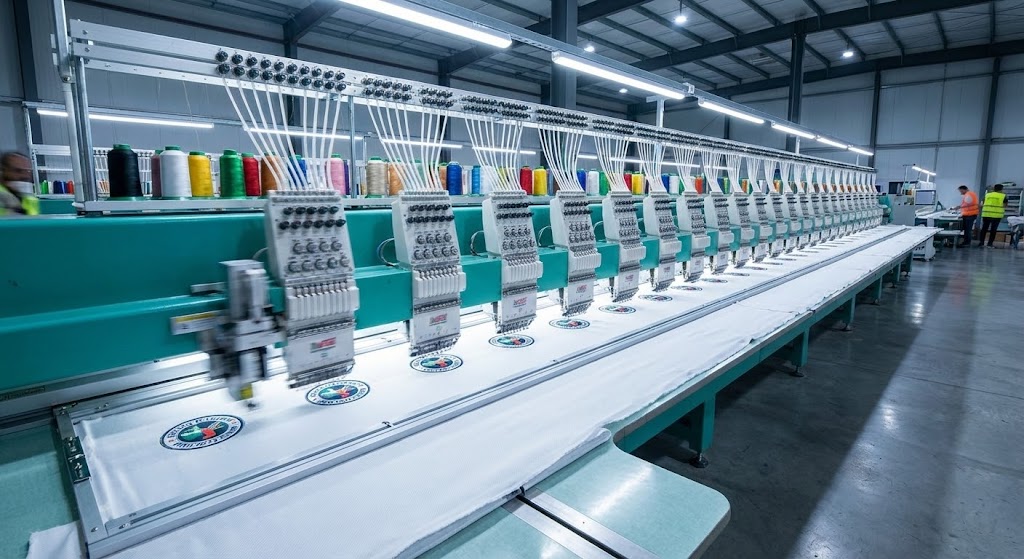
ndustrial embroidery machines provide speed—but machines alone don’t guarantee consistency.
In professional production, multi-head embroidery machines stitch dozens of patches simultaneously, executing thousands of stitches per minute with computer-controlled precision. Each head operates independently while staying synchronized with a central control system, allowing large batch orders to be produced efficiently and uniformly.
Advanced sensors detect thread breaks, tension loss, or misalignment in real time, preventing small errors from turning into full-batch failures. Environmental controls inside modern facilities also play a role, reducing static interference and ensuring stable machine performance during long production runs.
How Are Stitch Cycles Controlled in Real Production?
Automation handles speed—but consistency depends on oversight.
Real-time tension systems continuously adjust thread feed to maintain uniform stitch appearance across varying fabric thicknesses. At the same time, trained technicians perform manual checks, replacing dull needles, monitoring bobbin supply, and verifying stitch quality at key intervals.
In some production environments, high-resolution cameras assist by catching subtle defects that may occur during rapid transitions. This combination of automation and human supervision is what keeps the final output consistent—from the first approved sample to the last unit in a bulk order.
Key machine capabilities include:
- Multi-head synchronization
- Automated thread trimming
- Real-time tension sensors
- High-speed SPM output
Machine Spec Performance Metric Quality Result Head Count Throughput Scalable Output SPM (Stitches/Min) Speed Faster Turnaround Tension Sensors Consistency Uniform Batches
Key Takeaway
Industrial embroidery machines enable scale, but production reliability comes from how those machines are monitored, calibrated, and supported by experienced operators. Consistency across thousands of units is the result of controlled systems—not hardware alone.
5.Which Backing Suits Your Custom Patches?
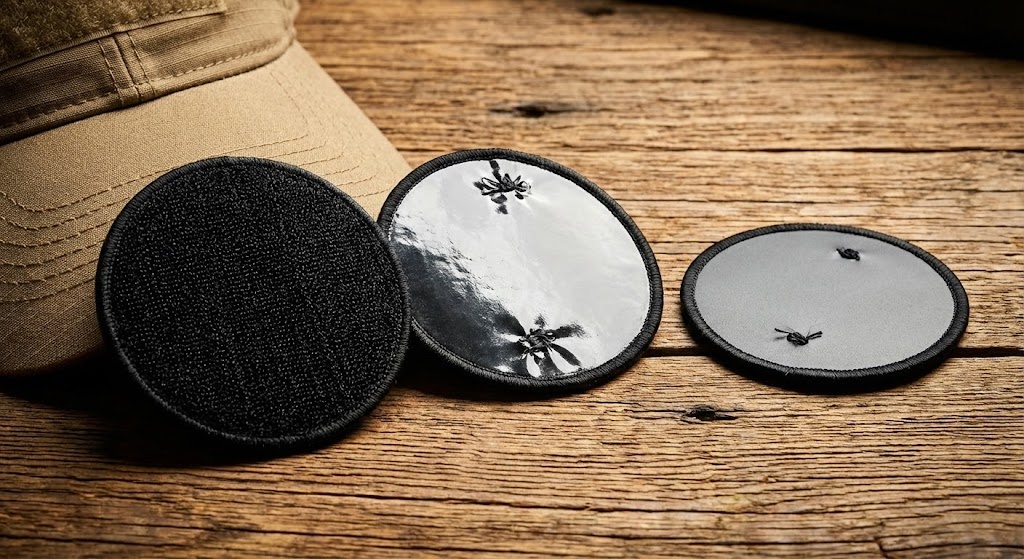
Backing selection determines how a patch performs after it leaves the factory—not just how it’s applied on day one.
The right backing depends on how end users will wear, wash, and handle the patch in real-world conditions. For some applications, ease of installation matters most. For others, long-term durability under stress, heat, or repeated laundering becomes the deciding factor.
Iron-on backings use heat-activated adhesive films to bond patches to garments quickly, making them popular for large promotional runs or uniform programs with controlled application processes. Hook-and-loop systems, on the other hand, are commonly used in tactical or team-based environments where patches need to be swapped or repositioned frequently.
Your backing choice directly affects thickness, flexibility, and attachment strength—factors that determine whether a patch stays secure or begins to peel, curl, or detach over time.
When Is Iron-On the Right Choice?
Iron-on backings offer convenience and speed, but they require precise heat, pressure, and dwell time to perform properly. When applied correctly, they create a strong initial bond on compatible fabrics such as cotton or polyester blends.
However, pressure-sensitive adhesives are not designed for extreme conditions. In high-wash or heavy-use environments, sew-on backings remain the most reliable option, providing mechanical attachment that outperforms adhesives over long service cycles.
Plastic backings are often added as a protective layer, preventing thread fraying and improving moisture resistance on the reverse side. Experienced manufacturers recommend backing types based on garment fabric, usage frequency, and expected laundering conditions—reducing the risk of premature failure after delivery.
Common backing options include:
- Heat-seal iron-on film
- Hook-and-loop (Velcro) backing
- Pressure-sensitive adhesive
- Protective plastic layer
| Backing Type | Application Method | Durability Level |
|---|---|---|
| Iron-On | Heat Press | Permanent (Controlled Use) |
| Velcro | Manual Attachment | Removable |
| Adhesive | Pressure | Temporary |
Key Takeaway
Backing selection is an engineering decision, not a cosmetic one. Bond strength, flexibility, and compatibility with the end garment determine whether patches remain secure through repeated wear and washing.
6. How do borders define Custom Patches?
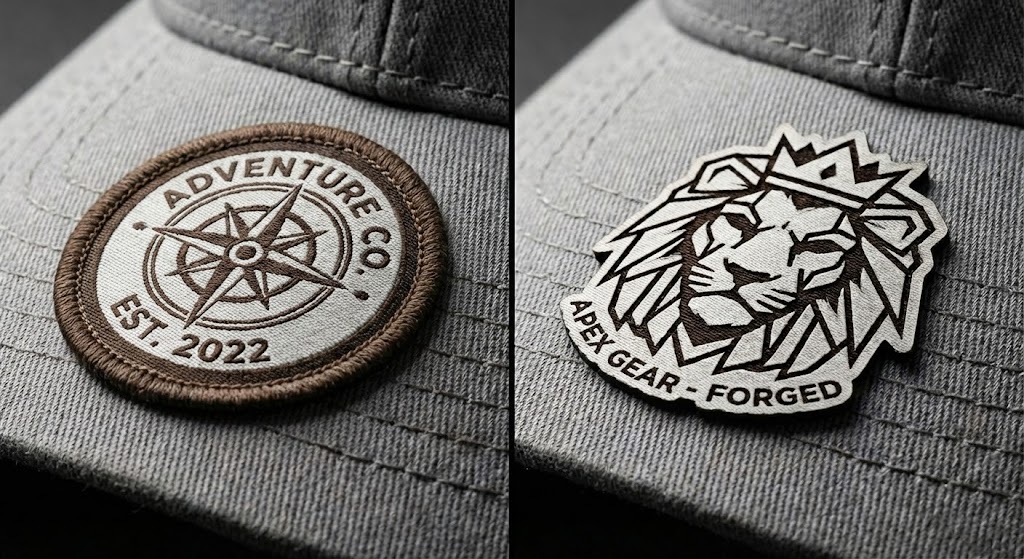
A patch border does more than define its outline—it protects the entire structure from fraying, distortion, and premature wear.
In professional production, borders are finished using either traditional merrowed stitching or precision heat-cut edges, each serving different design and durability requirements. Merrowed borders use thick, wrap-around thread to create a raised edge that reinforces the patch perimeter. This method is especially effective for simple shapes and is widely used in uniforms and workwear where long-term durability matters more than intricate contours.
Because merrowed thread cannot navigate tight corners or complex silhouettes easily, this finish works best for clean geometric designs. Many uniform and industrial apparel programs continue to rely on merrowing because it provides reliable edge protection over years of use.
Is Merrowing Always the Best Choice?
Not necessarily. When a design features irregular outlines, fine details, or character-based shapes, laser heat-cut borders offer a cleaner and more flexible solution.
Heat-cutting follows the exact contour of the artwork, sealing the fabric edge through controlled heat to prevent fraying while maintaining a low-profile finish. Compared to merrowed borders, heat-cut edges appear flatter and integrate more seamlessly with modern or minimalist garments.
Satin-stitched borders and chemical fray-seal treatments are sometimes used to balance appearance and durability, depending on the fabric type and intended application. Selecting the right border method ensures the patch maintains its shape, edge integrity, and visual clarity throughout its service life.
Common border options include:
- Traditional merrowed overlock
- Precision laser heat-cut
- Satin stitch embroidery
- Fray-check chemical seal
| Border Style | Visual Profile | Shape Flexibility |
|---|---|---|
| Merrowed | Raised / Thick | Low (Simple Shapes) |
| Heat-Cut | Flat / Clean | High (Complex Shapes) |
| Satin Stitch | Smooth / Modern | Medium |
Key Takeaway
Border selection is a structural decision, not just a design preference. The right finishing method protects against edge unraveling and directly impacts how long a patch holds its shape in real-world use.
7. Can colors make Custom Patches pop?
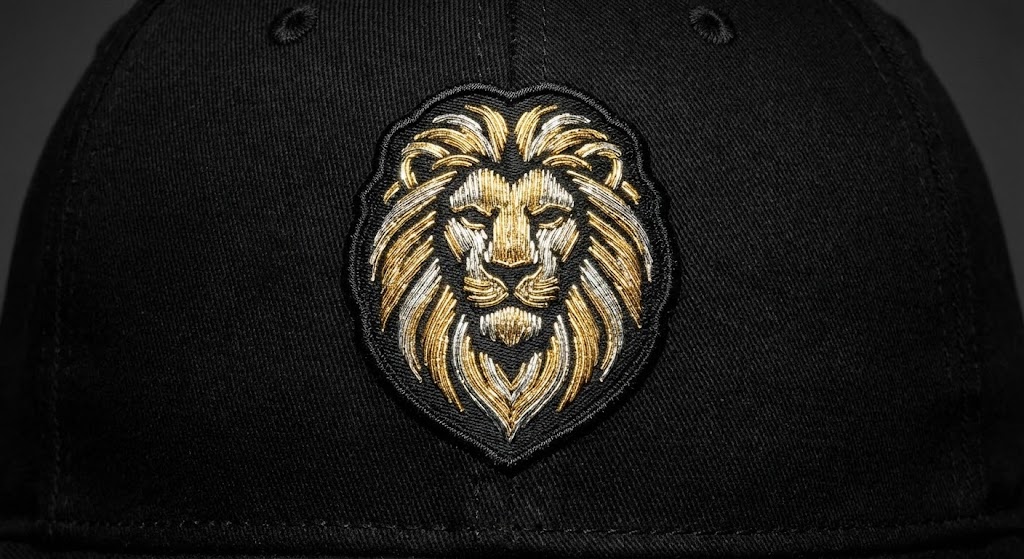
Color choices determine whether a patch remains readable and professional—or becomes visually cluttered once stitched.
Effective color management starts with contrast. Thread colors must stand out clearly against the base fabric to maintain legibility at a distance, especially on small logos or text-heavy designs. While industrial thread catalogs offer thousands of Pantone-matched options, practical production requires limiting color count to maintain stitching efficiency, clarity, and consistency.
Overloading a compact design with too many colors often leads to excessive thread buildup, resulting in uneven surfaces and distorted details. Experienced designers use controlled color palettes and complementary tones to create visual depth through natural highlights and shadows—without increasing stitch density unnecessarily.
How Does Thread Finish Affect Visual Impact?
Thread sheen plays a subtle but important role in how a patch is perceived. Mixing different thread finishes allows key elements to stand out while keeping the overall design balanced.
Matte threads create a clean, understated appearance often preferred for corporate apparel and uniforms. High-gloss rayon threads add a premium sheen that catches light and enhances logo visibility. In selective applications, metallic or fluorescent threads can draw attention to specific details without increasing patch size or complexity.
The goal is not maximum brightness, but controlled contrast that aligns with brand identity and holds up consistently across large production runs.
Common color strategies include:
- Pantone color matching
- Metallic thread accents
- Glow-in-the-dark or specialty yarns
- Matte vs. gloss thread finishes
| Color Strategy | Benefit | Brand Vibe |
|---|---|---|
| High Contrast | Readability | Professional |
| Metallic Accents | Visual Focus | Premium |
| Tone-on-Tone | Subtle Depth | Sophisticated |
Key Takeaway
Color selection is a balance between visual impact and production control. Strategic use of contrast and thread texture ensures patches remain clear, consistent, and on-brand—without introducing unnecessary complexity or production risk.
8. Why does QC matter for Custom Patches?
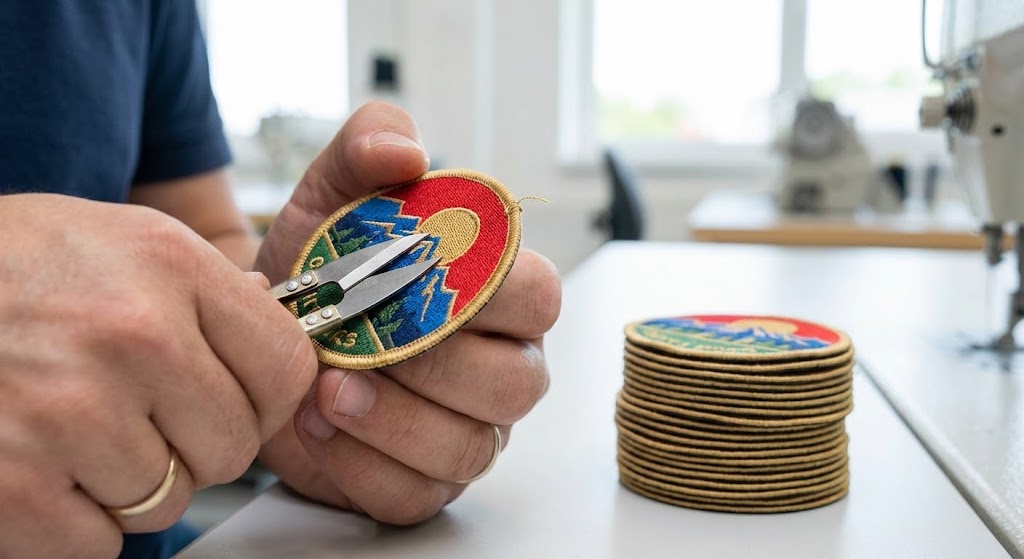
Quality control is the final safeguard between approved samples and real-world delivery. It’s where small issues are caught before they turn into costly returns, missed deadlines, or brand damage.
During patch production, QC specialists inspect finished pieces to identify microscopic thread breaks, alignment shifts, or edge inconsistencies that may not be visible at first glance. Randomized stress tests are performed to confirm backing adhesion under force, ensuring patches stay attached during wear, washing, and handling.
Human inspection remains essential at this stage. Experienced technicians can feel texture differences, detect subtle color variation, and recognize early signs of production drift—issues automated systems often overlook. Consistent QC standards build long-term trust for brands running high-visibility merchandise programs, uniforms, or retail launches.
How Is Order Accuracy Verified?
Quality control extends beyond visual checks. QC teams verify that final quantities match shipping manifests and that color shades remain consistent throughout the entire production run.
Finished patches are compared against approved digital proofs to confirm that details such as font size, border width, and overall dimensions remain within tolerance. Precision measuring tools are used to ensure sizing accuracy, especially for patches intended for automated application or standardized garment placement.
Strict QC protocols help prevent delays, rework, and unexpected defects—allowing bulk orders to ship on time and perform as expected once deployed.
Common QC checkpoints include:
- Microscopic stitch inspection
- Backing bond stress testing
- Sizing tolerance verification
- Color registration review
| QC Check | Tool / Method | Goal |
|---|---|---|
| Visual Inspection | Magnification | No Fraying or Breaks |
| Bond Test | Manual Pull | Secure Backing |
| Spec Audit | Calipers | Exact Sizing |
Key Takeaway
Quality control is not about perfectionism—it’s about predictability. Rigorous QC ensures every delivered unit meets specification, performs consistently, and protects your brand after the order leaves the factory.
9. How should you pack Custom Patches?
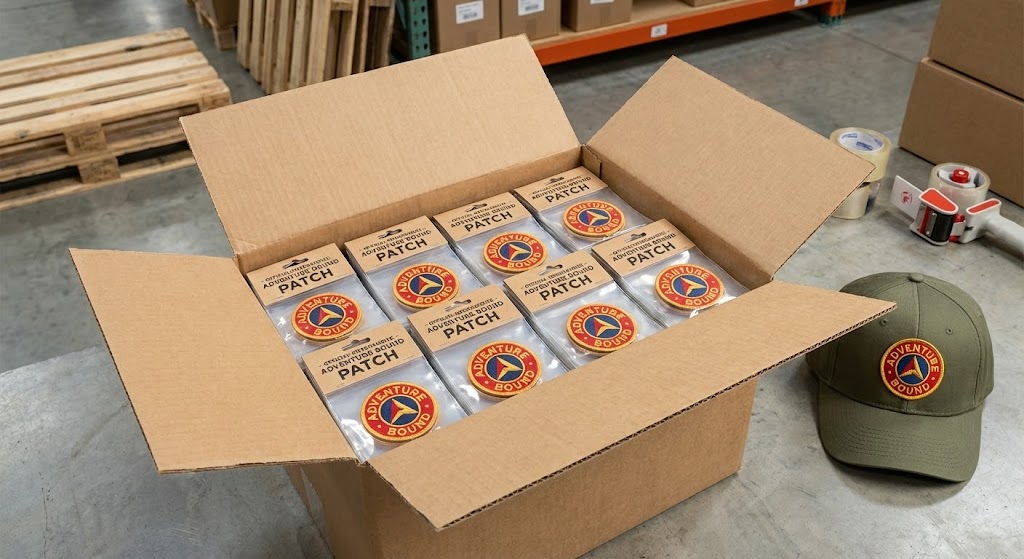
Packaging thousands of small emblems requires organized systems preventing damage during transit while making inventory counting efficient for your logistics team. Most manufacturers utilize clear protective poly bags containing specific quantities like fifty units simplifying your warehouse intake process upon delivery to you. These bags protect delicate embroidery from moisture or dust while the product moves through international shipping channels toward your facility. Properly labeled boxes indicating design name plus total count ensure your logistics team stays efficient during high-volume distribution sequences for you.
Do backer cards add value?
Look at the facts… individual packaging with custom backer cards provides a premium feel adding significant perceived value for the end consumer. These cards often include application instructions or brand stories turning simple patches into complete branded product experiences for every customer. Using eco-friendly materials like recycled cardboard for these inserts aligns your brand with modern sustainability trends while providing extra structural protection. High-quality packaging ensures patches arrive flat plus they remain in pristine condition until the moment they get applied toward a garment.
- Bulk poly-bagging systems
- Retail backer cards
- Moisture protection bags
- Clear quantity labeling
| Packing Method | Benefit | Ideal For | |
|---|---|---|---|
| Bulk Bags | Low Cost | Manufacturing | |
| Backer Cards | High Value | Retail Sales | |
| Individual Poly | Protection | Direct Shipping |
Key Takeaway: Professional packaging protects your investment besides streamlining the transition from factory toward end-user hands with organized inventory systems you need.
The logistics for packaging constitute the final physical barrier protecting the integrity for embroidered art from environmental degradation during long-distance transit.
10. Are eco-friendly Custom Patches worth it?
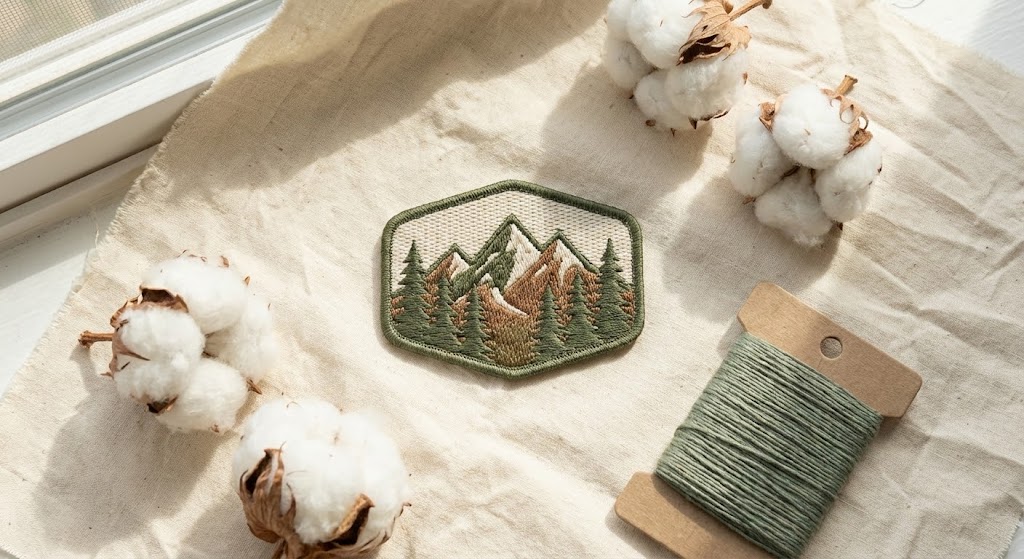
Environmental responsibility drives modern brands toward seeking Custom Patches manufactured from recycled polyester threads or organic cotton twill bases today. These sustainable materials offer nearly identical durability plus they maintain vibrant color saturation compared toward traditional petroleum-based synthetic fibers used before. Implementing eco-conscious production methods reduces the overall carbon footprint for your merch line without sacrificing that professional look you expect. Many B2B clients now prioritize suppliers who offer these green alternatives meeting their own corporate social responsibility goals while staying competitive.
How do you reduce manufacturing waste?
What is the real story? Optimized cutting algorithms minimize fabric scrap during production while modern machines consume less electricity than older mechanical models used. Using biodegradable adhesives or water-based dyes during the manufacturing process ensures your products leave smaller environmental impacts throughout their lifecycle. Transitioning toward digital proofing eliminates needs for shipping physical samples back plus forth further reducing transport emissions during your project. Investing in sustainable branding demonstrates a forward-thinking mindset resonating deeply with modern consumers who value ethical manufacturing practices in the market.
- Recycled PET thread
- Organic cotton twill
- Water-based adhesives
- Low-waste laser pathing
| Green Feature | Material | Impact | |
|---|---|---|---|
| Recycled Thread | PET Bottles | Less Waste | |
| Organic Twill | Natural Cotton | No Pesticides | |
| Water-Based Glue | Non-Toxic | Safer Factory |
Key Takeaway: Sustainable manufacturing options provide powerful marketing advantages while ensuring your brand remains viable in an increasingly eco-conscious global market today.
The transition toward sustainable textile components represents a strategic alignment between brand values plus the evolving environmental standards for global supply chains.
Final Thoughts
Manufacturing custom patches that perform consistently requires more than good design—it demands disciplined execution across every stage, from digitizing and material selection to controlled production and quality checks.
When these steps are handled correctly, the result is not just a patch that looks good on day one, but one that holds its shape, color, and attachment through real-world use. Understanding this process upfront helps brands avoid rework, delays, and post-delivery issues in bulk programs.
If you’re evaluating options for an upcoming project, a short feasibility review can help clarify materials, backing choices, and production constraints before any commitment is made.
FAQ
Q1: Can I use multiple colors for my design?Modern industrial machines handle up to twelve or fifteen different thread colors per design comfortably without sacrificing structural quality or production speed. We recommend keeping the count under seven to maintain optimal production speed plus it ensures the best visual clarity for smaller details.
Q2: What is the best way to apply my patches?Heat pressing with an iron-on backing remains the most popular method for fast application on cotton or polyester garments in bulk. However for the most permanent and rugged bond we always suggest sewing the edges onto the fabric directly using industrial sewing machines.
Q3: Can I order small quantities for a test run?Most professional manufacturers offer low minimum order quantities specifically for B2B clients who need to verify quality before committing toward bulk runs. This allows you to test the market plus it ensures the design looks perfect in physical form before full production.
Q4: What is the best material for outdoor use?Polyester twill combined with high-tenacity polyester threads provides the best resistance against sun fading plus moisture throughout years of outdoor service. These materials survive harsh conditions plus they stay vibrant throughout years of intense exposure across various climate zones and weather types.
Q5: Can I get my patches with a custom shape?Absolutely laser-cutting technology allows us to create any shape imaginable including intricate outlines that follow your logo exactly across every single unit. These heat-cut borders provide a modern clean look that fits perfectly on contemporary apparel styles without any bulky threads on edges.