
Outdoor and lifestyle brands are moving away from cheap giveaways. We see high-end brands treating headwear as a key part of their brand equity. If a patch peels off or the leather stains the fabric, customers lose trust in the whole product line. We focus on a “Zero-Failure” approach to help you avoid these supply chain risks.
Key Takeaways for Procurement Managers:
- Technical Durability: We use treated leather and synthetic threads to stop rot and dye bleeding.
- Risk Management: Our process aligns with LWG and Prop 65 standards to avoid legal issues.
- Cost Efficiency: We focus on the total cost of ownership rather than just the lowest unit price.
Does Your Leather Handle the Real World?
Many buyers choose “genuine leather” because it sounds premium. But for outdoor brands, the wrong grade of leather is a big risk. If your customers are hikers or anglers, their leather patch hats face extreme sun and moisture. Standard upholstery leather will dry out and shrink. When that happens, the patch pulls away from the hat crown. We choose materials that stay stable even when they get wet or hot.
We help you pick the right material for your production:
- Top-Grain Leather: This gives the best look and develops a premium patina. It needs a water-repellent finish, or it will act like a sponge. When it dries, the fibers tighten and can break the glue bond.
- PU Leather: This is cheap and waterproof, but it can feel like plastic. This might lower the value of a $35 retail hat.
- Bio-based Leather: These help meet ESG goals, but they often have lower tear strength. If your design has perimeter stitching, the leather might rip at the needle holes under tension.
Always check for dye migration before mass production. Many leathers use heavy dyes for dark colors. If the factory doesn’t seal these dyes properly, they will bleed onto the hat fabric—especially on white or grey mesh—the moment they get wet. We have seen $50,000 shipments fail because the leather dye ruined the fabric during a simple humidity check.
Is Your Logo Built for Scale?
Procurement managers often forget how the logo method affects the final cost and brand look. When you move from a 50-unit prototype to a 10,000-unit global order, keeping every patch the same is a big technical challenge. We help you choose the best way to make your logo: Laser Engraving, Debossing, or a Hybrid approach.
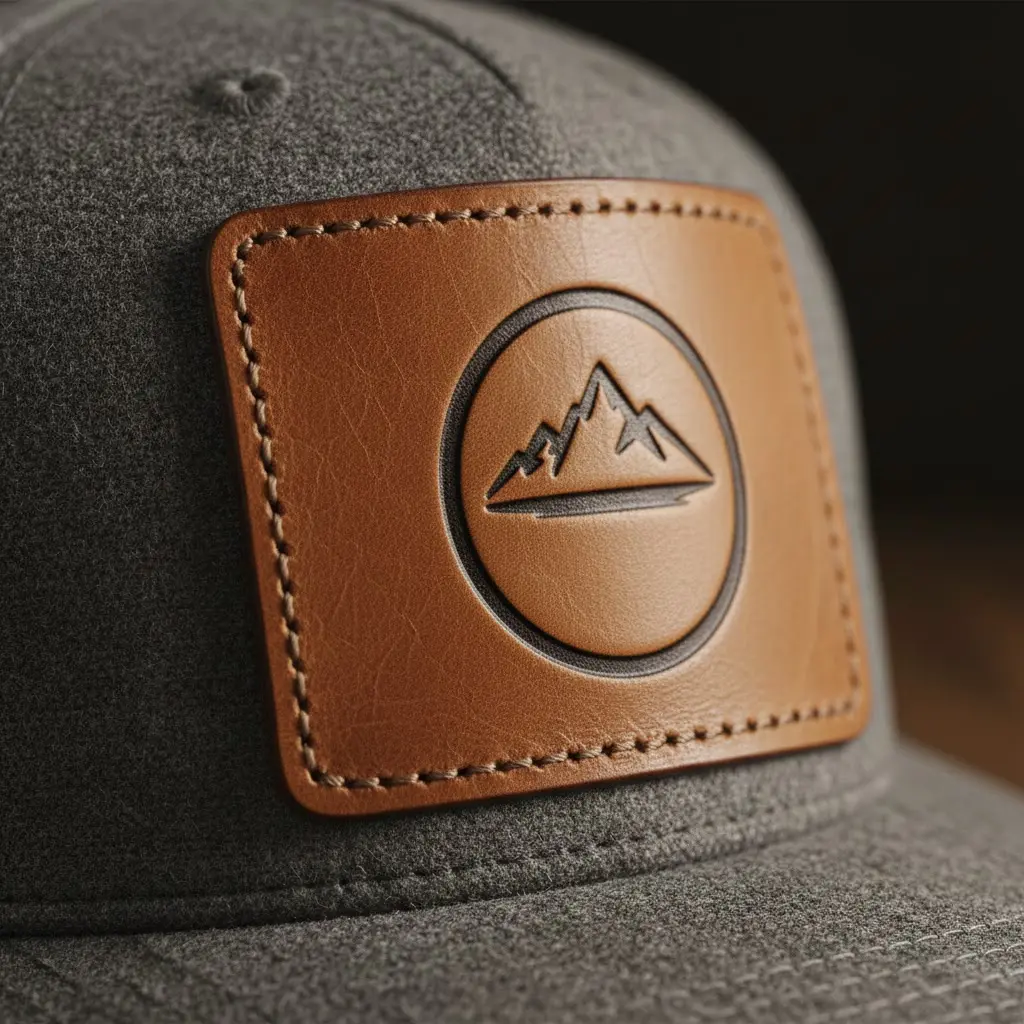
- Laser Engraving: This is the standard for speed. It works well for high-detail designs and doesn’t need expensive metal molds. But for light-colored leather, it can leave a “char” effect. The heat can leave a burnt smell and dark soot. We recommend a “clean-and-seal” step so your hats don’t smell like smoke when customers open the bag.
- Debossing: This uses a metal die to press the logo into the hide. It gives a deep, 3D look that feels more expensive. But it adds “tooling costs” and takes longer to set up. If your brand has many different patch sizes, these mold fees ($200–$500 per size) can add up fast. Also, the leather must have the right moisture level to take the shape without cracking.
For small, complex logos, we use “Laser-Etched Debossing.” We use a laser to clear the top grain before a light press sets the shape. This gives you the depth of a mold without the high cost for every single design. It’s the best way to get a premium look while keeping your budget under control.
Where Are the Hidden Failures in Your Production?
The most common failure for leather patch hats is not the leather itself. It is the invisible glue bond between the patch and the hat. A patch that looks fine on a desk can peel off after three months in a warm warehouse or two weeks in the sun. We manage this risk by strictly controlling three things: Pressure, Temperature, and Time.
Every fabric reacts differently to heat. Putting a patch on a heavy cotton canvas needs much higher pressure than a recycled polyester mesh. If the heat is too high, you will see a “burn ring” or melted fibers around the patch. If the pressure is too low, the glue doesn’t soak into the fabric. This leads to “corner lifting” where the edges start to peel.
For outdoor brands, we recommend a “Double-Lock” approach: combining a high-grade adhesive with a perimeter stitch. While some use the stitch just for looks, for outdoor gear, it acts as a mechanical anchor. This stops the “dog-ear” peeling that happens when a hat sits on a hot car dashboard or gets soaked in the rain.
90% of field failures come from a “Cold Leak.” This happens when a factory skips the pre-heating step. We always press the hat crown for 3-5 seconds before we put the patch on. This gets rid of moisture in the fabric and opens the fibers to take the glue. Without this step, the bond is weak and will fail the moment the material gets hot or cold.
Are You Calculating the True Total Cost of Ownership?
In the world of leather patch hats, the price per unit is often a trap. A $5.00 hat with a 10% defect rate is more expensive than a $5.50 hat built to a “Zero-Failure” standard. We help you look at the Total Cost of Ownership (TCO) by focusing on landed costs and the cost of quality.
- Customs and Tariffs: Import duties for headwear can be tricky. If your customs broker misclassifies your leather-patched hats as “leather goods” instead of “headgear,” you could see a 7-10% jump in tariffs. We help you use the right HTS Code (usually 6505.00) to ensure you pay the legal minimum in duties.
- The Cost of Quality: This includes the cost of inspecting shipments and the loss of profit on returned items. For a premium brand, a 2% return rate because of “peeling patches” can wipe out the profit of an entire order. We recommend a 3rd-party inspection at the factory to catch these issues before you make the final payment.
- Logistics and Cash Flow: Shipping by sea lowers the cost per hat, but it adds 40-60 days to your lead time. This ties up your cash and requires you to hold more stock. We help you balance sea and air freight to keep your cash flowing while hitting your sales windows.
Always consult a licensed broker to confirm your specific fabric blend (e.g., cotton vs. synthetic). The difference between a “cotton-heavy” and “polyester-heavy” hat can change your tariff rate significantly. Getting this right on your paperwork is the easiest way to save money.
Can Your Hats Survive the Great Outdoors?
A fashion hat for the city is not the same as a performance hat for the mountains. If your customers are anglers, hikers, or sailors, salt water and sweat will destroy a standard leather patch. We focus on “Environmental Engineering” to make sure your product lasts more than one season.
- Salt Water and Moisture: Salt water can make genuine leather stiff and brittle. We use leather with a water-repellent finish applied during the tanning process. This keeps the patch soft even after it gets wet.
- Sweat and UV Rays: Sweat contains salts that can rot traditional cotton threads. For outdoor lines, we use synthetic bonded nylon thread. It is stronger, resists UV rays, and won’t snap when the hat brim is curved or stressed.
- Eco-Friendly Design: Many brands now focus on sustainability. Because a hat uses leather, mesh, and plastic, it can be hard to recycle. We help you explore “Modular Design,” like using removable rivets, so customers can take off the leather patch before recycling the fabric body.
For any technical outdoor line, always use bonded nylon thread. Cotton thread will often rot and snap within six months of heavy use. It’s a small detail, but it prevents the most common customer complaint: the “falling patch” caused by broken stitches.
How Do You Scale Without Losing Your Market Window?
In the seasonal world of outdoor gear, lead-time management is the difference between a sold-out collection and a clearance-rack disaster. Procurement managers often face the “Peak Season Trap,” where global factories are fully booked from September through December. We help you move toward a more agile, “Blank Buffer” model for your leather patch hats.
Traditional lead times can take 12 to 14 weeks when you factor in leather sourcing and sea transit. This makes it impossible to react to a sudden trend. To fix this, we recommend a two-tier strategy:
- The “Blank” Strategy: You produce large volumes of high-quality “blank” hats offshore to get the lowest unit cost.
- Domestic Finishing: You hold these blanks in a U.S. warehouse. When you need a quick turnaround, you can work with a local decoration shop to apply your leather patches. This reduces your “Concept-to-Market” time from months to just 14 days.
- Inventory Control: This allows you to run “test batches” of 50 units for a new logo locally before you commit to a 5,000-unit production run overseas.
The most successful brands use a “Blank Stocking” agreement. You pay for the materials for 10,000 hats upfront but leave them unbranded in your domestic warehouse. This lets you send small batches to a local embroidery or patch shop for “Limited Drops” or “National Park” series. This strategy stops you from getting stuck with “Dead Stock” while allowing you to react to the market in real-time.
FAQ
Q1: How do we prevent leather patches from staining light-colored fabrics during shipping or storage? We manage this by screening for dye migration risks before mass production. Since heavy pigments in premium leather can react to high humidity, we recommend using leather that has been specifically finished for headwear. Pro Tip: Never assume a leather swatch will behave the same on different fabric blends. We suggest requesting a “composite test”—placing a sample of the patch pressed onto your hat fabric in a high-humidity environment for 48 hours to check for any color transfer.
Q2: What is the best way to ensure the patch adhesive stays secure in extreme heat? The most reliable method is a combination of proper heat-press settings and pre-conditioning the fabric. We recommend a short “de-humidifying” press of the hat crown to remove residual moisture before the patch is applied. Pro Tip: Verify the “Softening Point” of the adhesive with your supplier. If your hats are stored in containers that exceed 120°F (49°C), a low-grade adhesive can weaken. For outdoor performance lines, adding a perimeter stitch provides the best mechanical fail-safe.
Q3: How can we verify that the leather is compliant with U.S. customs without a mountain of certificates? Focus on the “Material Declaration” and correct HTS classification. While individual certificates for small patches are rare, you should have a signed statement from the factory declaring the animal species (e.g., Bovine) and confirming the glue meets basic safety standards like Prop 65. Pro Tip: Ensure your Bill of Lading (BOL) explicitly declares the animal species. Using vague terms like “Leather Goods” can trigger secondary inspections by U.S. Fish and Wildlife, leading to port delays.
Q4: How do we maintain logo consistency across large production runs? Consistency comes from standardized digital settings and master tool control. For debossed logos, using a high-quality metal die ensures the depth stays uniform. For laser engraving, settings should be calibrated for each new batch of leather since hide density can vary. Pro Tip: Aim for a “Commercial Match” on leather colors. Since leather is a natural material, slight variations are expected. We use a “Master Sample” and standard lighting to ensure the batch stays within an acceptable visual range for retail.