For headwear brand managers and bulk buyers, few things are as frustrating as a “color rejection.” You approve a Navy sample in your corporate office, but once the bulk shipment hits the retail floor, the product takes on a distinct, muddy purple hue. This isn’t necessarily a sign of a bad dye job—it is a physical phenomenon called metamerism.
In a B2B context, lighting color shift is a logistical nightmare. If your product color is inconsistent under different lighting, it leads to high return rates from retail partners and a fragmented brand image. To master hat color matching, a buyer must move beyond “visual approval” and implement a technical standard that accounts for the science of light.
Quick Answer for the Busy Buyer: What is Metamerism?
Metamerism is when two fabric samples appear to match under one light source (like daylight) but differ significantly under another (like warm retail LEDs). This happens because different dye recipes react uniquely to the wavelengths emitted by various bulbs. For navy fabrics, the hidden red undertones in the dye are often amplified by warm indoor lighting, shifting the perceived color toward purple.
1. Why Is Color a “Moving Target” in Professional Sourcing?
If you are responsible for large-scale procurement, you have likely realized that color is not a fixed property of a hat. Instead, it is a variable result of how light interacts with the material. This is why a sample that looks perfect on your desk can fail on the sales floor.
The core of the problem lies in the Spectral Power Distribution (SPD) of different light sources. Natural daylight contains a balanced amount of all colors in the rainbow. However, the artificial lights used in shopping malls often have “spikes” in specific colors like yellow or red. If your supplier used a dye recipe that relies on red pigments to achieve a deep navy, those retail lights will “pull” that red out, making the hat look purple.
The Three Pillars of Color Perception
To mitigate procurement risks, you must understand that color consistency depends on three factors:
| Factor | Technical Impact | Buyer’s Risk |
| Light Source | The specific wavelengths hitting the hat (e.g., D65 vs. TL84). | High: The most common cause of color disputes. |
| Object (Fabric) | The chemical composition of the dye and the fiber type. | Moderate: Different materials (Cotton vs. Poly) react differently. |
| The Observer | The sensitivity of the human eye or digital sensor. | Low: Can be standardized using spectrophotometers. |
The “Navy Challenge”: Why Dark Hues Shift More
Navy is arguably the most difficult color to stabilize in the textile industry. Because it is so dark, it requires a high concentration of pigments. Most “Classic Navy” dyes are not pure blue; they are a complex mix of blue, black, and violet. In a controlled lab setting, these colors balance out. But in a real-world retail environment, that balance is fragile. A buyer who doesn’t specify the lighting conditions for approval is essentially gambling with their inventory’s visual quality.
2. Why Does Retail Lighting Alter Your Brand’s Palette?
Retailers choose lighting based on atmosphere and sales psychology, not color accuracy. High-end boutiques often use warm-toned LEDs or halogen spotlights because they make the environment feel inviting and make textures look “richer.” Unfortunately, these are the exact conditions that trigger a lighting color shift.
Most retail environments operate under lights with a low Color Rendering Index (CRI). For a bulk buyer, this means that the “Navy” you approved under cool office fluorescents will likely reveal its hidden red undertones the moment it’s placed under a warm retail spotlight. If your quality control team isn’t testing samples under specific “Retail” illuminants, you are setting yourself up for a mismatch between your marketing photos and the physical product.
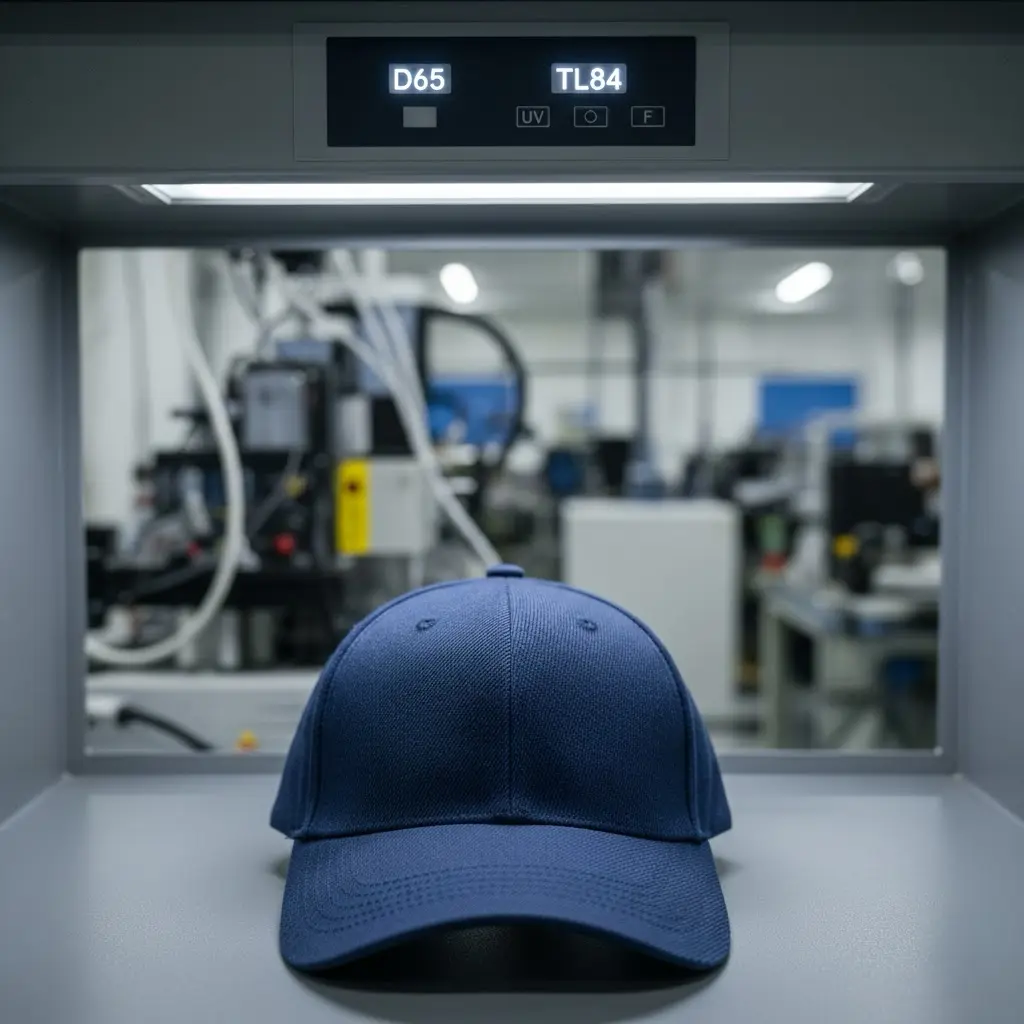
Common Retail Illuminants and Their Effects
| Light Source | Technical Name | Visual Impact on Navy Headwear |
| Artificial Daylight | D65 | The industry standard; shows the “true” balanced color. |
| Store Fluorescent | TL84 / CWF | Common in US malls; can make navy look greenish or “flat.” |
| Warm Retail LED | 3000K / 30Q | Common in boutiques; the primary cause of the “Purple” shift. |
3. The Material Factor: Why Your Brims and Crowns Clash
A common pain point in headwear procurement is the “two-tone” hat. This happens when the crown (often cotton) and the mesh or brim (often polyester) match perfectly in the factory but look like two different colors in the store.
This is a specialized form of metamerism. Cotton is a natural fiber that absorbs dye differently than synthetic polyester. Even if a factory uses the “same” Navy dye recipe, the light reflects off the surface of these fibers at different angles. For a B2B buyer, this creates a perception of low quality. To avoid this, it is critical to demand that all components are tested together under a controlled light box during the pre-production sample (PPS) stage.
Why Dye Chemistry Matters for Bulk Orders
- Metameric Pairs: Cheap dye recipes often use a mix of three colors (Red, Yellow, Blue) to create Navy. Better quality dyes use more stable, singular pigments that resist shifting.
- Optical Brighteners (OBAs): Some factories use these to make colors “pop,” but OBAs react violently to UV light. A hat with OBAs will look vivid in sunlight but might look dull and greyish in a windowless mall.
- Dye Lot Consistency: In large-scale manufacturing, even a 1% variation in the dye mix between batches can lead to metamerism issues across your entire inventory.
4. How to Set a Professional Standard for Color Approval?
For a procurement manager, relying on “naked eye” approval is a high-risk strategy. To ensure your Navy remains Navy, you must implement a standardized Color Approval SOP. By specifying the lighting conditions in your Tech Pack, you remove the ambiguity that leads to mass-production errors.
The gold standard in the headwear industry is the use of a Controlled Light Box. This equipment allows you to toggle between different “illuminants” to see how the fabric reacts before you commit to a 5,000-unit run. If you don’t have a light box, you are essentially flying blind.
The Professional Buyer’s Inspection Checklist
| Step | Action Item | Technical Goal |
| 01 | Define Primary Illuminant | Specify D65 (Daylight) as the primary match target. |
| 02 | Define Secondary Illuminant | Specify TL84 or U30 to simulate the retail environment. |
| 03 | Request a “Lab Dip” | Test the dye on all components (Cotton, Mesh, Plastic) simultaneously. |
| 04 | Set Tolerance Levels | Define the maximum allowable Delta E (ΔE) variance. |
5. Pro Tips: Testing Your Samples Without a Lab
If you are in the field and don’t have access to a spectrophotometer, you can still perform basic “stress tests” on your Navy samples. These methods help identify high-metamerism dyes before they reach your customers.
- The “Window vs. Interior” Test: View the hat in direct natural sunlight, then move to a windowless room with warm LED bulbs. If the color shifts more than 10%, the dye recipe is unstable.
- The Smartphone Flash Hack: Take a photo with a high-intensity LED flash. This often reveals the “Red-cast” hidden in the Navy dye, giving you a preview of how it might look under bright retail spotlights.
- The Component Comparison: Place the brim directly against the crown under three different light sources. If they drift apart in color, the material compatibility is poor.
6. Strategic Advice for Brand Owners and Designers
When designing for a US-based retail chain, you must design for the environment. If your client’s stores use warm 3000K lighting, a “Green-cast” Navy might actually appear more “True Navy” than a traditional “Red-cast” version. Critical thinking in the design phase prevents logistical headaches in the delivery phase.
The goal is Color Constancy. You want a dye recipe that is “constant” across all light sources. While 100% constancy is a scientific impossibility, high-quality dye houses can achieve a “Non-metameric Match.” This ensures that whether your hat is in a dimly lit bar, a bright stadium, or a shopping mall, the brand identity remains intact.
7. Can Metamerism Ever Be a Strategic Advantage?
While most procurement discussions focus on eliminating color shifts, a specialized segment of the headwear market uses metamerism as a design feature. In streetwear and high-fashion “drops,” intentional color shifting—often called “Chameleon” or “Iridescent” effects—can be a powerful selling point.
For the high-volume buyer, this highlights the importance of intent. If you are sourcing for a vintage-inspired brand, a slight “Red-cast” shift in the evening sun can add a layer of perceived authenticity and “soul” to a washed cotton twill. The key is to ensure that this shift is consistent across every hat in the box. A shift is only a defect when it is accidental and inconsistent.
8. Final Thoughts: Seeing the Light in Supply Chain Management
Metamerism is not a manufacturing failure; it is a natural law of physics that must be managed with technical precision. For the US-based buyer, the risks of “Purple Navy” syndrome are real, but they are entirely preventable with the right protocols.
By moving your approval process into a controlled environment and specifying light sources like D65 and TL84 in your contracts, you protect your brand from costly returns and customer dissatisfaction. In the world of premium headwear, the most successful brands don’t just pick a color—they master the light.
Conclusion
Successful color management requires moving beyond visual guesswork. Implement standardized light testing today to lower return rates, ensure brand consistency, and protect your bottom line in every retail environment.
FAQ
Q1: Why did my factory-approved Navy sample look purple when I received it in the US? A: This is almost always due to “Metamerism.” Your factory likely approved the color under their local fluorescent lighting or natural daylight, which didn’t highlight the red pigments in the dye. Once those hats are placed under the warm-toned LEDs common in US retail stores, those hidden red tones are amplified, making the navy appear purple.
Q2: Is it possible to achieve a Navy color that never shifts under any light? A: Scientifically, achieving 100% color constancy is nearly impossible because all dyes react to light wavelengths. However, you can achieve a “Non-Metameric Match” by using high-quality, stable dyes and ensuring the spectral reflectance of the fabric remains consistent. Specifying a secondary light source for testing (like TL84 or U30) during the sampling phase is the best way to minimize visible shifts.
Q3: Does fabric type affect how often metamerism occurs? A: Yes, significantly. Synthetic fibers like polyester (often used in mesh or performance fabrics) reflect light differently than natural fibers like cotton. When a hat uses mixed materials, they may match in sunlight but “split” into two different shades under retail lights. Always request that all component materials be tested together in a controlled light box.
Q4: What specific lighting standards should I include in my Tech Pack? A: For the US market, we recommend specifying D65 (Average North Sky Daylight) as your primary light source for general color matching, and TL84 (European/US Store Light) or 3000K LED as your secondary source to simulate the retail environment.
Q5: How can I communicate color requirements to a factory without expensive equipment? A: While digital tools are best, the most effective low-cost method is to provide a physical Pantone Swatch (TPG or TCX) and explicitly state: “Color must match this swatch under both D65 and TL84 light sources with no visible purple shift.”