If you’re sourcing headwear for the U.S. market, chances are you’ve heard at least one of these warnings:
- “Quality from China is inconsistent.”
- “Factories disappear after you pay.”
- “Shipping delays will kill your launch.”
- “Your designs will get copied.”
These fears are understandable — and in some cases, earned.
But here’s the problem:
Most sourcing failures don’t happen because production is in China. They happen because buyers don’t have visibility or control over the process.
This article isn’t here to sell you on “cheap manufacturing.”
It’s here to separate real risks from outdated myths, so you can make sourcing decisions with clarity — not fear.
If you’re struggling with inconsistent quality, missed timelines, or suppliers who go quiet at the worst moment, this guide will help you understand why it happens — and how experienced buyers avoid it.
I’ve spent years working directly with headwear factories across Guangdong and Zhejiang — not from behind a desk, but on production floors, in sampling rooms, and during quality inspections.
What I’ve learned is simple:
Factories rarely “hide the truth.” More often, buyers never ask the right questions — or lack a system to verify the answers.
That’s why successful U.S. brands don’t rely on promises.
They rely on process transparency, local oversight, and clear accountability — especially when scaling.
This guide reflects what actually works in real-world sourcing today, not theory.
Myth #1: Does “Made in China” Always Mean Low Quality?
If you’ve ever approved a sample—only to feel disappointed when the bulk order arrived—you’re not alone.
Many U.S. buyers quietly associate “Made in China” with inconsistency. Not because they believe Chinese factories lack capability, but because they’ve been burned before:
a sample that looked perfect, followed by a production run that felt rushed, thinner, or simply “off.”
The assumption becomes: China-made equals cheap.
But that conclusion skips an important reality.
The Reality: Quality in China Is Tiered—By Design
China doesn’t produce “one level” of quality.
It produces every level of quality.
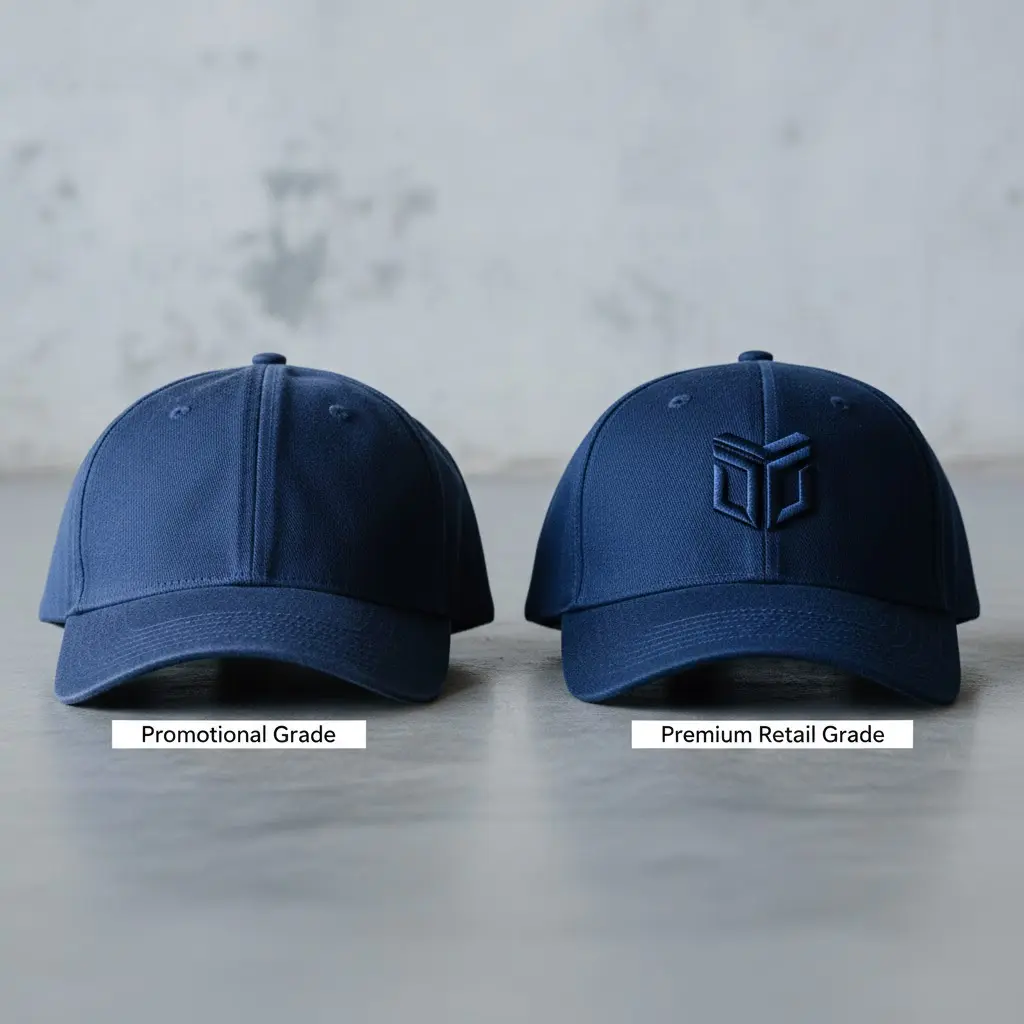
From premium retail caps sold in national chains to low-cost promotional giveaways, Chinese factories operate on a tiered manufacturing system. What you receive is rarely random—it’s the direct result of how clearly standards are defined at the start.
In other words, quality is a decision, not a gamble.
Most quality issues don’t start on the production line.
They start upstream—when expectations stay vague and pricing becomes the only anchor.
Why “Low Quality” Happens More Than It Should
When buyers focus primarily on unit price without locking down technical specs, factories are forced to optimize for cost. That’s not bad intent—it’s standard manufacturing logic.
For example:
- A “cotton cap” can mean many things.
- Entry-level: lightweight cotton twill
- Premium: heavy brushed cotton or performance blends
- If fabric weight (GSM) isn’t specified, the factory will default to the most economical option that fits the quote.
- The same applies to stitching density, sweatband construction, internal taping, and structure.
This is where most so-called “overseas sourcing risks” actually begin—not with the factory, but with unclear inputs.
The Three Common Quality Tiers in Hat Manufacturing
Professional buyers typically evaluate headwear across three production tiers:
| Quality Feature | Promotional Grade | Retail Grade | Premium / Custom |
|---|---|---|---|
| Fabric | Light polyester / thin cotton | Heavy cotton twill / wool blend | Performance tech / organic cotton |
| Internal Tape | Plain plastic / paper | Branded fabric tape | Double-stitched custom tape |
| Sweatband | Single-layer polyester | 4-row stitched cotton | Moisture-wicking multi-layer |
| Logo Method | Flat screen print | 3D embroidery / patch | Sonic weld / embossed leather |
| Structure | Unstructured / flimsy | Buckram-backed (structured) | Double-reinforced A-frame |
Each tier has a place—as long as it aligns with your brand promise and retail channel.
How Experienced Buyers Protect Quality at Scale
Seasoned sourcing teams don’t ask, “Is this good quality?”
They ask questions that remove ambiguity:
- What is the fabric GSM?
- Is the sweatband 100% cotton or blended?
- How many stitches per centimeter on the visor?
- Will this be matched against a Pre-Production Sample (PPS)?
A PPS isn’t just a formality—it’s a contractual reference point.
If bulk production doesn’t match the PPS, buyers have both commercial and legal grounds to request correction.
That single step prevents most quality disputes before they start.
The Takeaway
“Made in China” doesn’t mean low quality.
It means you control the outcome—if you control the specs.
The buyers who succeed aren’t louder or more aggressive.
They’re simply clearer.
Myth #2: Do You Have to Order 10,000 Units to Get a Good Price?
If you’re a growing brand, you’ve probably heard this before:
“Factories won’t take you seriously unless you order 10,000 units.”
That belief alone has pushed many small and mid-sized U.S. businesses toward wholesalers and middlemen—often at the cost of margin, flexibility, and speed.
But the reality in 2026 looks very different.
The Reality: MOQ Is No Longer One-Size-Fits-All
Modern hat manufacturing is far more flexible than it was a decade ago.
Advances in digital embroidery, modular production lines, and faster changeover tooling have dramatically reduced setup time. As a result, many factories now support low-MOQ production without disrupting their core operations.
For buyers, this changes everything.
Today, it’s common to see factory-direct offers starting at 100–300 units per style, especially for:
- New brand launches
- Seasonal drops
- Influencer or capsule collections
- Market-testing before scaling
This doesn’t mean every factory will say yes—but it does mean the old “10,000 or nothing” rule is outdated.
Why Flexible MOQs Exist (And Why They’re Not Always Cheap)
Lower MOQs don’t exist because factories are doing favors.
They exist because it makes operational sense.
Many factories now run dedicated mini-lines designed specifically for small-batch orders. These lines trade unit efficiency for flexibility.
That’s why small runs usually carry a price premium, not a penalty.
And that premium is often cheaper than the hidden costs of:
- Overstocking
- Dead inventory
- Being locked into a design that doesn’t sell
For most growing brands, the real risk isn’t a slightly higher unit price—it’s cash tied up in unsold stock.
Why Paid Samples Matter More Than MOQ
One common mistake buyers make is trying to avoid sample costs.
In reality, paid samples are a filtering mechanism.
A serious factory will typically charge $50–$150 for a fully custom sample to cover:
- Digitizing embroidery files
- Material sourcing
- Machine setup time
This isn’t a red flag—it’s a signal.
Most reputable factories credit that cost back once you place a bulk order. More importantly, a paid sample establishes a clear quality benchmark before you commit to production.
In overseas sourcing, that upfront clarity reduces risk far more than chasing free samples ever could.
How Order Volume Actually Affects Pricing
| Order Volume | Typical Pricing Impact | Best Use Case |
|---|---|---|
| 100–300 pcs | Premium (+20–30%) | New designs / boutique brands |
| 500–1,000 pcs | Standard factory pricing | Established regional brands |
| 2,000–5,000 pcs | Volume discount (≈ −15%) | National distribution |
| 10,000+ pcs | Tier-1 pricing | Global retail / large promotions |
The key is alignment.
MOQ should match your sales velocity, not your supplier’s maximum capacity.
The Takeaway
You don’t need to be “big” to source factory-direct.
You need to be clear, realistic, and intentional.
The smartest buyers don’t ask:
“What’s your minimum order?”
They ask:
“What’s the smallest run that still makes sense for both of us?”
That mindset keeps your inventory lean—and your cash working.
Myth #3: Is Communication an Impossible Barrier When Sourcing?
Many buyers hesitate to source overseas for one reason:
“What if my design gets lost in translation?”
They imagine language barriers, time zone delays, and endless back-and-forth that leads to mistakes, missed deadlines, or failed launches.
It’s a reasonable concern—but it’s also slightly misplaced.
The Reality: Language Isn’t the Real Barrier—Clarity Is
In 2026, basic communication is no longer the bottleneck.
Most professional factories now work daily with U.S. and European clients. English-speaking merchandisers, real-time messaging apps, and instant photo or video updates are standard—not exceptional.
When projects fail, it’s rarely because someone didn’t understand English.
It’s because requirements weren’t defined in a way manufacturing teams could execute.
In other words, the real gap isn’t linguistic—it’s technical.
“Looks Good” vs. “Can Be Produced”
Factories work in specifications, not concepts.
If instructions sound like:
- “Make it premium”
- “Same as last time, but better”
- “Match our brand vibe”
Even a local supplier would struggle.
But when buyers provide a Tech Pack—with clear measurements, Pantone colors, stitch density, fabric type, and reference photos—ambiguity disappears. Production becomes execution, not interpretation.
This is why experienced sourcing teams invest time upfront in documentation. It’s the fastest way to reduce downstream errors.
Why Real-Time Tools Matter (But Aren’t Enough Alone)
Apps like WeChat or WhatsApp are powerful—not because they translate language, but because they increase visibility.
Daily updates, short factory-floor videos, and quick confirmations allow buyers to:
- Catch issues early
- Align internal stakeholders
- Report progress with confidence
For U.S. buyers managing launches or retail timelines, this transparency is often more important than price.
That said, tools only work when expectations are already clear. Messaging can’t fix vague inputs.
Bridging the Cultural and Operational Gap
Some challenges aren’t about language at all—they’re about planning.
For example:
- Understanding Chinese New Year shutdowns
- Knowing when factories front-load or back-load production
- Aligning approval timelines across time zones
Buyers who plan around these realities don’t experience “surprises.” Buyers who don’t often misinterpret silence as negligence.
When On-the-Ground Support Makes Sense
For teams without internal sourcing experience, a specialized sourcing partner or headwear-focused agent can act as your operational extension.
Their value isn’t translation—it’s interpretation:
- Turning brand standards into factory instructions
- Verifying execution on-site
- Resolving issues before they escalate
They remove guesswork, so your internal team can stay focused on sales, marketing, and growth—not firefighting production issues.
Communication Methods Compared
| Communication Method | Pros | Cons |
|---|---|---|
| Clear records; formal approvals | Slow; not ideal for daily updates | |
| WeChat / WhatsApp | Instant replies; video & QC visibility | Harder to track long histories |
| Tech Pack (PDF) | Zero ambiguity; industry standard | Takes time to prepare |
| Sourcing Partner | Local oversight; execution control | Added service cost |
The Takeaway
Communication isn’t impossible when sourcing overseas.
It’s just less forgiving of vagueness.
Factories don’t fail projects because they don’t care.
They fail when expectations aren’t concrete.
Clear specs, visual references, and structured checkpoints matter far more than perfect English.
Myth #4: Will Factories Just Steal Your Design?
For many brands, this is the fear that stops everything:
“If I send my design overseas, what’s stopping the factory from copying it?”
Intellectual Property (IP) risk feels abstract—until it isn’t.
Designers worry that their signature detail, custom brim, or logo execution will quietly show up on a competitor’s product.
This concern isn’t irrational.
But it is often misunderstood.
The Reality: IP Risk Is Real—But It’s Not Random
Factories don’t steal designs because they can.
They steal designs when the risk-to-reward ratio makes sense for them.
In today’s export-driven manufacturing environment, reputable factories survive on repeat international business. One stolen design can permanently damage that pipeline.
That’s why the real question isn’t:
“Can a factory steal my design?”
It’s:
“Have I structured this project so stealing it would be irrational?”
Why “Export-Focused” Factories Matter
Factories that primarily serve domestic markets operate under different incentives.
Export-focused factories:
- Depend on long-term Western clients
- Understand international compliance expectations
- Face real consequences from blacklisting
These factories value relationship continuity far more than short-term gains from copying a single design.
This is why experienced buyers actively screen for factories whose revenue is tied to export clients—not local resale.
Legal Tools That Actually Work in China
A common mistake is relying on a Western-style NDA.
In China, enforcement matters more than intent.
That’s where the NNN Agreement comes in:
- Non-Use: The factory cannot use your design
- Non-Disclosure: They cannot share it
- Non-Circumvention: They cannot sell directly to your customers
Unlike generic NDAs, NNNs are written specifically to be enforceable under Chinese law.
A factory that refuses to sign an NNN isn’t being “cautious.”
It’s signaling misaligned incentives.
Trademark Registration: The Overlooked Safeguard
One of the most effective—and underused—IP protections is registering your trademark in China, even if you don’t sell there.
Why it matters:
- Prevents trademark squatters
- Reduces customs seizure risks
- Strengthens your legal position if disputes arise
For most brands, this is a modest upfront investment that prevents far larger downstream losses.
Layers of IP Protection (Compared)
| IP Protection Level | What It Covers | Difficulty to Implement |
|---|---|---|
| Basic NDA | General confidentiality | Easy (but weak in China) |
| NNN Agreement | Factory-level protection | Moderate (China-specific legal setup) |
| China Trademark | Brand name & logo | Requires professional legal filing |
| Design Patent | Unique shape or function | High effort, strongest protection |
Smart buyers don’t rely on one layer.
They stack protection based on how valuable the design truly is.
A Practical Risk-Reduction Strategy
Trust isn’t built all at once.
Many experienced brands:
- Start with standard designs
- Test factory ethics and execution
- Gradually introduce proprietary elements
This staged approach limits exposure while building operational confidence.
The Takeaway
Factories don’t steal designs by default.
They do it when boundaries are unclear and consequences are low.
With the right factory profile, legal structure, and rollout strategy, IP risk becomes manageable—not paralyzing.
Myth #5: Are Shipping and Logistics Too Complicated for Bulk Orders?
For many buyers, the moment of truth comes after production—when the shipping invoice arrives.
Unexpected charges, unclear duties, and freight fees that seem to change overnight make logistics feel unpredictable and risky. Some buyers even abandon factory-direct sourcing altogether after one bad shipping experience.
But here’s the reality:
The Reality: Logistics Is Complex—but It’s Not Chaotic
International shipping isn’t guesswork.
It’s a structured system governed by clear rules.
Once you understand a few core variables—Incoterms, shipping method, packaging volume, and duty classification—you can estimate your landed cost with surprising accuracy before production even starts.
Most “logistics horror stories” happen when buyers don’t control these variables upfront.
DDP vs. FOB: Control vs. Simplicity
For many U.S. B2B buyers, DDP (Delivered Duty Paid) is the safest entry point.
Under DDP:
- The seller or their forwarder handles export paperwork
- Freight, customs clearance, and duties are included
- Goods arrive directly at your warehouse
You pay one all-in price. No surprises.
FOB (Free On Board), on the other hand, gives you more control and potentially lower costs—but also more responsibility. Once goods reach the Chinese port, shipping becomes your problem.
There’s no “right” choice. The right Incoterm depends on your internal capabilities and risk tolerance.
The Silent Cost Driver: Volumetric Weight
In the headwear industry, freight cost is rarely about weight—it’s about space.
Structured hats can’t be compressed. That means air freight is charged based on volumetric weight, not actual kilograms.
For example:
- 500 structured snapbacks shipped by air may cost more than expected
- The same order by sea freight dramatically reduces cost per unit
That’s why experienced buyers reserve air freight for:
- Samples
- Emergency replenishment
And use sea freight for bulk.
In 2026, sea freight reliability has largely stabilized, with fast-ship options moving cargo from Ningbo to Los Angeles in roughly 15–20 days.
Duties and HS Codes: Where “Surprises” Actually Come From
Tariffs aren’t random—but they are specific.
Hat duties vary based on:
- Fabric composition (cotton vs. synthetic)
- Construction method
- Declared HS Code
A professional supplier should provide the correct HS Code, allowing you to verify duty rates in advance. This single step prevents most customs-related shocks.
Shipping Methods Compared
| Shipping Method | Typical Timeframe | Best For | Cost Level |
|---|---|---|---|
| Express (DHL / FedEx) | 5–7 days | Samples, urgent refills | Very high |
| Air Freight | 10–14 days | Mid-size orders (300–500 pcs) | High |
| Sea Freight (LCL) | 30–45 days | Standard bulk (1,000+ pcs) | Low |
| Fast Sea Freight | 18–25 days | E-commerce restocks | Moderate |
The Takeaway
Logistics isn’t the risky part of sourcing.
Unplanned logistics is.
Buyers who calculate landed cost early protect their margins—regardless of market volatility.
How to Vet a Hat Factory Like a Professional Buyer
The biggest sourcing risk isn’t shipping or MOQ—it’s choosing the wrong partner.
You don’t need to fly to China to reduce that risk.
Professional buyers rely on due diligence, not luck.
Step 1: Verify Legal Identity
A legitimate factory should have:
- A business license matching the bank account name
- Clear company scope (manufacturing vs. trading)
Third-party audits (SGS, TÜV, BV) significantly reduce fraud risk.
Step 2: Read Reviews for Behavior, Not Praise
Five-star reviews mean little.
Instead, look for:
- How the factory handled problems
- Whether issues were resolved
- Consistency over time
How a supplier reacts under stress predicts how they’ll treat your bulk order.
Step 3: Stress-Test the Sample
A sample isn’t for admiration—it’s for abuse.
Wash it.
Stretch it.
Expose it to heat or sunlight.
If it fails in testing, bulk will fail faster.
Factory Vetting Checklist
| Vetting Step | What to Check | Why It Matters |
|---|---|---|
| License Verification | Company & bank name match | Prevents payment fraud |
| Audit Reports | BSCI / ISO 9001 | Confirms standards |
| Transaction History | High recent volume | Financial stability |
| Sample Testing | Durability & accuracy | Predicts bulk quality |
Conclusion
Sourcing hats from China in 2026 isn’t about chasing the lowest price.
It’s about reducing uncertainty at every step.
When specs are clear, partners are vetted, and costs are planned,
China becomes one of the most reliable manufacturing ecosystems in the world—not a gamble.