
In the custom headwear industry, a small oversight in crown construction can derail an entire procurement cycle. I have seen managers save $2.00 on unit costs only to lose thousands in brand equity when their shipment arrives with permanent creases. Choosing between structured vs unstructured hats is a technical decision that dictates your embroidery options, shipping volume, and long-term durability. We wrote this guide to help you move past aesthetic preferences and focus on the engineering and logistics that protect your bottom line.
Key Takeaways for Procurement Managers:
- Logo Support: Structured crowns utilize a stiffened buckram backing to support high-density 3D embroidery, preventing fabric sagging under heavy stitch counts.
- Shipping Economics: Unstructured hats allow for “nested” packaging, which increases carton density by up to 30% and significantly lowers volumetric freight costs.
- Brand Integrity: Structured hats maintain a consistent silhouette for corporate uniforms, while unstructured “dad hats” offer the packability and comfort required for lifestyle retail brands.
II. The Structural Anatomy: Buckram vs. Natural Drape?
When we discuss “structure” in headwear, we are really discussing the engineering of the front two panels. Choosing the wrong internal support is the leading cause of “crown collapse,” a defect that makes even expensive hats look low-quality after minimal wear. We find that procurement failures here usually stem from a lack of technical specifications regarding the buckram insert.
The Engineering of the Front Panel
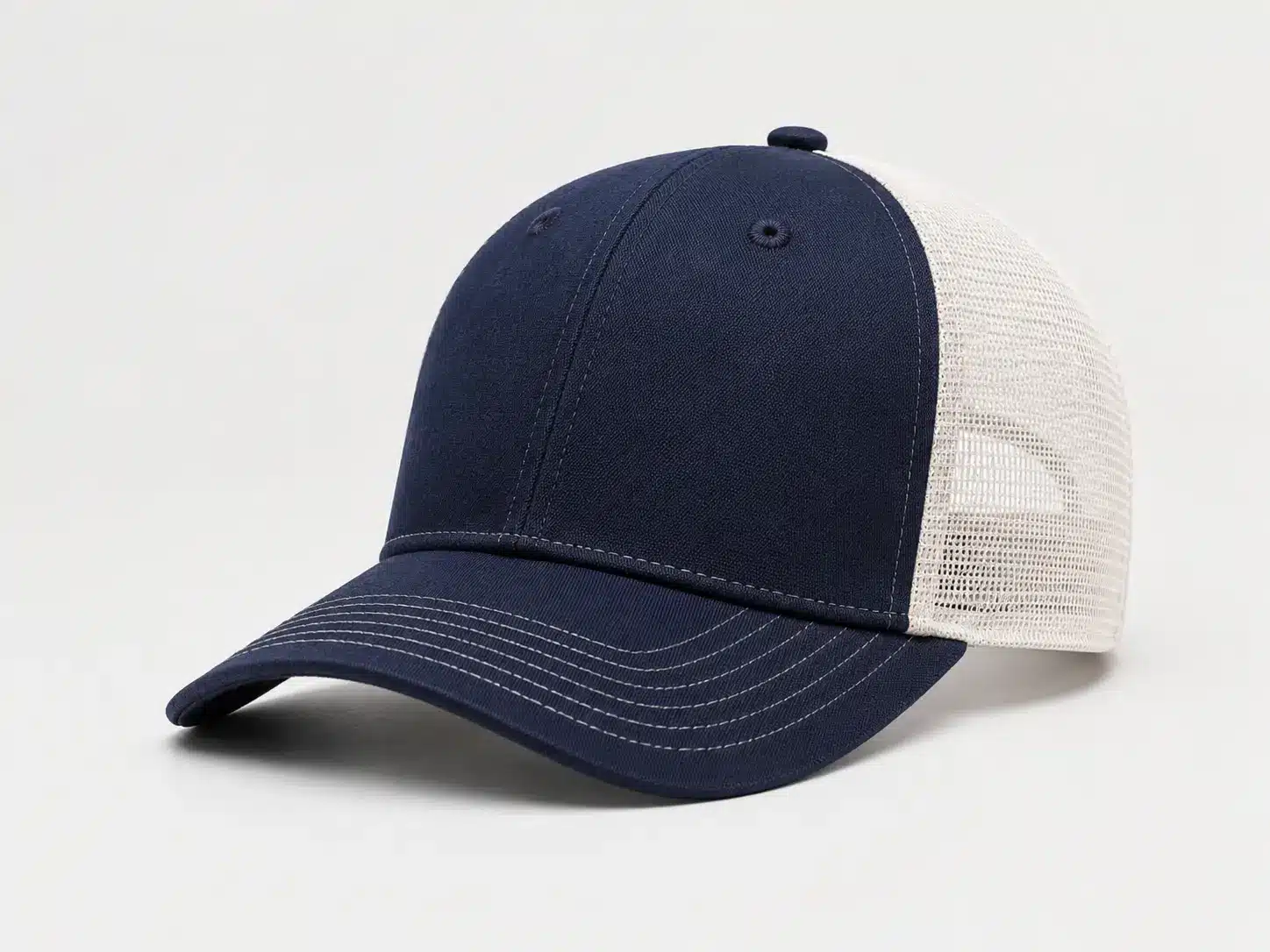
The primary difference lies in a material called buckram. This is a coarse cloth, often made of cotton or a synthetic blend, that is stiffened with adhesive or plastic. In a structured hat, we fuse this buckram to the back of the front panels. This creates a rigid “wall.” This wall allows the hat to stand upright on a table even when no one is wearing it. Without this reinforcement, the hat is considered “unstructured.” It will follow the natural curve of the wearer’s head, which we call a natural drape.
Resilience in Transit
From a supply chain perspective, the crown is a liability. Structured hats are prone to “cracking” if they are crushed during ocean freight. If a 20lb carton is stacked on top of a structured hat, the buckram can snap, leaving a permanent white line or crease. Unstructured hats are virtually immune to this. We can fold them, flatten them, and shove them into small mailers without damaging the product. If your distribution model relies on thin poly-mailers rather than corrugated boxes, unstructured styles are the safer bet for risk mitigation.
Material Synergy
I always advise my clients to match their fabric weight to their crown style. For example, a heavy 10.5oz cotton twill is stiff enough to offer some “pseudo-structure” even in an unstructured hat. However, if you are using a lightweight 100% polyester performance fabric, an unstructured crown will look like a “limp rag” on the shelf. In those cases, we use a lightweight buckram to give the fabric the support it needs to represent your brand professionally.
| Technical Spec | Structured (Reinforced) | Unstructured (Relaxed) |
| Internal Support | Fused Buckram (Single/Double Layer) | None (Self-Fabric Only) |
| Crown Height | Mid to High Profile | Low Profile |
| Fabric Weights | Best with 180gsm – 280gsm | Best with 250gsm+ (for shape) |
| Shape Retention | Permanent (Rigid) | Collapsible (Soft) |
Insider Insight: Always request a “smash test” report. Structured hats with low-quality buckram often crease permanently during ocean freight, leading to high QC rejection rates at the 3PL. We specify “washable nylon mesh buckram” for our high-end clients to ensure the stiffener doesn’t turn into mush if it gets wet.
III. Branding Strategy: Embroidery Density and Logo Integrity?
A common mistake in custom headwear procurement is treating the hat and the logo as two separate entities. In reality, the weight of your branding dictates the structure you need. We often see high-end logos fail because the fabric lacks the “skeletal support” to hold the thread count.
High-Profile Real Estate
If your marketing team insists on 3D Puff embroidery, your choice is already made. 3D Puff requires the needle to punch through foam to create depth. This process puts immense tension on the fabric. A structured hat provides the rigid canvas necessary to prevent the fabric from warping under this tension. Without the buckram reinforcement, a heavy 3D logo will pull the front panels inward, creating a “caved-in” look that ruins the premium feel.
The “Dad Hat” Aesthetic
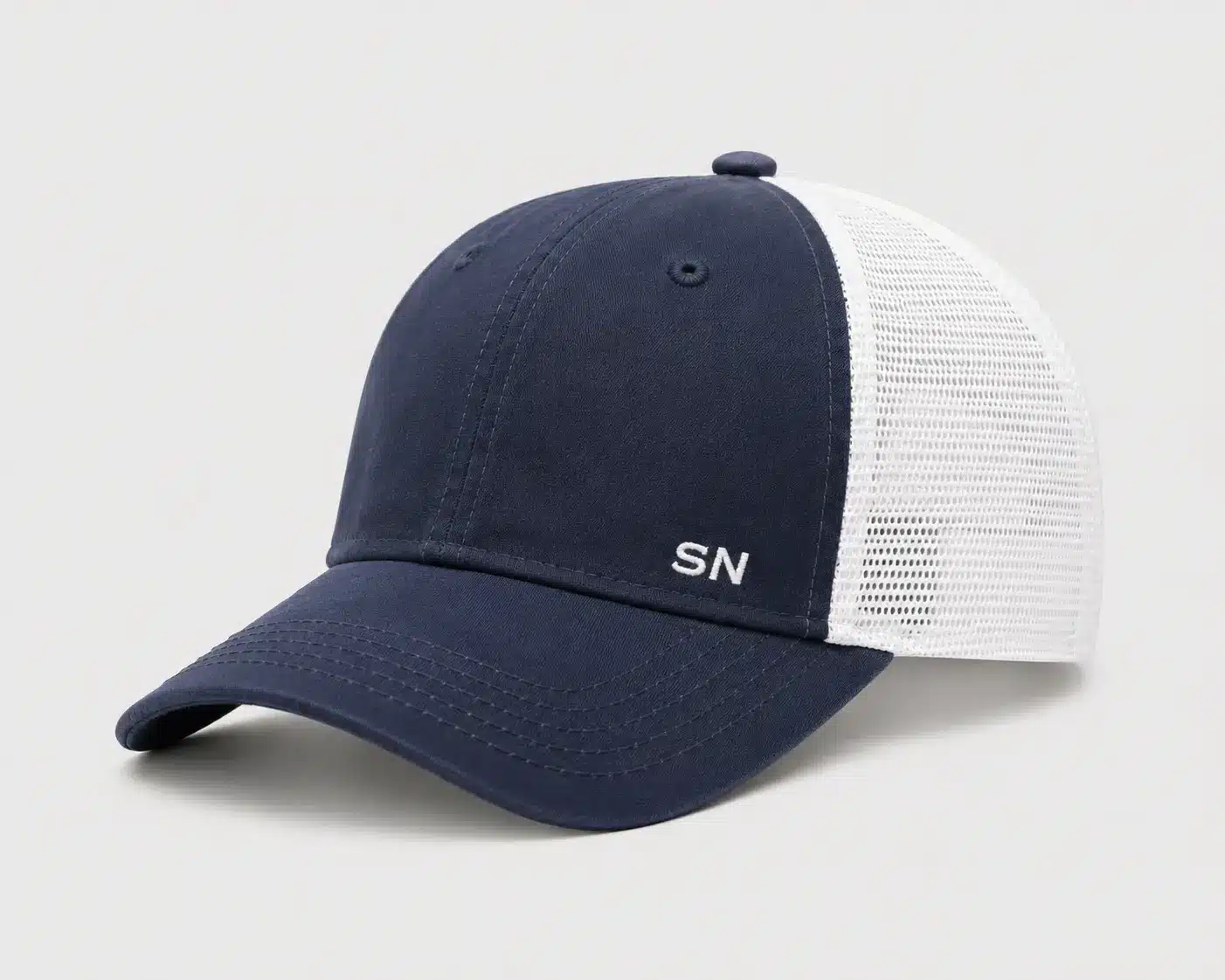
For lifestyle and retail brands, the unstructured hat is the gold standard for the “Dad Hat” look. This style favors flat-stitch embroidery or small, centered woven patches. Because there is no rigid backing, the embroidery moves with the fabric. This creates a comfortable, vintage feel that contours to the head. We recommend keeping stitch counts below 6,000 for unstructured crowns to avoid “puckering”—the unsightly bunching of fabric around the edges of the logo.
Visual Longevity
I evaluate branding success based on how the hat looks after six months of use. Structured hats excel here for professional services. The buckram acts as a permanent mold, keeping the logo crisp and legible even after the hat has been tossed in a truck or a locker. In contrast, unstructured hats develop a “personality” over time. While this is great for a surf brand, it is a risk for a security firm where “command presence” and neatness are non-negotiable.
Insider Insight: For high-stitch-count logos (over 8,000 stitches), unstructured hats often require a “tear-away” stabilizer on the inside. This stabilizer can be scratchy and irritate the wearer’s forehead. Structured hats eliminate this need because the buckram serves as the stabilizer, ensuring a smooth interior finish.
IV. Total Cost of Ownership (TCO): Shipping and Storage Economics?
In B2B procurement, the unit price is often a distractor. I always tell my clients to look at the landed cost. A structured hat might look better on a spreadsheet at first, but its physical volume can lead to a “freight tax” that erodes your margins.
Volumetric Weight vs. Actual Weight
Shipping structured hats means you are paying to ship air. Because the crowns are rigid, we cannot flatten the hats. This forces us to use larger shipping cartons with lower unit density. For air freight or long-haul trucking, carriers charge by volumetric weight (dimensions) rather than actual weight. You will find that shipping 1,000 structured hats costs significantly more than 1,000 unstructured ones because they require nearly 40% more cubic space.
Damage Mitigation
Structured hats require “white-glove” logistics. We often have to include plastic crown inserts or individual polybags with air pockets to prevent the buckram from collapsing under the weight of the boxes above. This adds to your packaging cost and, more importantly, increases the labor cost for your 3PL team during the intake and inspection process. Unstructured hats are much more forgiving; they can be “nested” tightly, reducing the carbon footprint and the cost per unit of shipping.
Inventory Turnover
If you manage a seasonal business, storage is a hidden cost. Structured hats cannot be stacked high without specialized shelving or reinforced cartons. If left at the bottom of a heavy stack in a hot warehouse for six months, the buckram can degrade or “set” in a warped shape. Unstructured hats offer higher inventory density. You can fit more units per square foot of warehouse space, maximizing your storage ROI.
| Logistics Metric | Structured (Rigid) | Unstructured (Nested) |
| Carton Capacity (Standard) | 144 units | 240 units |
| Shipping Volume | High (paying for air) | Low (dense packing) |
| Packaging Waste | Higher (inserts needed) | Minimal |
| Storage Density | ~25 units/cu. ft. | ~45 units/cu. ft. |
Insider Insight: You can fit roughly 25-30% more unstructured hats in a standard carton by “nesting” them. If your margins are thin, the freight savings on unstructured styles often outweigh the unit cost. I always suggest running a comparative freight quote before finalizing your SKU choice.
V. Target Demographics: Defining the End-User Use Case?
A hat is more than an accessory; it is a tool for the wearer. If the tool does not fit the environment, the end-user will discard it. I have found that procurement errors often occur when a buyer chooses a hat based on their personal taste rather than the functional requirements of the user’s daily routine.
Performance and Athletics
In the sports world, the structured hat is the undisputed champion. Whether it is on-field team sports or high-performance golf, athletes prefer a structured crown. It projects a sharp, aggressive image. More importantly, the internal buckram prevents the fabric from soaking up too much sweat and collapsing against the forehead, which can cause discomfort during intense activity. If you are buying for a performance-driven brand, structure is the industry standard.
Lifestyle and Outdoors
The trend has shifted heavily toward the “packable” unstructured hat for the hiking and travel sectors. Modern travelers want a hat they can shove into a suitcase or a backpack without a second thought. A structured hat would be ruined in minutes under those conditions. The unstructured hat is also inherently more breathable because there is no layer of adhesive-heavy buckram blocking airflow. For outdoor brands where comfort and portability are the primary selling points, unstructured is the strategic choice.
Corporate Uniformity
If you are managing a diverse workforce with varying head shapes, structured hats offer the benefit of visual consistency. They create a “uniform silhouette” across 500 employees. An unstructured hat, however, takes the shape of the individual’s head. This can lead to a “sloppy” appearance if not fitted perfectly. For professional service firms—such as delivery services, security, or hospitality—I recommend structured hats to maintain brand discipline and a “command presence.”
Insider Insight: Professional service firms should almost always opt for structured hats. They maintain their professional look for significantly longer under the rigors of daily wear. We often see that structured hats look “new” for 6–8 months, while unstructured hats begin to look “distressed” after just 2–3 months of heavy professional use.
VI. Factory Vetting: Identifying OEM Capabilities for Crown Construction?
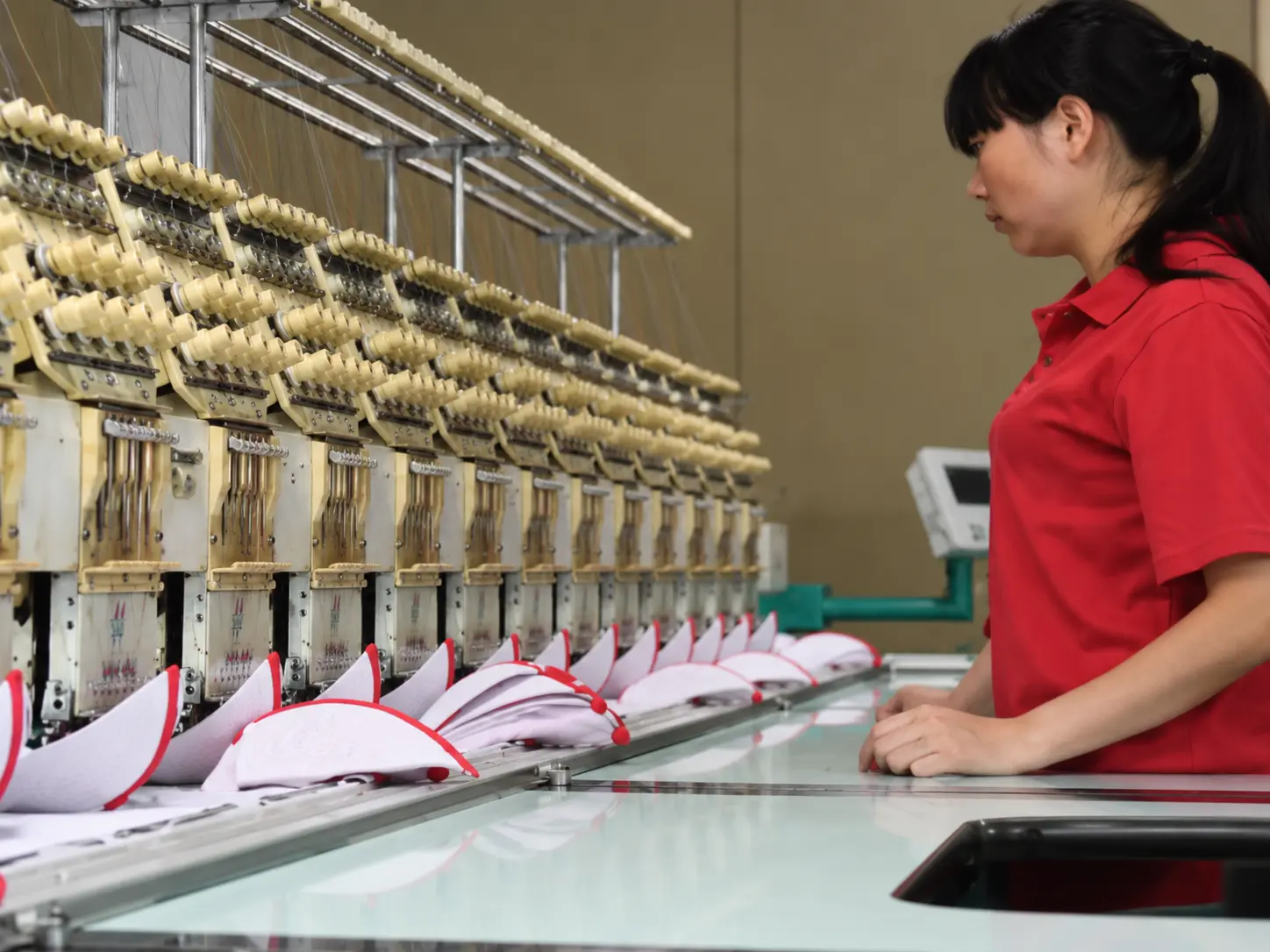
Not all factories are equipped to produce a high-quality structured hat. While an unstructured “dad hat” is relatively forgiving to manufacture, a structured crown requires precision engineering. If a factory lacks the right machinery or environmental controls, your hats will arrive with asymmetrical crowns or bubbling fabric.
Machine Specialization
The first thing I look for in a factory is their crown-seaming equipment. High-end structured hats should be produced using a double-needle crown machine. This ensures that the tension between the two front panels is perfectly even. If a factory uses standard single-needle machines for structured hats, the buckram will often twist during the sewing process. This results in a “leaning” crown that sits crooked on the wearer’s head.
Quality Consistency and Steaming
The “shape” of a structured hat is finalized in the steaming and blocking room. I always ask to see the factory’s aluminum molding stations. A quality OEM uses heated metal head-forms to “set” the buckram into its final shape. If a factory air-dries their hats or uses cheap plastic molds, the structure will be inconsistent. You might find that the “Crown Slope”—the angle from the brim to the top—varies by several millimeters across the same batch, which is a major red flag for retail-ready goods.
Compliance and Material Safety
The buckram is held together by heat-activated resins and adhesives. In low-cost manufacturing hubs, these glues can contain formaldehyde or restricted phthalates. For US-based procurement managers, this is a significant compliance risk under California Prop 65 or REACH standards. I recommend requiring your supplier to provide an Oeko-Tex Standard 100 certification for the internal structural components, not just the outer fabric shell.
Insider Insight: Ask the factory for their “Crown Symmetry” tolerance. Top-tier OEMs should guarantee less than a 2mm variance between the left and right panels of a structured hat. If they cannot provide a specific tolerance measurement, they likely don’t have a formal QC process for crown alignment.
VII. Featured Snippet: How to Choose Between Structured and Unstructured Hats?
When a brand’s reputation is on the line, the decision process must be data-driven. I’ve developed a 30-second decision matrix to help my clients cut through the marketing noise and select the right SKU based on technical requirements.
Structured hats feature a reinforced crown (buckram) that maintains its shape when removed. Unstructured hats lack this reinforcement, offering a soft, collapsible fit. Choose Structured for professional branding and 3D logos; choose Unstructured for comfort, portability, and vintage aesthetics.
The 30-Second Decision Matrix
- Is the logo 3D Puff or high-density? Yes → Structured.
- Is the hat for active duty/uniforms? Yes → Structured.
- Does the brand value a “vintage/worn-in” look? Yes → Unstructured.
- Is the product being sold to hikers/travelers? Yes → Unstructured.
- Is shipping cost the primary constraint? Yes → Unstructured.
Step-by-Step Selection Process
- Analyze the Brand Persona: A law enforcement agency or a premium golf club requires the rigid discipline of a structured hat. A tech startup or a micro-brewery usually aligns better with the relaxed, approachable feel of an unstructured “dad hat.”
- Audit the Artwork: Send your logo to the factory. If the stitch count exceeds 8,000, I strongly recommend a structured front to prevent “puckering.”
- Review the Distribution Channel: If you are shipping 10,000 units directly to individual customers via thin mailers, choose unstructured to avoid transit damage. If you are stocking retail shelves, choose structured for maximum shelf appeal.
Insider Insight: If you are stuck between the two, go with a “Hybrid.” Use a structured front for branding impact but a soft mesh back (trucker style). This offers the best of both worlds: logo support and breathability.
VIII. Risk Mitigation: Avoiding the “Cheap Stiffener” Trap?
In my years auditing global factories, I have discovered that the buckram is where suppliers most frequently hide cost-cutting measures. Because it is buried beneath the fabric, a buyer rarely sees the quality of the stiffener until it is too late. Using a sub-standard stiffener is a liability that can lead to large-scale consumer returns.
The Hidden Chemicals
Low-cost factories often use buckram treated with formaldehyde-based resins to achieve rigidity. This is a massive risk for US procurement managers. Under California’s Proposition 65, products containing certain levels of formaldehyde must carry a warning label. Worse, these resins can cause “contact dermatitis” (skin rashes) when the wearer begins to sweat. I always insist that my clients specify “Azo-free” and “Formaldehyde-free” adhesives in their tech packs.
Heat Sensitivity and “Bubbling”
During the final blocking phase, hats are subjected to high-temperature steam. If the factory uses a cheap, low-melt adhesive on the buckram, the glue can separate from the outer fabric. This creates “bubbles” or ripples on the front of the hat. You may not notice this in the golden sample, but in mass production—where heat settings are often rushed—it becomes a common defect. We recommend a “Peel Test” during QC: the buckram should be so well-fused that it cannot be pulled away from the fabric without damaging the fibers.
Post-Wash Distortion
The true test of a structured hat is the first rainstorm or wash cycle. Budget factories often use “Paper-Buckram”—a stiffened cellulose material that feels like cardboard. Once wet, this material dissolves or clumps into hard balls inside the crown. The hat is effectively destroyed. For any brand with a price point above $25.00, I recommend specifying Washable Nylon Mesh Buckram. It retains its memory and stiffness even after repeated exposure to moisture.
Insider Insight: Beware of “Paper-Buckram.” If you can hear a “crunchy” or “paper-like” sound when you squeeze the crown of a sample, the factory is using a cellulose stiffener. Always specify “Washable Nylon Mesh Buckram” to ensure your hats don’t turn into mush after a rainy day.
IX. Sustainability and Material Innovation?
In today’s B2B landscape, sustainability is no longer a “nice-to-have” feature; it is a corporate mandate. However, I often warn my clients that a “recycled” hat is rarely as eco-friendly as the label suggests. The internal structural components are the biggest hurdle to achieving true circularity in headwear procurement.
Recycled Stiffeners
Most “recycled” hats only use rPET (recycled polyester) for the outer shell. The internal buckram is almost always still virgin plastic or a blend of synthetic resins. To lead the market, you should specify rPET buckram. This material is derived from post-consumer plastic waste and offers the same rigidity as traditional stiffeners. While it may add a 5-10% premium to your unit cost, it allows your brand to claim a much higher percentage of recycled content by weight.
Biodegradability Hurdles
If your ESG (Environmental, Social, and Governance) goals require a 100% compostable product, you must pivot to an unstructured hat. As of now, there is no widely available, biodegradable structured insert that can withstand the humidity of global shipping without degrading prematurely. For “Zero-Waste” projects, we recommend an unstructured 100% organic cotton hat with a cork or embroidered eyelet. This ensures that the entire product can return to the earth without leaving synthetic micro-plastics behind.
Ethical Sourcing and Transparency
The supply chain for stiffening agents is notoriously opaque. Many OEMs buy their buckram from third-party chemical processors with little oversight. To mitigate reputational risk, I suggest requesting a Global Recycled Standard (GRS) certificate for all internal components. This ensures that the recycled claims are verified from the source, protecting you from “greenwashing” accusations that could arise during a corporate audit.
Insider Insight: Many “Organic Cotton” hats still use synthetic polyester buckram. To claim a 100% sustainable product, you must verify the internal structural components, not just the shell fabric. I always tell my clients: “If you can’t compost the stiffener, the hat isn’t organic.”
X. Conclusion: Making the Strategic Pivot?
In my fifteen years of navigating global supply chains, I have found that the most successful procurement managers do not choose between structured vs unstructured hats based on a coin flip. They choose based on a calculated alignment of brand identity, user utility, and logistical efficiency.
A structured hat is your primary tool for professional branding. It offers the “skeletal support” needed for bold, 3D Puff logos and ensures your team maintains a consistent, disciplined silhouette. However, you must account for its “volumetric tax” in your shipping budget and vet your factory’s steaming capabilities to avoid crown asymmetry.
An unstructured hat is your strategic choice for lifestyle appeal and cost efficiency. Its packability makes it the darling of the outdoor and travel sectors, while its nesting capability allows you to slash freight costs by up to 30%. It is the safer, more comfortable option for casual wear, provided your logo design is optimized for a softer canvas.
The Consultant’s Final Take: If you are entering a new market and cannot decide, I recommend a Hybrid Trucker Style. By using a structured front panel with a soft mesh back, you gain the branding real estate for a high-impact logo while maintaining superior breathability and slightly better nesting for transit.
FAQ
1. How can I verify if a factory is using “Paper-Buckram” without visiting the facility? Request a “Soak and Snap” test during the pre-production sample (PPS) phase. Ask the supplier to submerge the hat in water for 10 minutes, let it air dry, and then compress the crown. If the stiffener clumps, loses its shape, or creates a “crunching” sound like dry cardboard, they are using low-grade cellulose paper. A professional-grade structured hat should utilize a washable nylon mesh buckram that retains its memory after drying.
- Expert Tip: In your Purchase Order (PO), explicitly state that “100% Nylon Mesh Buckram” is a required material specification. This gives you legal grounds for a full refund if a third-party lab test proves otherwise.
2. Is there a specific stitch-count limit where an unstructured hat becomes a liability? Yes. In my experience, once a logo exceeds 7,000 to 8,000 stitches, an unstructured hat begins to “pucker” or bunch up at the edges. The fabric simply cannot handle the tension of the thread without internal support. If your branding requires high-density fills or heavy 3D foam, you are forced into a structured SKU. If you must use an unstructured style for a complex logo, consider a woven patch instead of direct embroidery to maintain fabric integrity.
- Expert Tip: Always ask your factory for a “Digitized Stitch Map” before production. If the map shows heavy overlapping segments in the center, it will likely cause the front panel to sag on an unstructured hat.
3. Does choosing a structured hat increase my “Damaged on Arrival” (DOA) risk during ocean freight? Significantly. Structured hats occupy more “dead air,” and if the bottom cartons in a container are crushed, the buckram in those hats can permanently crack. Unlike unstructured hats, which can be steamed back to life, a cracked structured crown is a total loss. To mitigate this, we recommend specifying “double-wall corrugated shipping cartons” and a maximum stack height of five cartons in the warehouse.
- Expert Tip: For high-volume structured orders, insist on “plastic crown stay” inserts. These $0.05 inserts act as internal scaffolding during transit and can reduce your QC rejection rate by up to 15%.
4. Can a structured hat truly meet 100% sustainable or organic certification? This is a major transparency gap in our industry. Most “100% Organic Cotton” structured hats are actually only 85% organic by weight because the internal buckram and the brim insert are made of virgin plastics or synthetic glues. If your brand relies on strict ESG compliance, you must request GRS (Global Recycled Standard) certification for the buckram itself. If the factory cannot provide this, your safest strategic move is to pivot to an unstructured organic hat with no internal stiffener.
- Expert Tip: Check the “Interlining” section of the factory’s Material Safety Data Sheet (MSDS). If it lists “Polyester-blend adhesive,” the hat is not fully biodegradable, regardless of the shell fabric.