
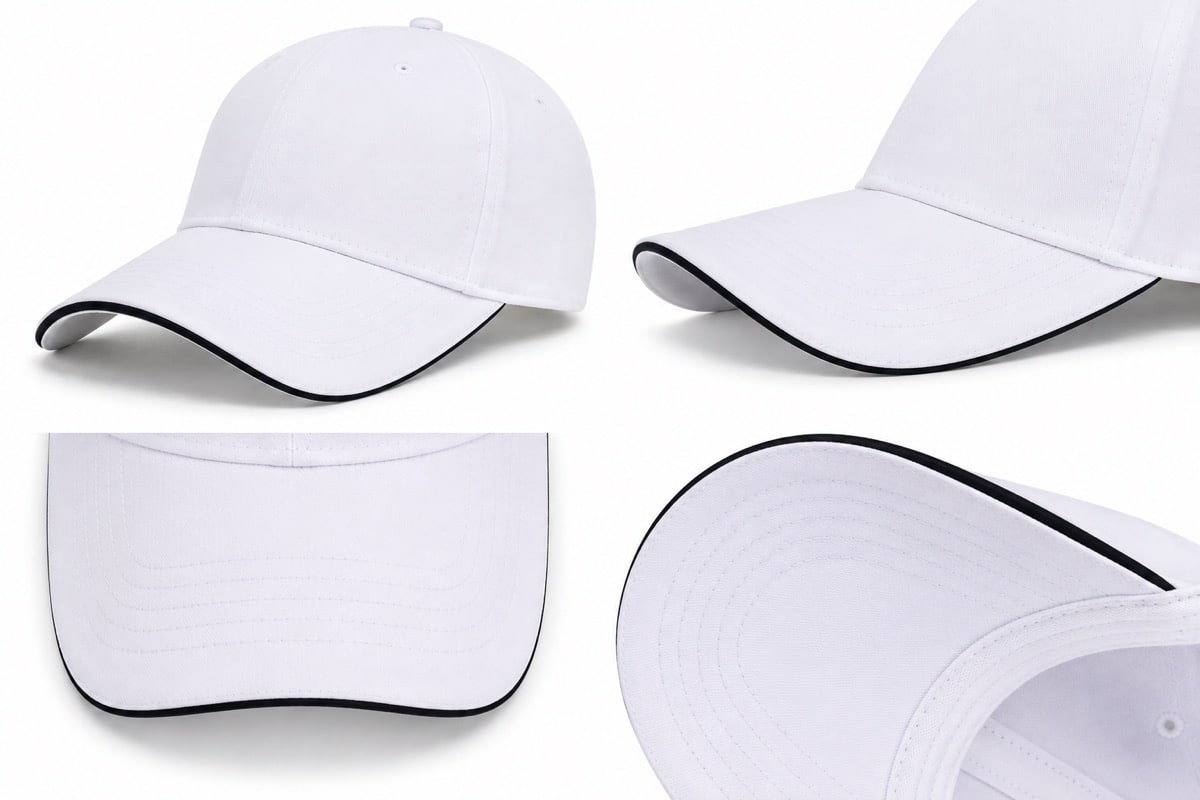
A cap can have the right crown and logo yet still feel wrong when the visor is too long, too rigid or curved differently from the approved sample. For a custom program, the visor needs its own specification. “Standard brim” leaves too much to interpretation.
Start with the people who will wear the hat. A retail collection may be judged on silhouette; a staff or event program may need a familiar shape across many wearers. Neither brief tells a factory the exact curve, insert feel, edge finish or stitching. Those decisions should be visible on a physical sample.
Define the shape in more than one view
A flat and a pre-curved visor are easy to distinguish in a product photo. Two moderate curves are not. Request a straight-on view to judge symmetry, a side view for the angle and projection, and an underside view for the actual curve. Check the visor against the crown: a broad visor on a shallow crown changes the silhouette even if each component looks reasonable alone.
Record the measurement method as well as the number. A supplier can measure projection from the center seam, the crown join or along the curved surface and reach different results. Mark the points on the approved sample, then have the bulk sample measured the same way. Photograph any shaped or squared outer edge directly from above.
Choose stiffness by handling the finished sample
The visor insert, fabric layers and stitching all affect how it feels and holds shape. “Soft” and “firm” are useful first descriptions, but they are not a purchasing specification. Compare two actual samples in the intended fabric and construction. Bend them as a wearer would, check the edge and look at the profile after release. If the cap will be packed tightly, include a trial pack-out in the approval.
A visor that feels right in a showroom may behave differently once the top and underbrim fabrics, piping and stitch rows change. Review the final combination, not only an insert swatch. A soft lifestyle cap and a structured team cap may both be appropriate for different audiences.
Stitching, edge finish and underbrim color are design choices
Visible stitch rows change the visor’s appearance and make inconsistencies easier to see. Specify the number and spacing of rows by reference to an approved physical sample or drawing. Inspect whether the lines run evenly around both sides, especially near the outer edge. If you choose contrast thread, confirm its color on the actual fabric rather than a screen image.
Piping and other edge treatments add a strong outline. That can help carry a brand color, but a thick or uneven edge may make the visor look heavier than intended. The underbrim remains visible when the cap is worn or displayed. Decide its color, fabric and any print alongside the top fabric; a late change can alter the sample’s appearance and cost.
Approve a visor specification before bulk production
- Keep front, side, top and underside photos of the approved sample.
- Record visor width and projection with named measurement points.
- Confirm flat or pre-curved shape and the acceptable curve on the actual sample.
- Identify top fabric, underbrim fabric, insert feel, edge finish and thread color.
- Check row count, spacing, symmetry and the join to the crown.
- Unpack a trial carton and compare several visors with the approval sample.
For a range of colorways, decide whether every color uses the same visor construction. A change to the underbrim or piping color should be documented in the colorway specification. Our custom baseball caps page shows the wider construction decisions, while the customization guide covers component coordination.
SN’s usual starting minimum for regular custom hats is 100 pieces per style, per color. Final specifications, availability and quotation are confirmed for each project. Send a reference cap or multi-angle photos, the intended wearer, quantity by color and preferred visor feel. We can review what needs to be fixed in the sample before bulk production. Start your project.
Buyer questions
Can a supplier reproduce a visor from one photo?
A photo communicates the general silhouette, but rarely shows insert feel, underside or measurement points. A physical reference and approved sample reduce ambiguity.
Does more stitching always mean a stronger visor?
No universal row count proves strength. Evaluate the complete sample, including insert and fabric, against the intended use.
Should visor curve be checked before or after packing?
Both. Approve the finished sample first, then open a trial carton to see whether the proposed pack-out changes the curve.