

A custom hat can match the approved color and logo yet still fail when the fit changes from one production run to the next. For repeat orders, buyers need more than a size label. They need a defined measurement method, an approved tolerance and a record that connects each reorder to the same fit standard.
This guide explains how to control custom hat sizing tolerance without pretending that a sewn textile product can be identical to the millimeter. The aim is a repeatable fit: the same measurement points, the same conditions and an acceptable range agreed before bulk production.
Custom Hat Sizing Tolerance at a Glance
| Control point | What the buyer should define | Why it matters |
|---|---|---|
| Head circumference | Finished internal measurement and measurement method | Controls the basic size label and wearable range |
| Crown depth | Measurement path from crown top to sweatband | Changes how high or low the hat sits |
| Opening and closure | Adjustment range at agreed closure positions | Affects fit across different head sizes |
| Sweatband | Material, width, thickness and stretch behavior | Directly affects the internal fit |
| Finished condition | When and how hats are conditioned before measuring | Heat, steam and packing can temporarily change shape |
| Tolerance | Approved plus/minus range for each critical point | Creates an objective pass/fail rule |
Why a Size Label Is Not Enough
Labels such as One Size S/M and 58 cm describe an intended fit but they do not explain how the finished hat was measured. Two hats with the same label can feel different because of crown depth, sweatband construction, fabric stretch, closure position or the shape created during pressing.
That is why a reorder should reference a measurement specification and an approved physical sample. The sample shows the overall feel; the specification identifies the dimensions that must remain controlled.
The Measurements That Define Hat Fit
Internal circumference
Internal circumference is normally measured along the inside of the sweatband. The method must state whether the closure is open, centered or fixed at a specified position. Pulling the tape tight or compressing the sweatband changes the result, so the tape should follow the inside curve without stretching the hat.
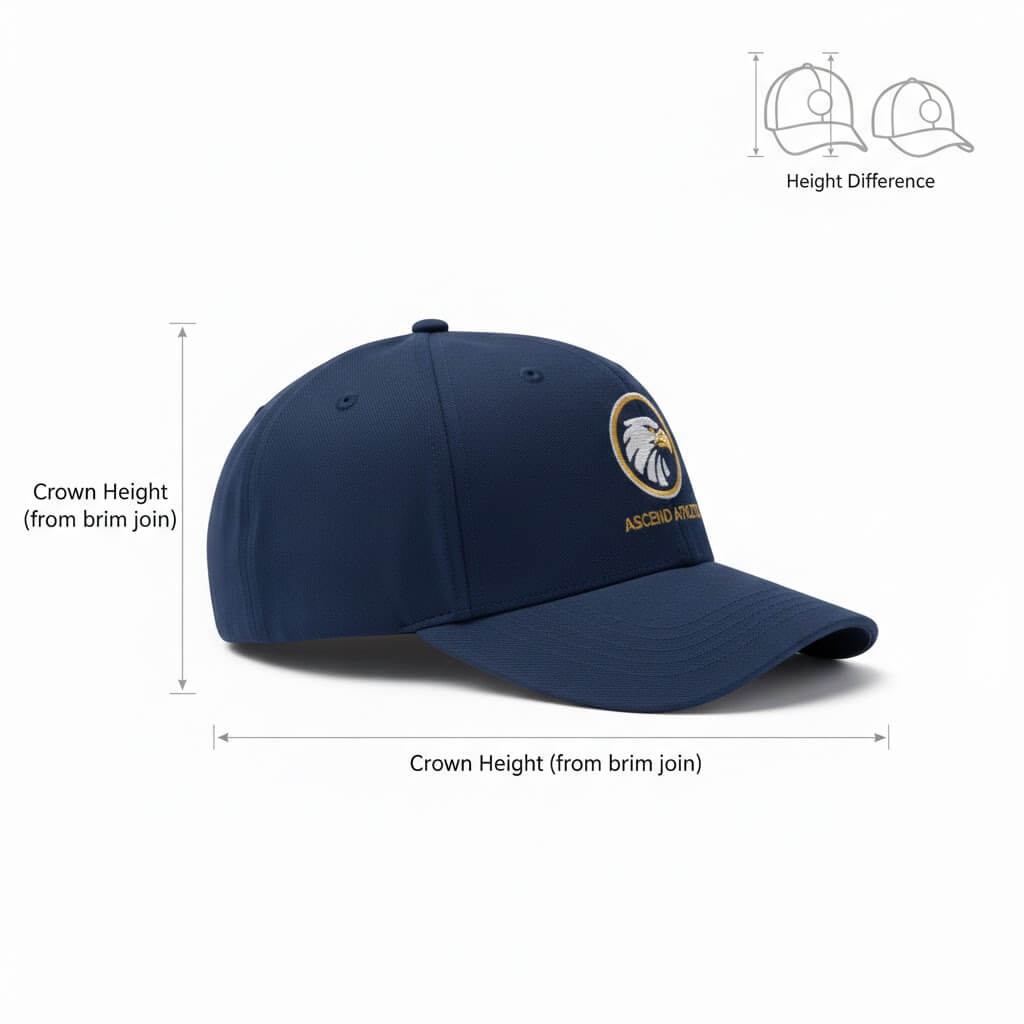
Crown depth
Crown depth influences perceived size even when circumference is correct. A shallow crown may sit high and feel tight or unstable; a deeper crown may cover more of the head. Define the exact path of measurement because a straight vertical measurement and a measurement following the crown surface are not interchangeable.
Closure adjustment range
For snapback, buckle, hook-and-loop and elastic closures, record the usable minimum and maximum fit. For a snapback, also define the reference setting used for sample approval. For an elastic or stretch-fit hat, measure both the relaxed condition and the practical stretch range rather than relying on a generic size name.
Sweatband and opening shape
The sweatband is part of the fit system. Changes in foam, elastic, backing or sewing tension can alter the internal circumference or pressure around the head. The rear opening shape and width can also affect comfort even when the measured circumference appears unchanged.
How to Set a Realistic Tolerance
There is no single tolerance that is automatically correct for every hat. A tolerance should reflect the construction, material behavior, measurement repeatability and the degree to which a dimension affects fit. The buyer and manufacturer should agree the range during sampling rather than copying a number from an unrelated style.
Use tighter control for measurements that directly affect wearability, but do not set limits that cannot be measured consistently. If two trained inspectors obtain different results from the same hat, improve the measurement method before tightening the tolerance.
| Question | Decision |
|---|---|
| Is the measurement critical to fit? | Give it a specific tolerance and inspection frequency |
| Can inspectors locate the same points? | Add a diagram and written measurement path |
| Does the fabric stretch or recover? | Define relaxed conditions and waiting time |
| Is the closure adjustable? | Specify the reference position and usable range |
| Did the approved sample feel correct? | Use its confirmed dimensions as the starting reference |
Seven Checks for Consistent Reorders
- Lock the measurement diagram. Mark every start point, end point and measurement path.
- Keep the approved sample. Store a sealed reference sample in a stable condition and record its approval date.
- Freeze critical materials. Record the fabric, sweatband, buckram, closure and other components that affect fit.
- Confirm the measuring tool. Use the same type of non-stretch tape or suitable gauge and check it against a known reference.
- Define conditioning. State whether measurement occurs after steaming, cooling, relaxation or unpacking.
- Measure across the run. Check units from different cartons or production stages instead of measuring only one convenient sample.
- Compare the reorder with the original record. Review the actual measurements, not only photos and size labels.
What Can Cause Size Drift?
Hat fit can change when a pattern is revised, a panel is cut differently, seam allowances vary or sweatband tension changes. Fabric stretch, shrinkage, steam shaping and packing pressure can also affect the finished form. A component substitution that looks visually similar may behave differently during sewing or wear.
Do not diagnose every sizing problem as a cutting error. Compare panel dimensions, seam construction, sweatband attachment, closure setting and finished conditioning. The source may be one factor or several small changes working together.
How to Measure a Reorder Sample
- Place the hat in the agreed relaxed condition without forcing the crown flat.
- Set the closure to the documented reference position.
- Measure the internal circumference along the sweatband using the approved path.
- Measure crown depth at the specified front, side or back position.
- Record the result for each unit rather than reporting only an average.
- Compare minimum, maximum and distribution with the approved range.
An average can hide a mixed shipment. If some hats are too small and others are too large, the mathematical average may still match the target. Buyers need individual readings or a clear distribution summary for the inspected sample.
Different Hat Types Need Different Fit Controls
| Hat type | Fit points to watch |
|---|---|
| Adjustable baseball cap | Internal circumference at a fixed closure position, crown depth and opening shape |
| Snapback trucker hat | Snap setting, foam or twill front shape, mesh stretch and sweatband tension |
| Five-panel hat | Side-to-side crown shape, depth, strap range and seam placement |
| Stretch-fit hat | Relaxed circumference, recovery and pressure across the intended size range |
| Performance hat | Lightweight fabric stretch, sweatband recovery and heat-related shape changes |
When a brand changes fabric or crown construction, the previous pattern should be treated as a reference, not an automatic final answer. Review the relevant customization options together because fabric, closure, structure and sweatband choices all influence fit.
What Buyers Should Put in the Tech Pack
- Size name and target user range.
- Internal circumference target and tolerance.
- Crown depth measurement path and tolerance.
- Closure type, reference position and adjustment range.
- Sweatband construction and material reference.
- Measurement diagrams with stable landmarks.
- Conditioning and measurement instructions.
- Approved sample identification and revision date.
Frequently Asked Questions
What is custom hat sizing tolerance?
It is the permitted plus-or-minus variation from an approved target measurement. It should identify the exact measurement point, method and condition as well as the numeric range.
Should every hat use the same circumference tolerance?
No. The achievable and useful range depends on the hat construction, material, closure and measurement repeatability. Agree it during development for the specific style.
Why can two hats with the same circumference feel different?
Crown depth, crown shape, sweatband thickness, stretch, closure position and rear opening can change perceived fit even when circumference is similar.
Can an approved sample control future reorders by itself?
A physical sample is important, but it should be paired with measurements and component records. Samples can age, deform in storage or be interpreted differently without a written specification.
Build the Reorder Standard During Sampling
The best time to control repeat-order sizing is before the first bulk run. Approve the fit, document how it was measured and preserve the components that influence it. For a full custom project, send your target wearer, hat style, existing sample and preferred size range through our contact page. We can review fit requirements as part of the complete hat construction.