
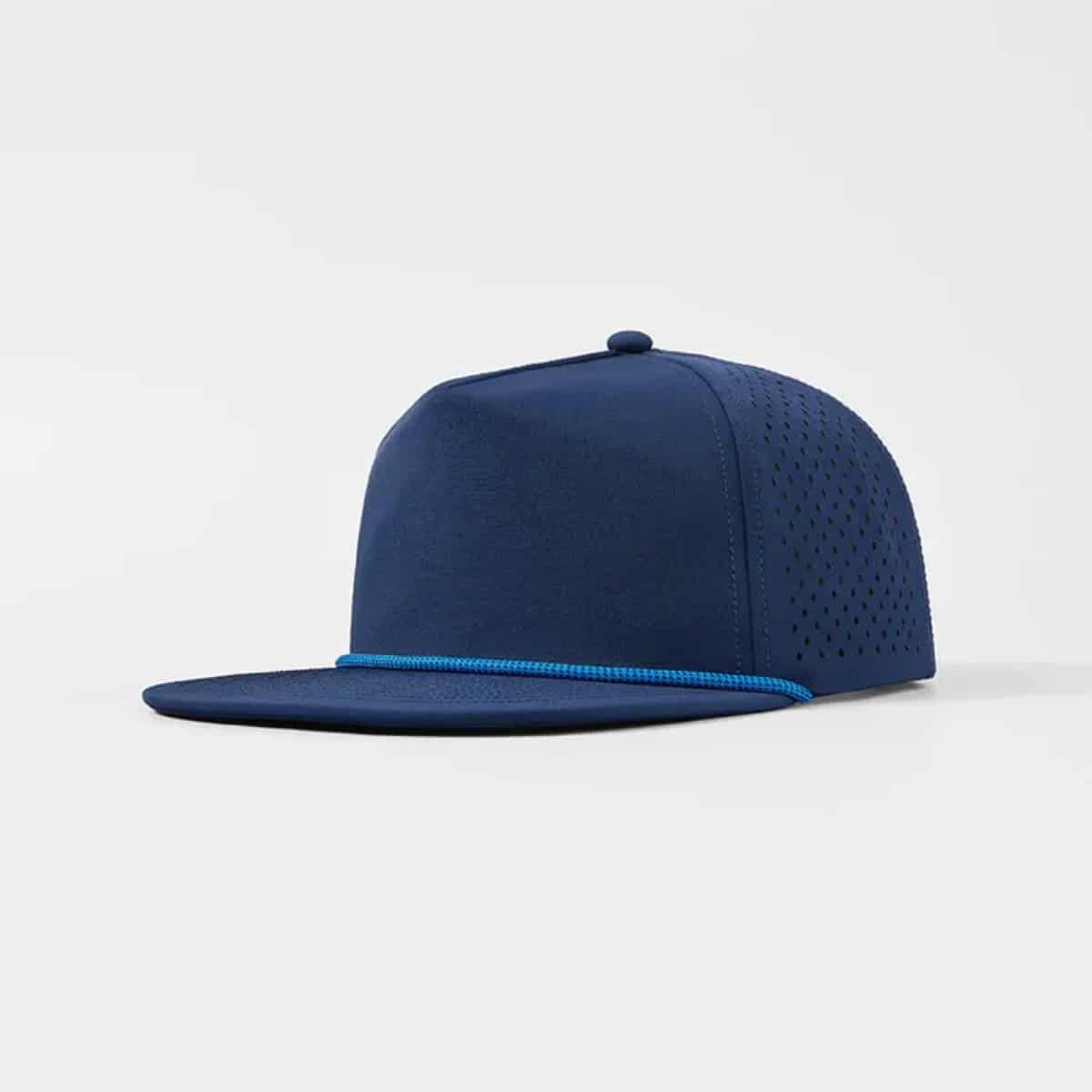
A rope across the visor join can make an otherwise familiar cap look distinct. It is not limited to golf. Retail brands, clubs and merchandise programs can use the detail too — but the cord has to work with the crown, visor and front mark. Treat the rope as part of the construction, not an afterthought added to a finished cap image. Choose the silhouette first, then the cord, then the logo: the silhouette decides how much space the rope gets and how much room is left for the front mark. Every custom style starts at 100 hats per style and color, so plan each one in blocks of 100. Samples take about one week after specifications, artwork and the sample payment are confirmed, and bulk takes about 30 days after the sample is approved. Never order bulk before the sample is approved.
This guide keeps the original question — how to make the cord work with the cap — and adds the parts the first version left out: a silhouette comparison, a cord spec checklist, a sample approval list and a color-route method. The full custom range is on our full custom OEM hats page.
Choose a Cap Silhouette Before the Cord Color
Compare the front height, crown structure and visor shape of the available samples. A low, soft front gives the rope a different role from a tall, flat-front design. Decide whether the final hat should feel understated enough for everyday wear or make a stronger visual statement at an event. This decision affects how much contrast the cord needs and how much space remains for a front logo.
| Silhouette | Rope role | Logo space | Best use | Watch out for |
|---|---|---|---|---|
| Low unstructured cap | A quiet detail; the cord reads as a trim line | A soft, curved front — keep the logo small and simple | Everyday retail, casual brand merch | A soft crown changes shape when worn — check the rope on a worn sample |
| Structured 5-panel cap | A clear focal line across a flat front | One flat front panel gives a clean logo area | Golf and member events, retail drops | Rope placement against the single seam — check alignment on the sample |
| Structured 6-panel cap | A strong line across a familiar crown | Front panels with a center seam — keep the logo clear of it | Team and club programs, event merch | The center seam runs through the front — plan the logo around it |
| Visor | The cord marks the band, not the crown | A narrow band — the logo must fit a small area | Warm-weather events, staff and volunteers | No crown to carry the look — the cord and the band do all the work |
The table is a planning framework, not a rule: the sample is where the silhouette, the rope and the logo are judged together. For golf-specific programs, the rope hat is the player-gift pick — see our golf tournament hats guide for how the rope hat fits a tournament order. The broader range of golf styles is on our custom golf hats page.
Inspect the Cord as a Finished Component
Look at its diameter, texture, color consistency, end finish and attachment along the visor join. A thick cord can compete with a small embroidered mark; a very fine cord may disappear in a busy color scheme. Check the cord on the physical hat from front and side, including where the ends meet the panels. Do not approve by a color chip alone, because the same hue can look different as a braided component.
Record each item in the spec before sampling:
- Cord: diameter, texture, color and how the color reads as a braided component
- End finish: how both rope ends are finished and attached to the panels
- Attachment: where the cord meets the visor join and how it is fixed
- Crown and visor: crown height and structure, visor shape and profile
- Logo: artwork, size, placement and distance above the rope
- Color combinations: the approved cord color for each base fabric, named per SKU
The construction detail behind these points — rope placement, crown height and visor shape — is covered in our rope hat construction guide; this guide does not repeat it. How to write the spec itself is covered in our tech pack guide.

Make the Logo Readable Without Crowding
Set the front mark at its intended dimensions above the rope. Review it while the cap is worn: the curved surface, front seam and visor angle all change the perceived spacing. If a patch is proposed, assess its thickness and lower edge against the cord. If embroidery is proposed, check whether stitch density changes the front shape. This is a visual and fit review, not a contest to put every possible brand element on one hat.
Look at the cord’s scale against the visor and front panel, then inspect the attachment on the actual sample. A logo that reads well on a flat mock-up can crowd the rope on the real cap — the sample is where that is caught.
Approve the Sample the Right Way
Check the cord on the physical hat, not on a rendering. On the sample, check these points before approval:
- Front and side: the cord’s placement across the visor join from both angles, including where the ends meet the panels
- Worn review: the rope, the logo and the crown together on a real head — fit problems show up only when the hat is worn
- Daylight and indoor light: the cord must remain visually distinct from the visor seam under both
- Scale: the cord against the visor and the front panel — a thick cord can overwhelm a small logo, a fine cord can disappear
- Attachment: the cord fixed firmly along the join, with both ends finished the same way
Keep the approved cap sample, cord reference, crown and visor measurements, logo artwork and attachment position together. Our MOQ guide explains how the 100-unit minimum works per style and color.

Compare Two Color Routes, Not a Wall of Options
A tonal rope can make the detail more subtle; a contrasting rope can make it a focal point. Sample one of each against the actual front logo. Look at the hat in daylight and indoor light, and check whether the cord remains visually distinct from the visor seam. The best choice depends on the identity of the line and where the hat will be worn. An event hat may tolerate stronger contrast than a quiet retail basic, but that is a merchandising choice, not a technical rule.
If several styles share one rope color, confirm the component against each base fabric. Different backgrounds can make the same cord appear warmer or cooler. The production brief should name the approved combination for each SKU, including the finish at both rope ends.
Record the Details for Replenishment
For a merchandise line that may reorder, name each approved color combination as its own SKU. A repeat order should not depend on someone remembering whether the last navy cap used bright blue or dark blue cord. Keep the approved sample and the cord reference with the spec, and note any approved changes by date. The same quantity rule applies to every new style and color: each one starts at 100, planned in blocks of 100, approved by sample before bulk. Rope hats are one of the four styles on our 2026 shortlist — see our 2026 hat styles shortlist for how the rope hat fits a program with a theme.
The Buying Decision
If the program needs a rope hat, decide in this order: silhouette first, then cord, then logo — and approve the sample before the bulk order. A rope hat is a one-shot order: the cord, the crown and the logo arrive together, so the sample is the last chance to catch a mistake in any of them.
Send us your silhouette, cord color and logo through Request a Quote — we reply within one business day.
FAQ
Can a rope hat work outside golf?
Yes. The rope is a construction detail, not a golf-only mark: retail brands, clubs and merchandise programs use it too. The choice is the silhouette and the cord contrast — a quiet tonal cord on a low unstructured cap suits everyday retail, while a contrasting cord on a structured 5-panel cap suits events. Golf is one use, not the only use.
How do I choose between a tonal and a contrasting cord?
Sample one of each against the actual front logo and look at the hat in daylight and indoor light. A tonal cord is more subtle and suits a quiet retail basic; a contrasting cord is a focal point and suits an event hat. Check that the cord stays visually distinct from the visor seam under both lights before deciding.
What should I check on a rope hat sample?
The cord’s placement from front and side, where the ends meet the panels, the cord’s scale against the visor and the front panel, the logo’s spacing above the rope while the cap is worn, and the cord’s color against the actual base fabric. Approve the cord on the physical hat, not by a color chip alone.