
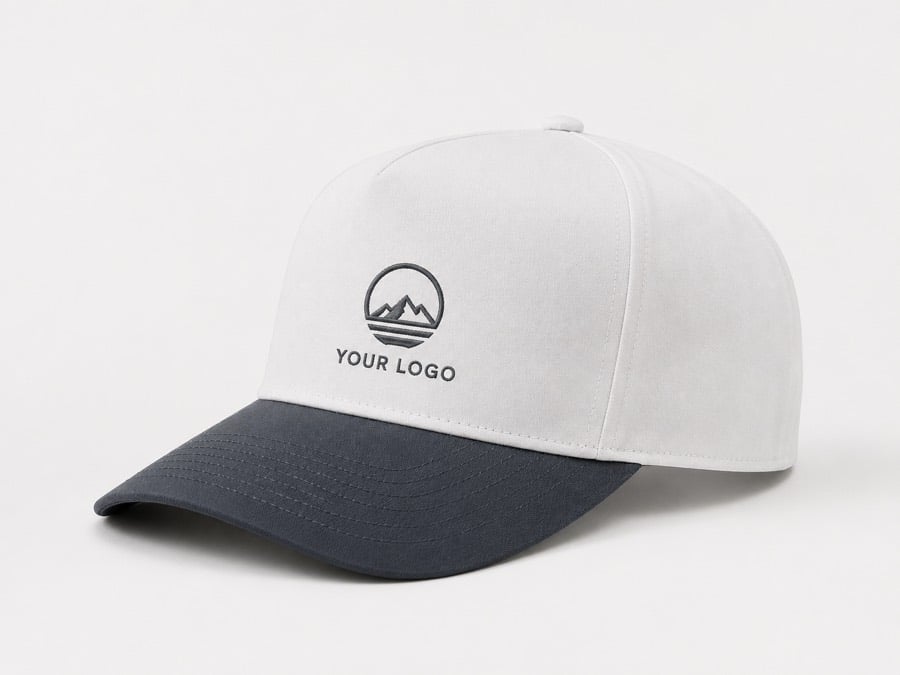
Before a logo goes on a custom hat, confirm in writing who can authorize it for this order — and keep that rights approval separate from the artwork approval and the production approval. A logo file in hand is not permission, and a beautiful sample is not proof that the mark may be used. This checklist sets out the five decisions to settle before production, and the written record to keep with the approved artwork.
Name the rights holder first
“We have the logo file” is not the same as “we may put it on hats.” The file might have come from a brand employee, an agency, an event organizer or a previous supplier — none of which proves the sender can authorize manufacturing. Before production files are made, the buyer and supplier should know who can authorize this specific product.
The approval chain depends on whose mark it is. A corporate buyer may control its own mark; a distributor may order on behalf of a client; an event organizer may use a sponsor logo for one event but not for resale; a club may use an emblem under conditions set by a governing body. These are different approval chains.
This is a project-control checklist, not legal advice. Rights vary by artwork, agreement and country, so when ownership or permitted use is unclear, the parties should resolve it with the relevant rights holder or qualified counsel before production. The US Copyright Office notes that original graphic art may carry copyright needing the owner’s permission for reuse, and the USPTO explains trademarks’ separate role in identifying goods or services. A logo can raise more than one type of rights question, so a file transfer alone is not proof of permission.
The five decisions to make before production
Use this table as the brief-building framework: one decision per row, with a different test for each mark scenario.
| Decision | Buyer’s own mark | Licensed or third-party mark | Client mark via a distributor | Check on the sample |
|---|---|---|---|---|
| Who authorizes | The organization controlling the mark, and its manufacturing approver | The rights holder, or the authorized party under the agreement | The client organization behind the order | Is the authorizing party named? |
| What proof is needed | Written authorization naming the mark version, products, market and sale or distribution | The agreement or clearance covering hats and the planned use | The client’s documented authorization for this order | Does the record name the exact mark version and planned use? |
| Artwork file requirements | Approved source file, color treatment, size and placement | The licensed artwork version named in the agreement | The client-approved file, not a previous supplier’s file | Is the file the approved version? |
| Decoration approval | Brand owner signs the decorated sample | Sample-approval conditions in the agreement | Client approves the decorated sample | Does the decorated sample match the approved file and placement? |
| Reorder authorization | Reconfirm if the mark, scope or decoration changes | Reconfirm if the agreement, term or product changes | Reconfirm with the client for each new order | Is the new scope confirmed with the same party? |
Scope the permission to the order
Ask the buyer to name the organization controlling the artwork and the person who can approve manufacturing; if the artwork belongs to a third party, request documented authorization covering the planned use. Do not assume permission for a website, slide or shirt extends to hats sold in another market.
A useful authorization record names the exact mark or artwork version, the products, the intended market, whether the hats will be sold or distributed, any date or quantity limits, and who can approve changes to color, layout, placement and decoration method. If the buyer supplies a licensed sports or entertainment mark, check whether the agreement has product-quality or sample-approval conditions. The fire department hats guide works through a similar case: an emblem that needs a named authorizer before it goes on merchandise, with no official endorsement implied.
The manufacturer does not need the customer’s license terms published. It does need a reliable go/no-go decision from the authorized party before production files or samples are made — kept with the approved artwork version, so later questions are answered from the record, not from memory.
Keep three approvals separate
At least three decisions often get collapsed into one email, and each needs its own approver:
- Permission: May this party use the mark on this hat order?
- Artwork: Is this the approved file, color treatment, size and placement?
- Product: Does the decorated sample match the commercial brief?
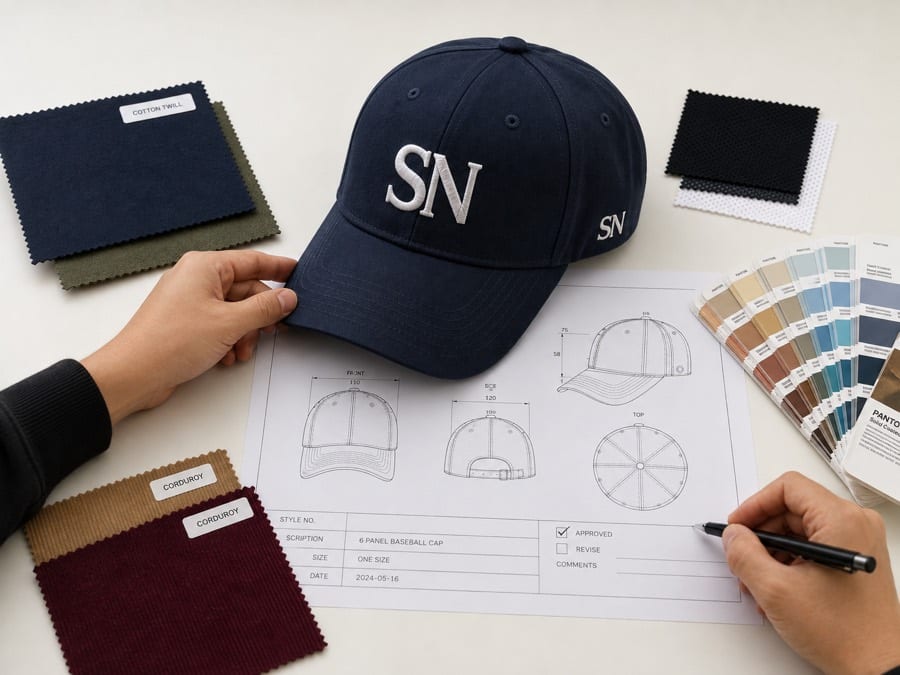
An agency may approve a visual proof while the brand owner retains final rights approval, and a sample can look excellent and still be the wrong edition of a logo. Name the approver for each decision and preserve their versioned sign-off. The image below shows a sample review, not proof of ownership or licensing.
Settle the artwork file and its version
After authorization, ask for a usable source file at final dimensions, with off-limits areas marked on the file the decorator works from. A digital proof can establish placement and layout, but it cannot approve the finished decoration alone. Review the decorated sample straight on and at a three-quarter angle, checking scale, distortion, hand feel and balance.
Treat each version separately: confirm a revision with the same authorizing party before it is used for production, and keep the new sign-off with the new version. Mark the new version and retire the old file — two live versions is how the wrong edition reaches production. Decoration routes and placement are set out on the customization page.
Approve decoration on the sample, not the proof
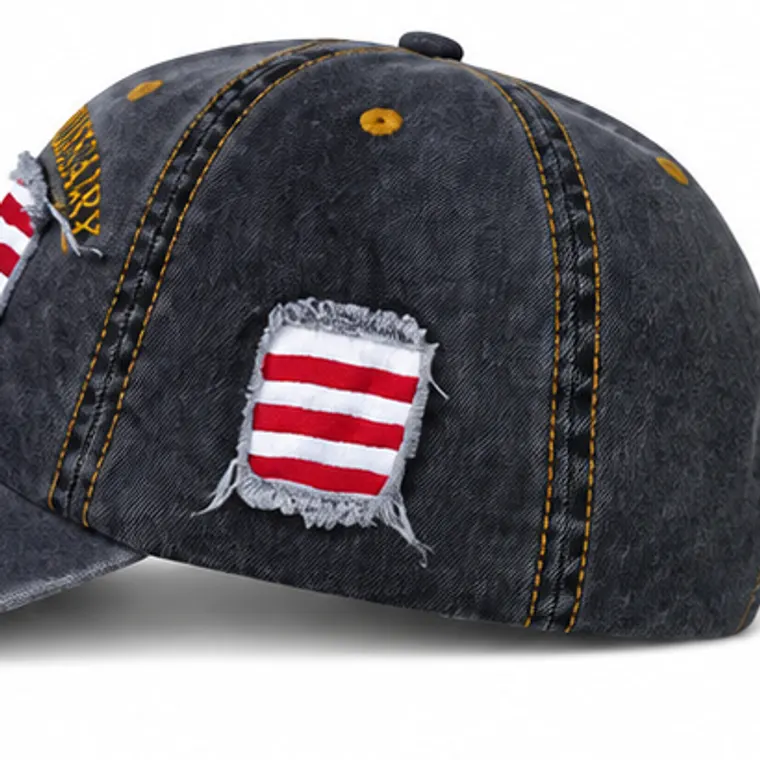
Approve decoration weight, edge finish and position on the same finished sample used for fit evaluation, clear of seams, closures and ventilation openings. Check the back of the embroidery or patch for loose threads and stiff backing: a large dense logo can pull a soft crown, and a flat-proof logo can crowd a curved front. The closure and fit guide explains how to judge fit and adjustment on a sample before bulk approval, and the same review shows whether the decoration still sits where construction allows.
If the record names a person who can approve changes to color, layout, placement and decoration method, confirm the change with that approver directly — not through the party that sent the file. Keep visual and rights approval separate in the record, so a decoration change does not silently become a permission change.
Count quantities by style-color line
Count by style-color line, not by total hats. Each line — one style in one color — starts at the standard 100 pieces. Example: one style in two colors is two lines, so the starting quantity is 200 pieces, and each line carries its own artwork version and decoration approval. Show the lines in the brief. The quantity, color, and size plan guide works through this line-by-line method in full.
Record the decisions in the tech pack
Record the reference hat, the authorizing party, the authorization record and the approved artwork version. The tech pack is the document the order is made from, so it should carry the mark version, decoration position and method, size-set and packing destination. The tech pack explains what a complete pack contains and how to check it before approval.
A reorder is a new scope to confirm, not an automatic repeat. Do not assume permission for one order extends to the next: confirm the new scope with the authorizing party before production, and treat a changed mark version, product, market or decoration as a new authorization to record. The process from brief to sample to bulk runs the same way for a reorder as for a first order.
A logo order is ready when the rights holder is named in writing, the scope matches the planned use, the artwork version is approved, and the decorated sample is signed off by the right approver. If any of those is still open, the next confirmation — not the bulk order — is the right step. Share the artwork, the intended use and the authorizing party’s name through the contact page, so the question is settled first.
Frequently Asked Questions
What if the buyer has the logo file but no written permission?
Mark the artwork as pending; do not treat the file as a production instruction. Ask the buyer to name the organization controlling the mark and the person who can approve manufacturing, and request documented authorization covering the planned use. The supplier can still discuss hat construction while the artwork question is resolved, but no production files or samples should be made from an unapproved image.
Can permission for a website or a shirt extend to hats?
Do not assume so. Confirm the new scope with the authorizing party before production: the record should name the mark version, products, market, sale or distribution, and any date or quantity limits — a change in any of these is a new scope to confirm.
What if the logo changes after the sample is approved?
Treat each version separately: confirm the revision with the same authorizing party before production, and keep the new sign-off with the new version. A sample can look excellent and still carry the wrong edition of a logo, so a version change means re-running the approval.