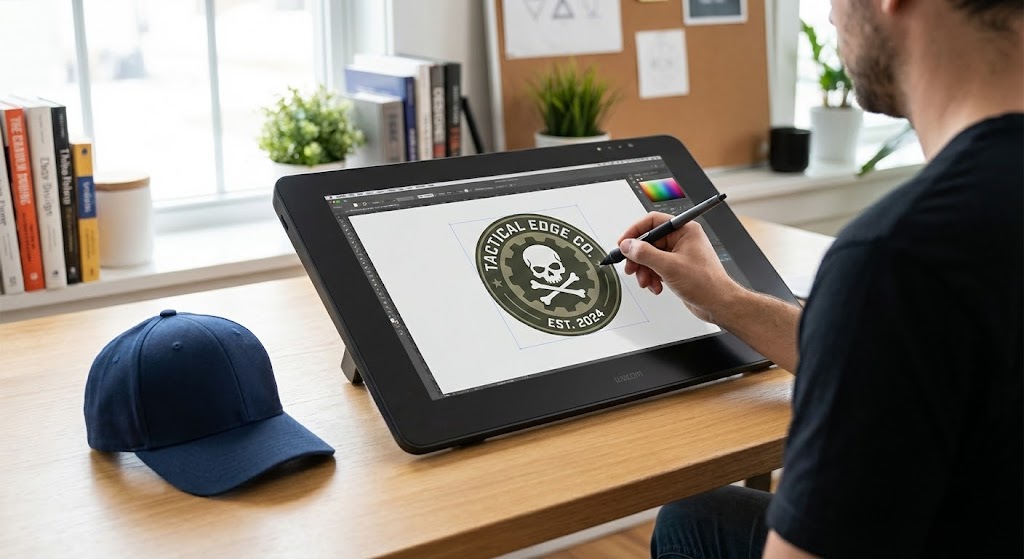
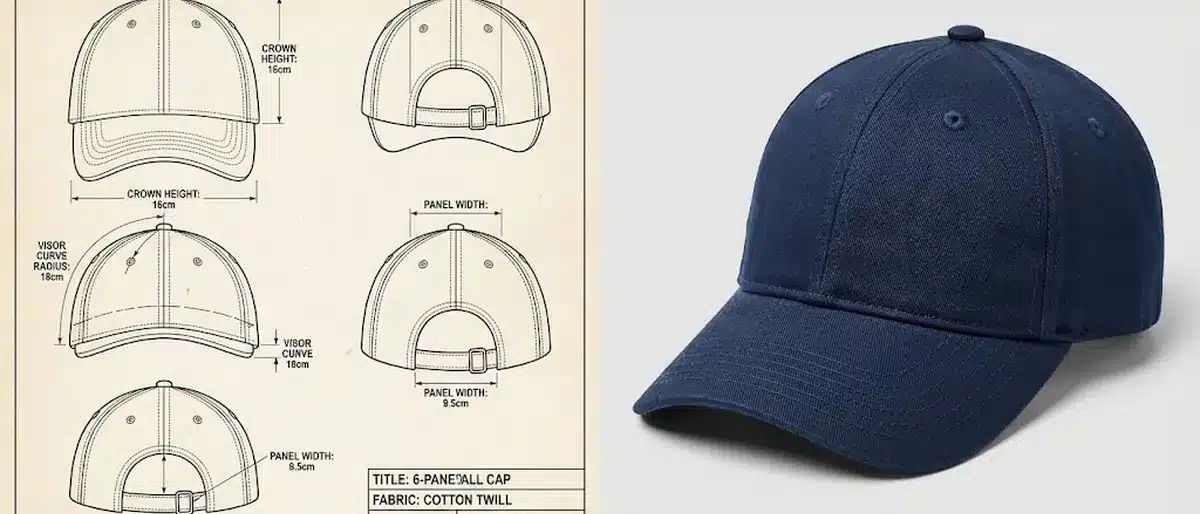
Hat artwork has two jobs. It must describe the brand mark accurately, and it must tell the development team how that mark belongs on a curved, sewn product. A clean logo file is a good start, but it does not settle size, placement, decoration method or the way the design interacts with crown seams.
Artwork is only one part of a complete product specification. For construction, materials, decoration and private-label coordination, review our full custom OEM hat development service.
Use our custom hat tech pack guide to organize the artwork together with construction, measurements, materials, labels and approval references before sampling.
This guide covers the buyer’s handoff before sampling. If you are still changing the logo itself for embroidery, first read how to design a logo for hat embroidery.
Send the strongest source file available
An editable vector file is usually the most useful source for a logo or line-based graphic because it can be resized without losing edge quality. Common working formats may include AI, EPS, SVG or a vector PDF, depending on the software and supplier. Include a visual PDF or PNG as a reference so the team can confirm that the editable file opens correctly.
If the only artwork available is a small screenshot or a photograph, say so at the beginning. The artwork may need to be rebuilt, and the rebuilt version should be approved before it becomes the basis of a sample. Do not assume that enlarging a low-resolution image creates missing detail.
| Item to provide | What it answers | Common gap |
|---|---|---|
| Editable artwork | The intended shapes, lines and text | Only a screenshot is supplied |
| Visual reference | How the file should look when opened | Fonts or linked elements display differently |
| Color reference | Which colors belong to the approved design | Colors are sampled from an email preview |
| Placement view | Front, side, back or interior location | The file says “front” but gives no position |
| Desired size | Approximate width, height or proportion | A mockup is treated as an exact measurement |
Define placement on the actual hat construction
The same artwork behaves differently on a high structured crown, a soft dad hat and a five-panel cap. Identify the hat style before finalizing placement. Front-panel seams, eyelets, visor attachment and crown curvature create physical limits that a flat mockup may not show.
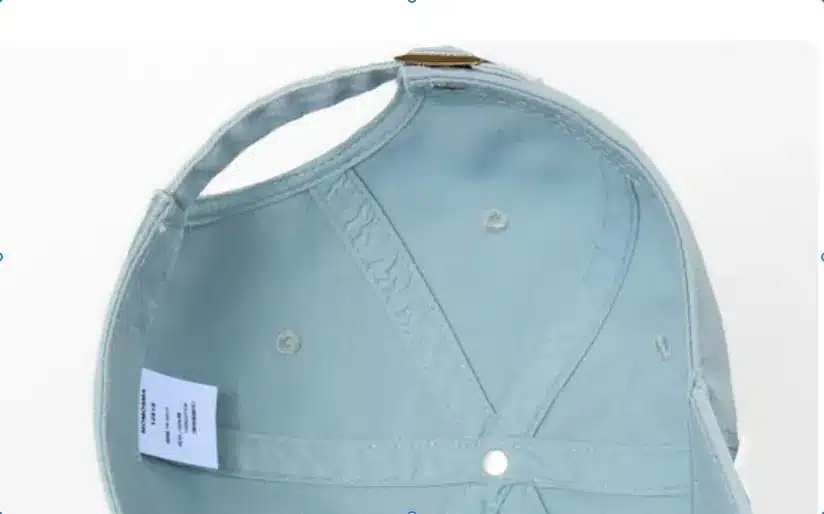
For front decoration, state whether the mark should be centered on the complete crown, centered within one panel or intentionally offset. For side and back decoration, confirm clearance from seams, the visor and the closure. Interior labels and branded taping also need location and orientation notes because they affect comfort and assembly.
Match the artwork to the decoration method
Do not force one artwork version into every technique. Flat embroidery, raised embroidery, woven patches, embroidered patches and print reproduce detail differently. The crown fabric and support behind the decoration also affect the result.
- Flat embroidery: review small type, line weight, filled areas and stitch direction on the selected crown.
- Raised embroidery: reserve it for suitable parts of the artwork rather than assuming every line should be raised.
- Woven patch: useful when the design needs finer woven detail and a defined patch edge.
- Embroidered patch: creates a more visibly stitched texture; very fine elements may still need simplification.
- Print: review fabric compatibility, edge definition and the intended surface feel on a sample.
A manufacturer or decoration specialist can recommend adjustments, but the brand should approve the production-ready version. Keep the original brand artwork and the hat-specific production artwork as separate, clearly named files.
Use a placement proof without mistaking it for a sample
A digital placement proof is useful for confirming the selected artwork version, general position, colors and approximate scale. It cannot show how the crown changes on the head, how stitches pull a soft panel, how a patch edge sits on a seam or how the inside of the decoration feels.
After the proof is approved, evaluate the physical sample from the front, side and back. Measure the visible mark if dimensions matter, but also judge proportion at normal viewing distance. A technically correct measurement can still look unbalanced on a particular crown.
Control revisions before bulk production
Give each revised artwork file a version name or date. Record what changed: size, color, line thickness, placement or decoration method. When the physical sample is approved, identify the exact artwork version linked to that sample.
If a later order changes the hat style or fabric, repeat the decoration review. The old artwork file may remain correct, but its placement and production settings may not transfer unchanged to a different crown.
Artwork preparation FAQ
Do buyers need to supply an embroidery machine file?
Usually the buyer should supply approved source artwork. The production team can prepare the machine-specific file for the selected hat and decoration setup. Confirm whether that preparation is included in the project and approve the sewn result on a sample.
Can a photograph of another hat be used as the artwork brief?
It can communicate scale, location or general direction, but it is not a complete production file. Buyers must also have the right to use the artwork they provide; a reference photo is not permission to copy another brand’s logo.
Should one logo size be used on every hat style?
Not automatically. Available front area, crown curvature, panel seams and intended proportion differ by style. Keep the brand mark consistent while approving the size and location for each construction.
Review customization and decoration options before finalizing the hat-specific artwork. Our development process shows how the brief, proof and physical sample become an approved production reference.