
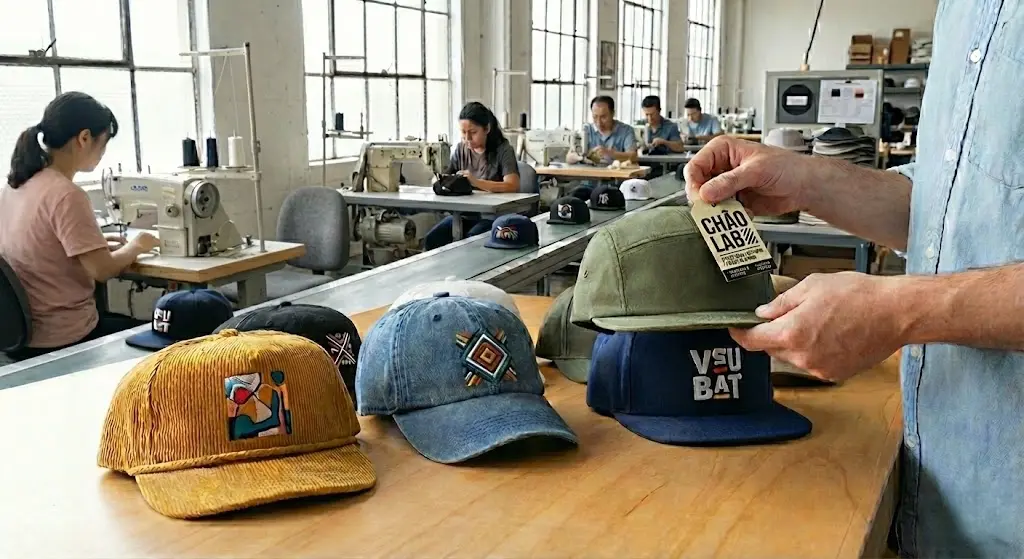
A retail private label hat program runs end to end: choose the styles, fix the specs, approve the samples, make the labels, hangtags and barcodes, pack for retail, hand over to the store, and reorder what sells. Start with the line, not one hat: a private label program is a coordinated range, not a single style with your logo on it. Every custom style starts at 100 hats per style and color — plan each one in blocks of 100. Samples take about one week after specs, artwork and the sample payment are confirmed; bulk about 30 days after the physical sample is approved. Never order bulk before the sample is approved. Four routes build the line: a blank with your logo, a semi-custom base, a private label line, or full custom development, and the right one depends on how much control you need over the hat itself.
This guide walks the full line, step by step. Each section covers the decision at that step; the deep detail lives in our linked guides. The full custom range is on our full custom OEM hats page.
The Four Routes, Compared
The route decides how much of the hat is yours. The table compares the four routes on the points that decide a program.
| Route | Control | MOQ | Sample flow | Best for | Watch out for |
|---|---|---|---|---|---|
| Blank hat + logo | Logo only; the hat is an existing blank | No custom build — confirm the decoration run minimum in the quote | A decorated blank sample to approve logo size, placement and thread colors | A first test run or a one-off retail drop | The hat itself is not yours — fit, fabric and colors are fixed by the blank |
| Semi-custom | Your colors, decoration and trims on an existing base | 100 per style and color | A sample on the chosen base with your changes | A line that needs your brand look without a full new build | Base limits — crown shape and panels stay as the base |
| Private label line | Your styles, specs, labels and packaging across the range | 100 per style and color | A sample per style, approved before bulk | A retail range sold under your own brand | Every style and color counts separately — plan the line in blocks of 100 |
| Full custom development | Full control: crown, fabric, colors, labels, decoration | 100 per style and color | Tech pack, then sample, then approval | A signature range where the hat itself must match the brand exactly | Longest decision chain — every detail is decided before sampling |
The only verified minimum is 100 hats per style and color, and it applies to custom styles. The blank route has no custom build, so its minimum is confirmed in the quote, not stated here. For the three custom routes, count every style and color separately: two styles in two colors each is four style-color combinations, so four blocks of 100 at minimum. The arithmetic shows the method; it is not an SN order.
Choose the Styles and Fix the Specs
Pick a small range that shares one brand language — two or three styles, one or two colors each, is a workable start. The styles should look like one line on the shelf, not four unrelated hats. Decide the range before the details: a line that grows style by style without a plan ends up with colors and crowns that do not match.
Then fix the specifications in a tech pack before sampling: crown and panel construction, fabric, colors, closure, decoration method and placement, inside labels, hangtags, barcodes and packaging. A tech pack is the document the sample is judged against — if a detail is not in it, it will not be checked. How a retailer plans the range itself is covered in our private label hats for retailers guide; this guide does not repeat it.
Quantity logic follows the same rule as the table: each style and color starts at 100. Our MOQ guide explains how the 100-unit minimum works per style and color.
Inside Labels, Hangtags, Barcodes and Packaging
These four items are where a private label program becomes a retail product. Each one has one decision to make before sampling.
Inside labels. Decide what the label must carry — brand, size, and any care or origin information the retailer requires — and whether it is a woven label or printed taping. A woven label suits a premium feel; printed taping suits a clean interior. Check the label on the sample: it must sit flat, read clearly, and survive wear. The label options in detail are covered in our custom inside labels guide.
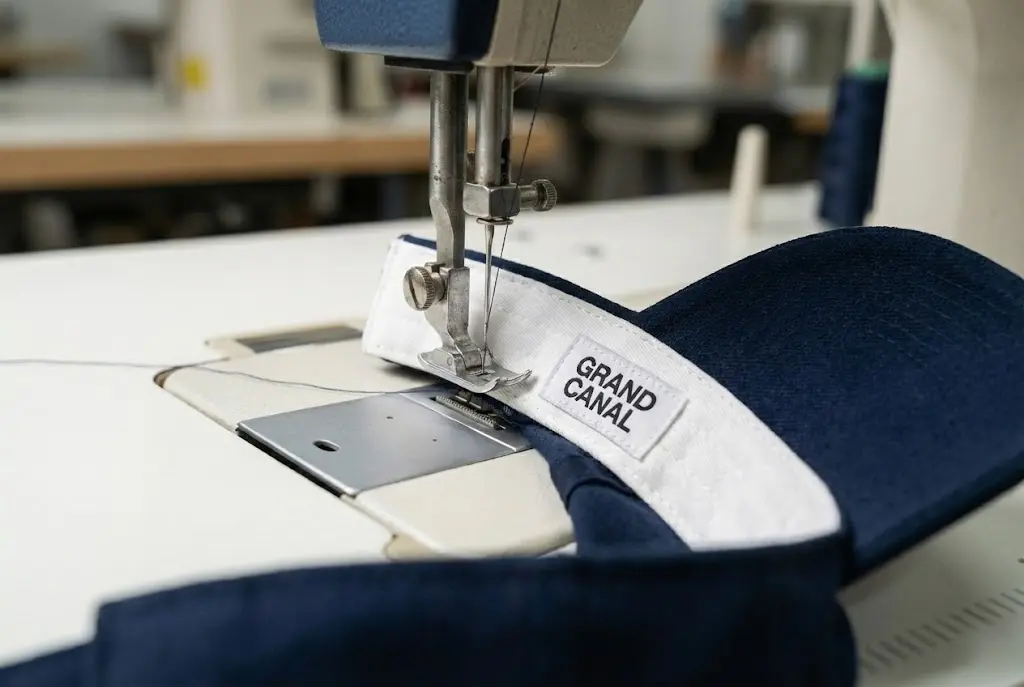
Hangtags and barcodes. A hangtag carries the brand and the price; a barcode is what the retailer scans at receiving and at the till. Decide the barcode per style and color before bulk — one barcode per style-color combination, not one for the whole line — and confirm the hangtag matches the hat it is attached to. The handoff detail is covered in our hat hangtags and barcodes guide; this guide does not repeat it.
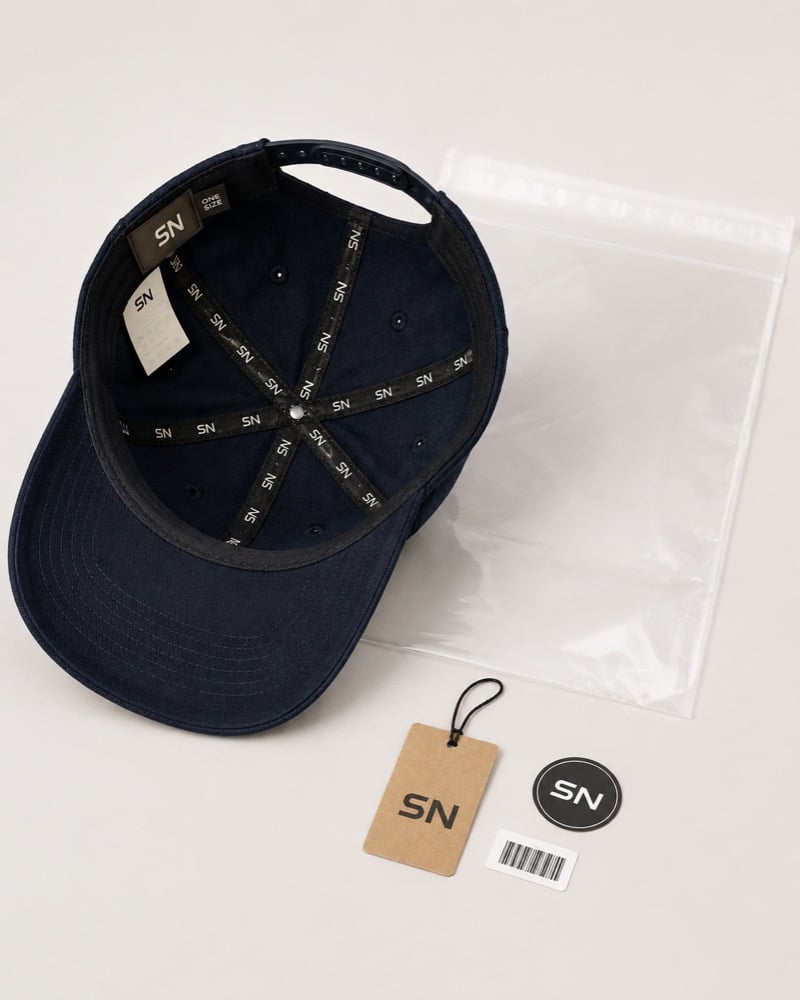
Packaging. Retail packaging protects the hat and presents it: a polybag, a header card where the retailer uses one, and carton marking that matches the contents. Decide the pack before bulk, because repacking a finished run costs time and risks the shape. A hat that arrives crushed or in the wrong carton is a retail problem, not a production detail.

Retail Handoff
The handoff is the test of the whole program: the retailer must be able to receive, scan, shelve and sell the hats without rework. Before the bulk ships, check the points the retailer will check — barcodes scan, hangtags match the hats, carton labels match the contents, and the styles and colors in the carton are the ones ordered. The full retail-ready check is in our retail-ready promotional hats checklist; this guide does not repeat the list.
If the handoff fails on a detail, the fix is decided at the sample stage, not at the warehouse. That is why the sample approval covers labels, hangtags, barcodes and packaging together — approving the hat and forgetting the trims is the most common way a private label program stalls at receiving.
Reorder and Line Coordination
A private label line earns its keep on the reorder. Track which styles sell and reorder those — the range should grow around its sellers, not around new ideas alone. Keep the approved sample and the tech pack on file so a reorder matches the first run: same crown, same fabric, same colors, same labels.
When the line grows, coordinate the new styles to the same brand language — same label style, same hangtag format, same packaging. A second drop that looks like a different brand breaks the line. And the same quantity rule applies to every new style and color: each one starts at 100, planned in blocks of 100, approved by sample before bulk.
The Buying Decision
If the range is planned, decide in this order: route first, then styles, then specs and tech pack, then labels, hangtags, barcodes and packaging — and approve the sample before the bulk order. A private label program is a one-shot line: the hats, the labels and the packaging all arrive together, so the sample is the last chance to catch a mistake in any of them.
Send us your range plan, styles, and logo through Request a Quote — we reply within one business day.
FAQ
What is the difference between private label and white label hats?
A private label hat is built to your specification — your styles, fabrics, labels and packaging — and sold under your brand. A white label hat is an existing product with your label applied and no other branding; you control the label, not the hat. Private label gives you control over the product; white label is faster, but the product is not yours.
What do I need to prepare for a private label hat program?
The styles and colors for the range, the specifications in a tech pack, the artwork, the inside label content, the hangtag and barcode data, and the packaging requirements. The sample is approved against all of it — hat, labels, hangtags, barcodes and packaging together.
How long does a private label hat program take?
Samples take about one week after specifications, artwork, and the sample payment are confirmed. Bulk production takes about 30 days after the physical sample is approved. International shipping and customs are separate.