
A reversible bucket hat is two finished faces, not one face plus an inside. Approve both faces on a worn sample before bulk: the pairing, the seam finish in both orientations, the decoration reverse on each face, and the label placement. If the second side exposes a scratchy label, an awkward seam or a logo that only makes sense the other way up, the hat will be worn one way only — and the buyer has paid for a feature nobody uses.
Decide what each side is for
Write down two wearing situations before choosing details. A restrained solid side might suit daily use; a printed side might be the more expressive retail or event look. If both sides carry large graphics, turning the hat over may offer little practical choice. Photograph each proposed side on a person, not only flat on a table. Name Side A and Side B in the brief and specify each as a finished face: outer fabric, color or print, logo location, visible stitching, and where identity, size and care information will go. A mockup shows the palette; it cannot prove how two layers behave at the crown and brim. Decide the pairing before sampling, so neither side is treated as a back-up. For a program where the bucket is one of several sun shapes, the sun hats guide compares visor, bucket and wider-brim styles — choose the shape first, then the pairing.
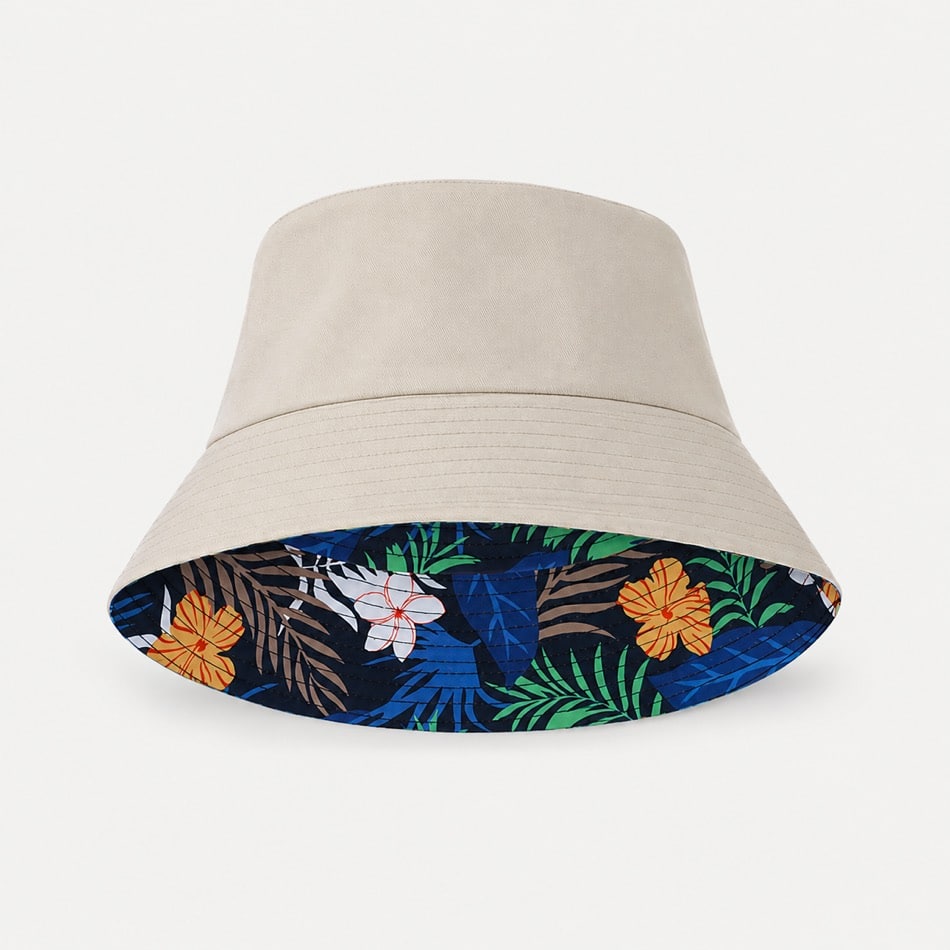
The five decisions to make on the sample
Use this table as the brief-building framework: one decision per row, with a different test for each pairing.
| Decision | Solid + printed | Two printed faces | Two solid faces | Check on the sample |
|---|---|---|---|---|
| Construction and seam finish | One solid layer, one printed layer; seam allowances enclosed on both faces | Two printed layers; pattern interruption at panel seams on both faces | Two solid layers in different colors; topstitching read against both colors | Turn the sewn sample over several times; does either orientation pucker or feel bulkier at the crown seam? |
| Reversibility and brim behavior | Brim edge shows the printed face even when the solid side is worn out | Brim shows the second print in both orientations | Brim edge shows the second color in both orientations | On the worn sample in both orientations, does the brim hold its shape and does the edge reveal look intentional? |
| Decoration on both sides | Logo on the printed face; quiet face stays clean | Same or different logo on each face; check the decoration reverse on both | Logo on one face only, or a small mark on each; check the reverse on the decorated face | On the worn sample, is the decoration finished on its reverse, with no exposed threads? |
| Fit and size range | Crown depth and brim angle judged in both orientations | Same fit checks; heavier print layers can change how the crown drapes | Same fit checks; two solid layers can feel bulkier at the crown seam | A size-set tried on real wearers in both orientations; the band sits securely either way |
| Quantity planning | Count by pairing, not by total hats | Each pairing is its own style-color line | Each color pairing is its own line | Confirm each style-color line starts at 100 pieces |
Check the construction on both sides
The normal inside of a single-face bucket hat is not automatically a finished second face. Inspect these points on the sewn sample, in both orientations. Crown seams: are the allowances enclosed on both sides, and does the lower crown edge sit smoothly when reversed? Brim edge: are the layers aligned all the way around, and does the brim hold its shape in both orientations? Topstitching: is the stitch line acceptable against both fabrics, including areas with strong color contrast? Labels: where will identity, size and care information go, so one side does not present an exposed label against the forehead? Confirm the approach against the market’s labeling requirements. Decoration reverse: if a logo is embroidered or a patch is attached, what is visible on its reverse?
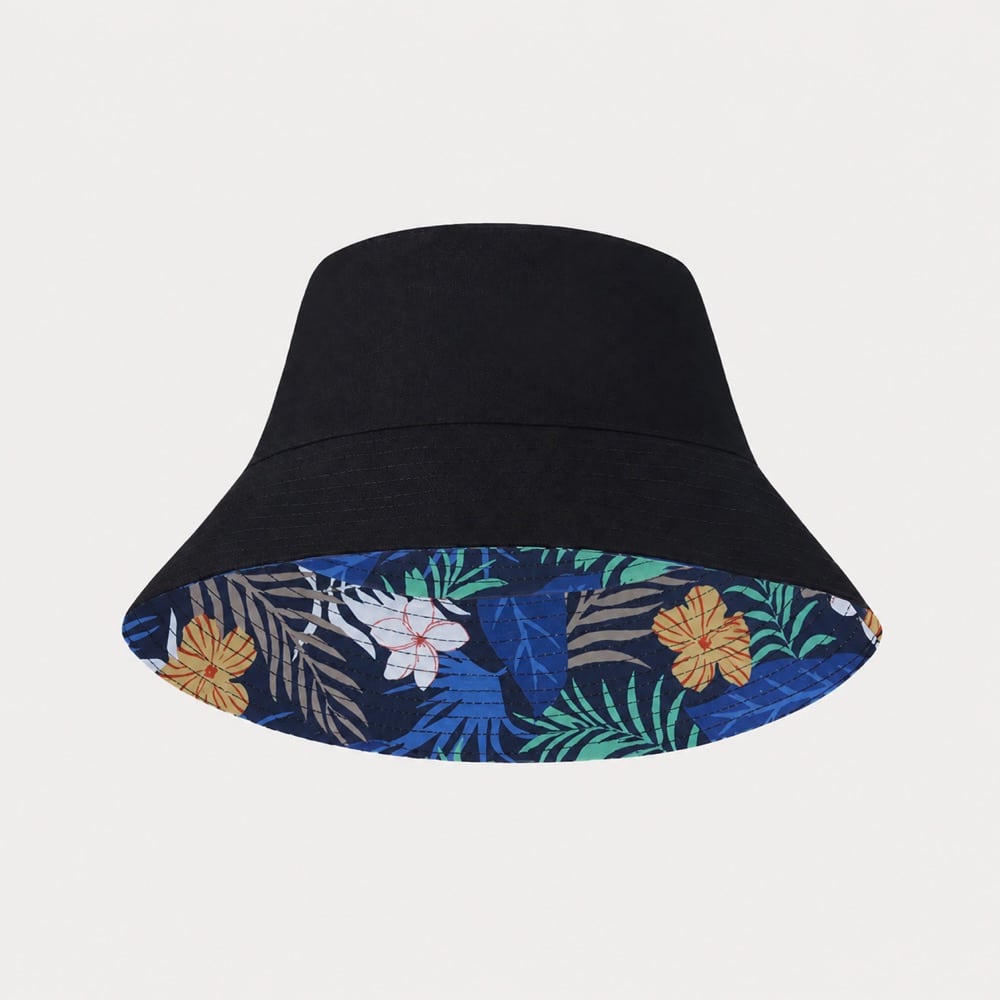
Keep fabric and branding choices compatible
Two fabrics can differ in thickness, stiffness and shrink behavior. Pairing them changes the hand feel and the way the brim falls. Before approving bulk production, turn the finished sample over several times and check whether either orientation puckers, twists or feels noticeably bulkier at the crown seam.
For printed fabrics, agree where the pattern may be interrupted by panel seams. For embroidery, examine both the decorative face and the reverse-side finish: a large dense logo can affect how a lightweight bucket crown drapes. A woven straw version is a different construction — the straw hats guide covers weave, brim shape and bulk packing. A wider-brim outdoor shape has its own decisions — see the boonie hats guide.
Approve decoration on both faces
Decide the branding for Side A and Side B separately. The same logo on both faces means checking the decoration reverse on each face; branding on one face only keeps the other face quiet, but the reverse of that decoration must still look finished when the hat is turned. Approve decoration weight, edge finish and position on the same finished sample used for fit evaluation, and keep decoration clear of seams and ventilation openings. Check the back of the embroidery or patch for loose threads and stiff backing. A large dense logo can pull a soft crown. If a buyer needs a verified claim about the fabric or the finished product, request the relevant records before that claim appears on packaging or a sales page.
Test fit and size range on real wearers
Fit is where a shared brief fails first. Try the sample on several wearers in both orientations and watch for pressure, slip, and whether the crown depth and brim angle still look intentional when reversed. If multiple sizes are planned, approve a size-set rather than assuming one sample scales perfectly. The closure and fit guide explains how to judge fit and adjustment on a sample before bulk approval. Neither check needs a number in the brief — only the method: who tries the sample, in which orientation, and what counts as a pass.
Count quantities by style-color line
Count quantities by style-color line, not by total hats. Each line — one style in one color pairing — starts at the standard 100 pieces. Example: one reversible style in two pairings is two lines, so the starting quantity is 200 pieces, and each line carries its own decoration approval. Show the lines in the brief, not only a single total. For a program that mixes pairings, keep each pairing as its own line even when the logo is the same, and keep a size and style allocation table with the samples. The quantity, color, and size plan guide works through this line-by-line method in full.
Record the decisions in the tech pack
Record the chosen reference hat for each pairing, what is approved, and what still needs a sample decision. The tech pack is the document the order is made from, so it should carry the Side A and Side B specifications, the brim reference, the size-set, the decoration position on each face and the packing destination — not a general description of the hat. The tech pack explains what a complete pack contains and how to check it before approval. For a multi-location order, state whether the hats need sorting by pairing and size, and whether each destination needs its own carton marks. A packed sample can reveal creasing and brim deformation an unpacked showroom sample will not.
A reversible bucket hat order is ready when each face is approved on a worn sample in both orientations, the size range is approved as a set, and the decoration sits where construction allows on each face. If any of those is still open, the next sample — not the bulk order — is the right step. Share the two wearing situations, the pairing and the decoration direction through the contact page.
Frequently Asked Questions
Should both sides carry the same logo?
Not necessarily. Decide the branding for Side A and Side B separately in the brief. The same logo on both faces means checking the decoration reverse on each face; branding on one face only keeps the other face quiet, but the reverse of that decoration must still look finished when the hat is turned. Confirm the result on the physical sample worn in both orientations, not from a mockup of one side.
What should I do if the sample looks good on one side only?
Do not approve it on the strength of one face. Record the side-specific differences, and check the weak side for seam finish, brim shape, label exposure and decoration reverse. Ask for the weak side to be addressed and re-checked in both orientations before bulk approval.
Can a reorder change one side of the pairing and keep the other?
Yes, if the changed side is treated as a new line with its own sample approval. Record the new pairing with the approved samples and confirm the quantity line by line. Do not assume the unchanged side carries over without a check: the two fabrics behave as a pair, so a new fabric on one side can change how the brim falls in both orientations.